What CTOs Get Wrong About Build vs Buy: A Capacity × Capability Lens
November 10, 2026
November 10, 2026

Key Takeaways
Introduction
Build versus buy is often treated as a cost comparison: the price of a vendor subscription against the estimated cost of building a custom solution.
For AI agents, that comparison misses two equally important questions:
Does your team have the capacity to deliver?
Does it have the capability to build and operate the solution successfully?
The answer can vary across workflows within the same organisation. A ready-made agent may be sufficient for customer support, while a workflow involving proprietary logic, sensitive data or complex integrations may justify greater ownership.
The decision is therefore not simply whether to build or buy. It is whether to build, buy, extend or partner, based on what the workflow requires and what your organisation can realistically deliver.
The Capacity × Capability Matrix provides a practical way to make that assessment.
Build-versus-buy decisions for AI agents involve more than features, licence fees and development timelines.
AI agents can interpret context, interact with business systems and take actions within workflows. That makes the decision closely tied to data access, integration, operational control and risk.
Enterprise software vendors are increasingly incorporating AI agents into platforms organisations already use. This can accelerate experimentation and reduce the need to build everything from scratch.
But availability does not mean suitability.
A vendor agent may work well for a standard workflow yet require substantial customisation when it needs to interact with legacy systems, follow organisation-specific rules, or operate within strict access controls.
The question is not simply whether a product exists. It is whether that product meets the workflow's requirements without introducing unacceptable constraints.
AI models, tooling, and pricing continue to evolve. Building around a particular model or platform can create dependencies, but buying can create similar dependencies through pricing, integrations, and available controls.
CTOs therefore need to consider not only what works today, but how easily the solution can adapt tomorrow.
An agent that searches internal documentation has a different risk profile from one that initiates payments, accesses sensitive records, or influences contract decisions.
As consequences increase, so do requirements around permissions, monitoring, auditability, and human oversight.
That is why each workflow should be assessed individually. Consider:
These factors establish the context for the build-versus-buy decision.
Build-versus-buy decisions often go wrong because the choice is evaluated using incomplete assumptions about cost, ownership, and execution readiness.
Four mistakes are particularly common.
A vendor subscription is easy to identify. The cost of a custom AI agent is harder to calculate because it includes engineering, integration, testing, security, monitoring, and maintenance.
A fair comparison considers the lifecycle of both options.
The relevant question is not which has the lower initial price. It is which delivers the required outcome at a sustainable total cost.
Build versus buy is a workflow-level decision.
A customer support agent may be served effectively by an established platform. A pricing agent based on proprietary logic may justify a custom build. Another workflow may benefit from a combination of vendor technology and custom integrations.
Applying one rule across every use case can result in unnecessary custom development in some areas and insufficient control in others.
AI agents require ongoing ownership.
Depending on the workflow, teams may need to monitor performance, review access, update prompts or models, test changes and respond to incidents.
Buying transfers some responsibilities to the vendor, but it does not remove the organisation's accountability for how the agent is used.
Before committing, identify who will own, monitor and maintain the agent after launch.
Buying today does not mean buying forever. Building today does not mean every future capability needs to be developed internally.
The greater risk is losing the ability to change direction.
CTOs can preserve flexibility by documenting requirements and test cases, understanding data-export options, retaining ownership of important custom components, and reviewing contractual restrictions before committing.
The goal is not to eliminate dependency. It is to understand which dependencies are acceptable.
Two questions can clarify much of the decision:
Do we have the capacity to execute?
Do we have the capability to execute successfully?
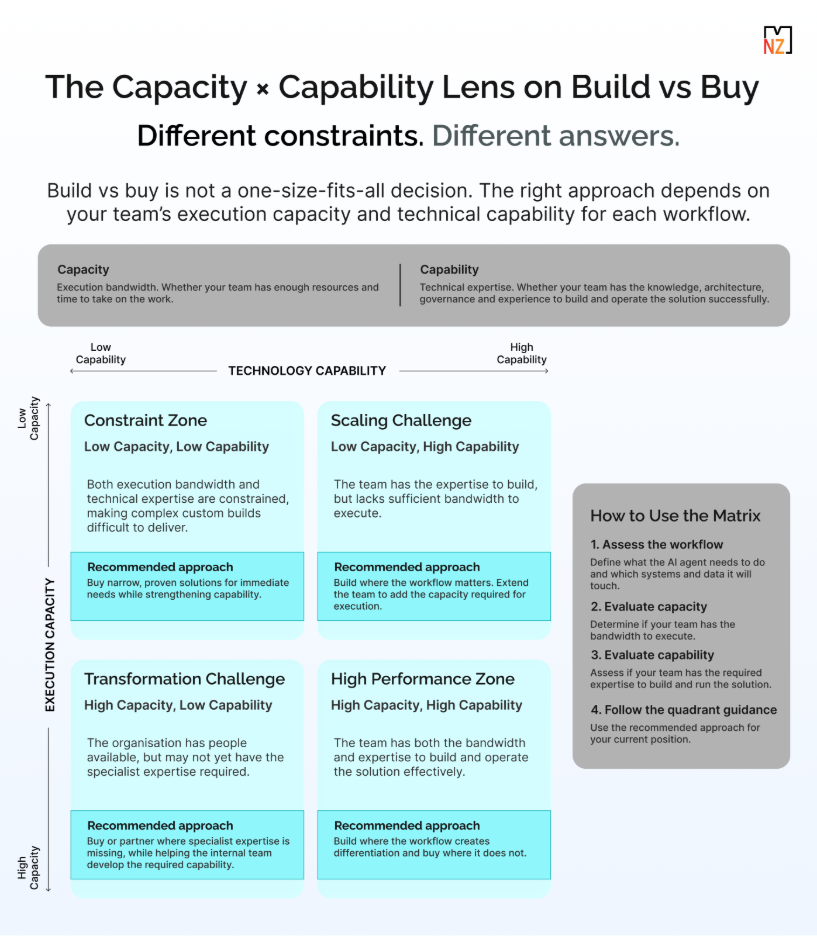
Capacity is about bandwidth: whether the team has enough engineering resources and time.
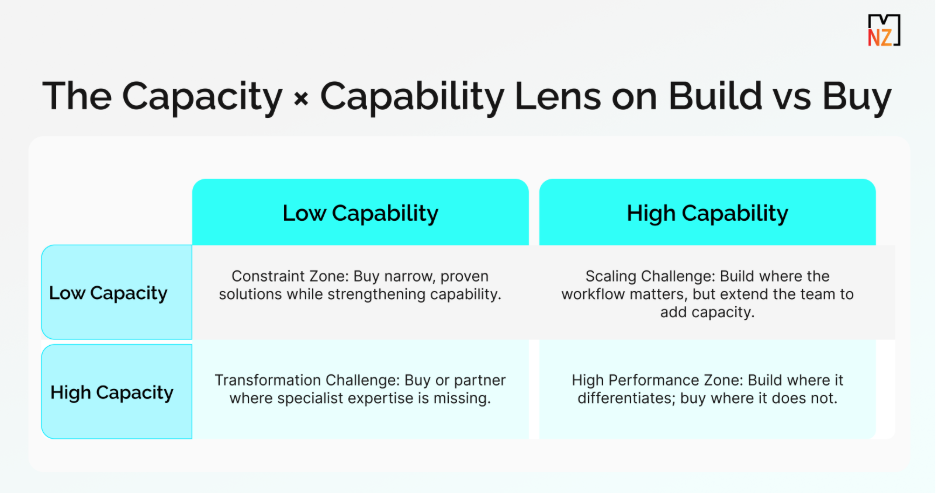
Capability is about expertise: whether it has the technical knowledge, architecture, governance, and experience required to build and operate the solution effectively.
Together, they create four different scenarios.
When both are constrained, a complex custom build carries significant execution risk.
For a well-understood, non-differentiating workflow, a narrow vendor solution may provide a more practical route while the organisation develops the capability required for more strategic initiatives.
The sequence matters: adding more people before the right expertise and technical direction exist may increase coordination without resolving the underlying constraint.
Here, the team understands what needs to be built but lacks bandwidth.
Where the workflow carries proprietary logic or strategic value, buying simply because resources are stretched can mean giving up something the organisation is capable of owning.
Instead, the team can add capacity through staff augmentation or a dedicated team while retaining technical direction.
Here, people are available, but specialist expertise is missing.
Adding more general engineering capacity does not solve the problem. Buying may make sense for standard requirements, while partnering with specialists may be more appropriate where customisation or control matters.
The objective should be to deliver the initiative while developing the internal capability required for what comes next.
When both are strong, the organisation can choose based primarily on strategic value.
Build where the workflow creates differentiation, contains proprietary logic, or requires control that a vendor cannot provide.
Buy where an existing product can meet a standard requirement effectively.
An organisation rarely sits permanently in one quadrant.
The same company may face a Scaling Challenge for one workflow and a Constraint Zone for another.
That is why CTOs should assess the team and workflow that will actually own the initiative before comparing vendors or approving a custom build.
The Capacity & Capability Diagnostic™ helps organisations assess these dimensions separately and identify where their execution constraints sit.
Buying should not be treated as the less ambitious alternative.
When a workflow is standard, differentiation is limited, and a mature solution already exists, buying can be the stronger technology decision.
Building an AI agent may require integrations, permissions, evaluation processes, monitoring, and security reviews before production.
A mature vendor product may already provide much of that foundation, reducing the engineering effort required to deploy a standard workflow.
With a bought solution, much of the underlying product development sits with the vendor.
Model integrations, security features, and platform improvements can be distributed across the vendor's customer base rather than funded entirely by one internal engineering team.
For a non-differentiating capability, that can make more sense than recreating it internally.
Established vendors may already have security controls, certifications, documentation, support processes, and audit capabilities.
That does not replace due diligence, but it can provide a stronger starting point than creating everything internally.
Every custom system creates something else the engineering organisation must operate.
Buying can transfer part of the platform maintenance burden to a vendor, allowing internal teams to focus on integrations, governance and business outcomes.
The question for CTOs is therefore not simply:
“Could we build this?”
It is:
“Is this a capability we need to own?”
If the answer is no, buying may preserve engineering capacity for areas where ownership creates greater strategic value.
The trade-offs of buying become more important when an agent works across complex systems, handles sensitive data, or supports a strategically important workflow.
Agent value may depend on prompts, workflow configurations, integrations, permissions, and business rules built inside a platform.
If those components cannot be transferred easily, changing providers may require significant rework.
Before buying, understand what can be exported, what remains portable, and what would need to be rebuilt.
Pilot economics can be misleading.
Vendor costs may increase with users, conversations, transactions, or consumption. CTOs should model expected production usage rather than base a long-term decision on pilot pricing.
Pre-built agents work best within systems a vendor already supports.
In enterprise environments, an agent may need to connect with customised ERP platforms, legacy applications, private databases, internal APIs or on-premises infrastructure.
A bought solution can therefore still create substantial engineering work.
As an agent takes on more consequential tasks, organisations may need tighter control over permissions, human approvals, logging and actions.
They also need clarity about where data is processed and retained, and enough observability to investigate failures.
The question is whether the vendor's architecture provides sufficient control for the workflow's risk.
Buying can offer speed and reduce engineering ownership, but it may introduce dependencies around customisation, data, integration, visibility, and commercial flexibility.
The objective is to understand those dependencies before they become expensive to reverse.
Also Read: Every CTO Should Ask These Two Questions Before Starting AI Projects
A polished demonstration does not show how an AI agent will perform with your actual data, integrations, and edge cases.
Before making a long-term commitment, test the product in the environment where it will operate.
Use representative, anonymised data and include ambiguous requests, incomplete information, and scenarios where the agent should escalate rather than act.
The objective is to understand not only where the agent works, but where it fails.
Establish where data is processed and stored, how long it is retained, which sub-processors may access it, and whether it is used for model training or improvement.
Document the answers rather than assuming them.
Test the commercial model against realistic adoption.
How will costs change as users, interactions, transactions, or data volumes grow? Are there additional charges for integrations or higher service levels?
Can your team trace the agent's actions? Limit permissions? Require human approval for consequential actions? Stop the agent quickly if something goes wrong?
The required safeguards should increase with the consequence of failure.
Understand which data, configurations and workflow assets can be exported and what would need to be rebuilt if you changed vendors or brought the capability in-house.
A good vendor decision should provide a workable route in and a realistic route out.
Ultimately, evaluate the vendor against the workflow, not the demo.
If the product meets the organisation's requirements and the workflow does not need to be owned internally, buying may be the right choice.
If significant custom engineering, proprietary logic or specialist oversight is still required, the gap between buying and building begins to narrow.
The cost of building an AI agent extends beyond model APIs, cloud infrastructure, and initial development.
Production systems need integration, evaluation, monitoring, security, and maintenance.
That makes the real comparison less about subscription versus compute and more about total ownership.
Build vs Buy: Where the Costs Sit
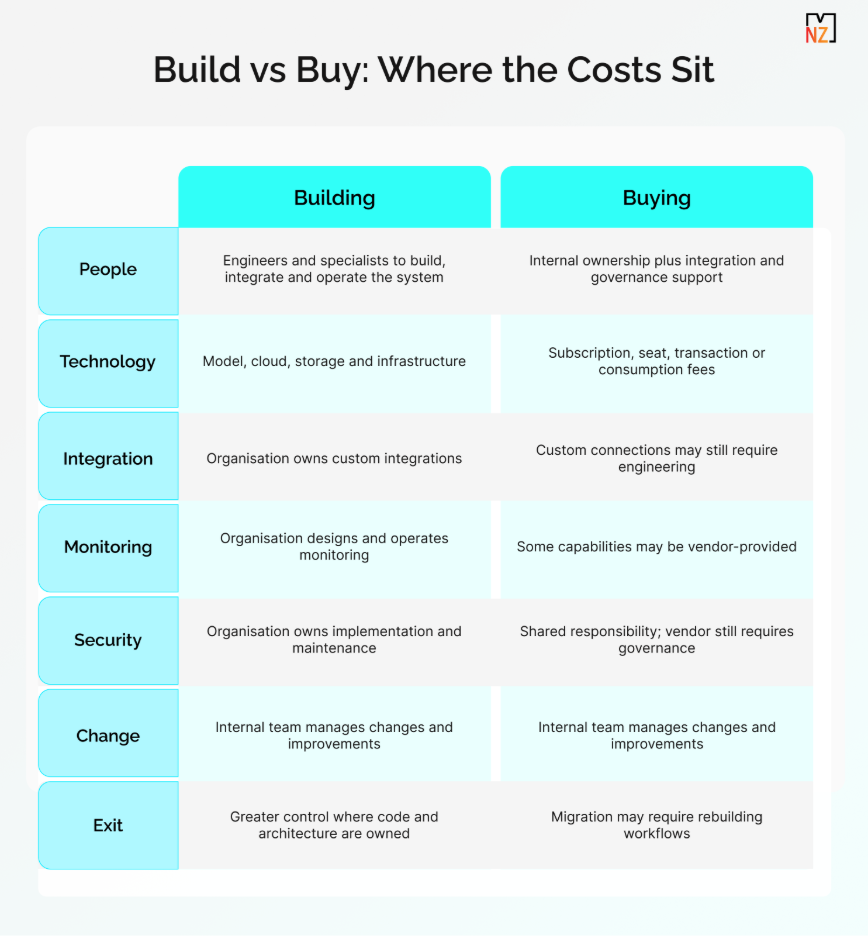
Neither option is inherently cheaper.
Building moves more cost towards engineering ownership. Buying moves more cost towards vendor fees and dependencies.
Before deciding, ask:
The goal is to understand where the cost, responsibility, and risk sit throughout the lifecycle.
The choice is rarely limited to two paths.
In practice, CTOs have four:
Buy. Build. Extend. Partner.
Buy When the Workflow Is Standard
Buy when the requirement is well understood, existing products can meet it effectively, and the workflow is not a source of strategic differentiation.
The objective is to avoid spending engineering capacity recreating a capability the market already provides.
Building becomes more compelling when the workflow contains proprietary logic, sensitive data, complex integrations, or control requirements that cannot be met adequately by an existing product.
But the organisation still needs the capacity and capability to own the solution after launch.
If the internal team has the expertise and technical direction but lacks bandwidth, the problem is capacity.
Extending the team can support execution without giving up ownership of a strategically important workflow.
If engineering resources are available but specialist expertise is missing, adding more general capacity will not resolve the constraint.
A specialist partner can provide the required capability while involving internal engineers in delivery and knowledge transfer.
Build and buy do not have to be mutually exclusive.
An organisation might use a vendor platform for underlying infrastructure while owning the agent logic, integrations, or control layer that creates differentiation.
The principle is straightforward:
Own what matters. Buy what does not need to differentiate. Preserve the ability to change.
Also Read: How to Choose the Right AI Agent Development Company in 2026 (Before You Spend a Dollar)
Consider a mid-sized B2B software company exploring AI agents for three workflows:
A platform vendor could potentially support all three. But applying one decision across the organisation would overlook important differences.
Note: This is an illustrative composite designed to demonstrate the framework. It does not represent a specific NZMinds client engagement or guaranteed outcome.
The requirement is relatively standard and contains limited proprietary business logic.
An established solution can address much of the requirement without forcing the organisation to own another technology stack.
Pricing depends on proprietary business rules. The engineering team understands the systems and has the capability to own the solution, but lacks sufficient bandwidth.
This places the workflow in the Scaling Challenge quadrant.
The organisation retains control of its pricing logic while adding the capacity required for execution.
Here, both specialist capability and available capacity are limited, placing the workflow closer to the Constraint Zone.
Because internal search is not currently a major source of differentiation, committing scarce engineering resources to a custom build is difficult to justify.
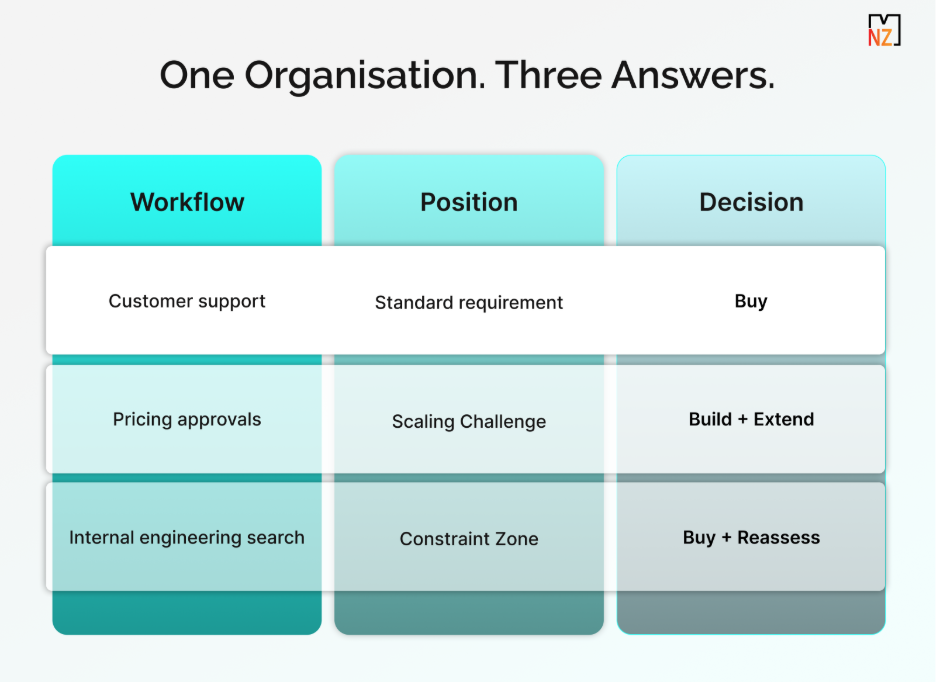
The lesson is simple: the organisation does not need one build-versus-buy strategy for AI agents.
Instead of asking:
“Should we build or buy AI agents?”
Ask:
“For this workflow, what do we need to own, and do we have the capacity and capability to own it successfully?”
At NZMinds, the build-versus-buy conversation starts before technology selection.
The first question is not:
“What should we build?”
It is:
“What does the organisation need to own, and what is preventing it from executing effectively?”
The Capacity & Capability Diagnostic™ helps distinguish between two constraints:
Capacity: Is there enough engineering bandwidth to deliver and sustain the initiative?
Capability: Does the organisation have the specialist expertise and technical direction required?
Once the constraint is clear, the intervention can match the problem.
If the organisation has the technical capability but lacks bandwidth, additional engineering capacity can support delivery while the internal team retains direction and ownership.
If capacity exists but specialist expertise is missing, the focus should be on closing that capability gap rather than simply adding more engineers.
Not every workflow needs custom software.
If an established solution meets the requirement effectively and ownership creates little strategic value, buying may be the better decision.
When building is appropriate, validate the critical assumptions before expanding the scope.
Test the workflow against representative data, integrations, controls, and failure scenarios before committing significant engineering capacity.
Build less. Validate more. Scale what works.
The goal is not to build by default.
It is to understand what needs to be owned, what can be bought, and where capacity or capability needs to change for either option to succeed.
It depends on the workflow. Buying can make sense for standard requirements that existing platforms handle effectively. Building becomes more relevant when proprietary logic, sensitive data, complex integrations, or greater control are involved.
Not necessarily. Building introduces engineering, infrastructure, monitoring, security, and maintenance costs. Buying introduces vendor fees and dependencies. Compare total lifecycle cost rather than initial price.
This is a Transformation Challenge. The organisation can buy a proven solution for standard requirements or partner with specialists where greater customisation and ownership are required.
Assess portability before committing. Understand what data and configurations can be exported, what integrations or models are supported, and what would need to be rebuilt if you changed providers.
There is no standard timeline. It depends on workflow complexity, integrations, data readiness, security requirements, evaluation, and the level of operational control required.
The Capacity & Capability Diagnostic™ helps identify whether the primary execution constraint is bandwidth, expertise, or both, providing a clearer basis for choosing whether to build, buy, extend, or partner.
Build vs Buy Starts With the Right Question
The build-versus-buy decision becomes clearer when the conversation moves beyond licence fees and development estimates.
The real questions are:
What does the organisation need to own?
Do we have the capacity to execute?
Do we have the capability to execute successfully?
For a standard workflow, buying may preserve engineering capacity without sacrificing the required outcome.
For a workflow built around proprietary logic, sensitive data, or strategic differentiation, greater ownership may justify building.
And when building makes strategic sense but execution is constrained, the answer may be to extend capacity or bring in specialist capability rather than change the technology decision.
There is no single build-versus-buy answer for an organisation.
The decision should be made workflow by workflow, based on strategic value, risk, lifecycle cost and execution readiness.
The strongest technology strategy is not the one that builds the most or buys the least.
It is the one that knows what to own, what to buy, and where to strengthen capacity or capability.

Resources