
How to Choose the Right AI Agent Development Company in 2026 (Before You Spend a Dollar)
April 20, 2026
April 20, 2026
.jpg)
The global AI agents market is projected to reach $50.31 billion by 2030. That growth has brought hundreds of vendors into the space overnight — all of them calling themselves an "AI agent development company." Most of them are not.
Choosing the wrong partner doesn't just mean a failed project. It means six to twelve months of wasted time, $50,000–$200,000 down the drain, and an agent that either never ships or quietly underperforms until someone notices.
Whether you are a CTO building a vendor shortlist or a founder exploring AI automation for the first time, this guide gives you the framework to make the right call — before you sign anything.
Before evaluating vendors, you need to be clear on what you are actually buying — because the market has blurred the line between chatbots, automation tools, and real AI agents to the point where most buyers don't know the difference until they are already locked in with the wrong vendor.
An AI agent is not a chatbot.
A chatbot follows a decision tree and matches patterns. An AI agent perceives its environment, makes decisions, executes multi-step tasks across connected systems, and adapts when things change — all with minimal human oversight.A real AI agent development company designs and builds systems that can:
If a vendor cannot describe building these capabilities from production experience, they are building chatbots. There is nothing wrong with chatbots for the right use case — but if you need agentic behavior, you need a company that has shipped it in a live environment, not just demoed it.
Not every business needs the most sophisticated system on the market. One of the most expensive mistakes companies make is buying more complexity than their use case warrants. A serious AI agent development company will help you identify which tier you actually need — not upsell you into the highest one.
Script-based systems with limited AI. Good for FAQ handling, basic support routing, and simple data lookup. Fast to build, easy to maintain. If your use case is predictable and bounded, start here.
Short-term memory, multi-step workflows, API integrations. Can handle scheduling, lead qualification, document summarization, and structured data entry across connected tools. Most mid-market automation projects fall in this range.
Planning logic, tool orchestration, real-time decision-making. These agents connect to your systems and act on data independently. They are what most enterprise buyers mean when they say they want an "AI agent." Timelines run 3 to 5 months.
Multiple specialized agents coordinating under an orchestrator, each handling different aspects of a complex workflow. Think end-to-end claims processing, autonomous sales pipelines, or integrated supply chain management. These are 6 to 12-month builds requiring a partner with serious enterprise delivery experience.
The build cost is often the smaller part of the equation. What surprises most businesses is what comes after:
Integration complexity is the biggest budget killer. Connecting an agent to a legacy CRM or proprietary ERP involves API development, data mapping, security hardening, and extensive testing. A single CRM integration typically adds $2,000 to $5,000. Most production agents need three to six integrations.
LLM choice affects both build cost and ongoing operational cost. Enterprise-grade models like GPT-4o or Claude cost significantly more per token than open-source alternatives. Starting with LLaMA 3 or Mistral for early-stage development, then upgrading when performance demands it, can cut initial costs by 20–40%.
Observability infrastructure — logging, error tracking, analytics dashboards — is not optional in production. Expect $1,000 to $3,500 per month in operational costs once your agent is live, plus 20–30% of the initial build cost per year for maintenance and retraining.
The single most effective cost lever: narrow your scope before development starts. A focused, single-purpose agent is cheaper to build, faster to launch, and easier to maintain. Expansion comes after you have validated the first use case.
Our AI team at NextZen Minds offers a free 30-minute scoping call — no pitch, no obligation. We will tell you honestly which tier your use case falls into, what integration complexity looks like for your stack, and what a realistic budget and timeline should be.
Book Your Free AI Agent Scoping Call →
500+ engineers. ISO certified. Partnered with AWS, Google Cloud, and Azure.
The number of companies claiming AI agent development services expertise has exploded since 2023. Most of them are generalist software shops who added "AI agents" to their website after ChatGPT went mainstream. Here is how to tell the difference quickly.
This is the most important question and the most revealing. Demos are cheap to build. Production is hard. Ask for a case study showing an agent running in a live business environment, integrated with real systems, handling real data over time. Ask what broke post-launch and how they fixed it. Companies with real experience have war stories. Companies without it show polished slides.
Production-grade AI agent development companies work with modern agentic frameworks: LangChain, LangGraph, CrewAI, AutoGen, or AWS Bedrock Agents. These tools handle memory management, tool routing, multi-agent coordination, and failure recovery. If a vendor cannot name the framework they use and explain why they chose it for your use case, they are building everything from scratch — meaning longer timelines, higher cost, and unpredictable behavior.
AI agents fail. LLMs hallucinate. Anyone claiming otherwise has not shipped a production agent. Ask specifically how they architect guardrails: confidence thresholds, fallback behaviors, human-in-the-loop checkpoints, escalation paths. The answer tells you immediately whether the vendor has operated real agents under real conditions or just built proof-of-concepts in a controlled environment.
If your agent is fine-tuned on your proprietary business data, you need to own that model — not license access to it. Losing a vendor relationship should not mean losing your AI system. Get this in the contract before development begins. Also confirm how your data is handled during training and whether it is used to improve the vendor's models for other clients.
An AI agent for a healthcare provider needs HIPAA compliance, EHR system integration, and audit trails. One for a financial services firm needs AML logic, real-time fraud detection, and regulatory reporting capability. A vendor who has never worked in your industry will learn on your budget. Industry-specific experience directly affects whether the agent is actually usable in the real world.
Agents drift. As your data evolves, APIs update, and user behavior changes, performance degrades without active maintenance. Ask for a specific retraining cadence, SLA for production incidents, and what ongoing optimization looks like. "We offer support packages" is not an answer. You want to know exactly what happens when the agent starts giving wrong answers at 2am on a Tuesday.
A trustworthy AI agent development company will often recommend starting smaller than what you initially asked for. They will scope a pilot, define measurable KPIs, and de-risk the investment before committing to full-scale deployment. If a vendor's first response is a large proposal with no phased approach or pilot option, that is a warning sign, not ambition.
The best companies define success metrics before writing code: task completion rate, reduction in manual effort, cost per interaction, time-to-resolution. If a vendor cannot help you define what "working" looks like in measurable terms before the project begins, they are not operating as a strategic partner.
Use this as your baseline filter when evaluating vendors. A company that cannot demonstrate these capabilities should not be handling production AI agent work.
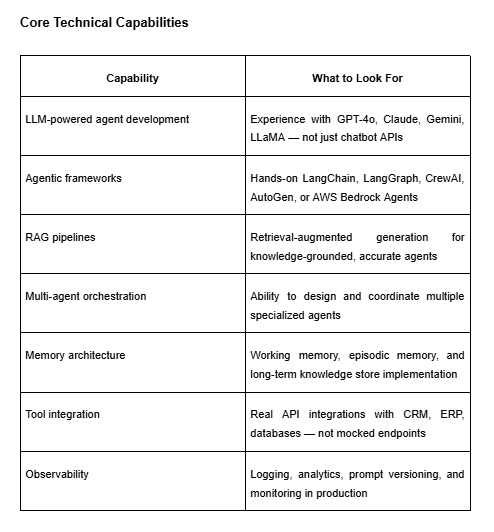
A phased delivery approach is non-negotiable: discovery → prototype → pilot → production. Any vendor jumping straight to full-scale development without a discovery phase is trading your project stability for their speed. Expect transparent pricing that accounts for integration work upfront — not a low headline number followed by scope creep and change orders.
For enterprise deployments, look for ISO 9001 and ISO 27001 certifications, data encryption at rest and in transit, role-based access controls, and industry-specific compliance experience (HIPAA, GDPR, SOC 2). This is especially critical for agentic AI web development projects where agents interact with user-facing systems and handle sensitive customer data.
One area that deserves its own mention is agentic AI web development — building agents that operate within or alongside web applications and platforms.
This is different from a standalone backend agent. Web-integrated agents can browse interfaces, extract data, fill forms, trigger cross-platform workflows, and deliver fully personalized user experiences in real time. The applications are significant: e-commerce personalization at scale, SaaS onboarding automation, service business intake and follow-up, and dynamic content systems that adapt to individual users without manual configuration.
By 2028, Gartner projects that one-third of all enterprise software will incorporate agentic AI — up from under 1% in 2024. Businesses building this capability into their web infrastructure now are not chasing a trend; they are getting ahead of a structural shift in how digital products operate.
The engineering complexity here is higher than a standalone agent. You are dealing with browser interaction, session management, front-end integration, security at the UI layer, and real-time personalization pipelines. Not every AI development shop has built this in production. When evaluating vendors for agentic AI web development specifically, ask about their web-layer experience independently from their backend AI capability — these are distinct engineering skill sets.
There are three routes to an AI agent. Here is an honest breakdown of who each one actually suits.
Build internally is right if you have a strong in-house ML engineering team, a genuinely unique use case that no existing solution addresses, and the bandwidth to maintain what you build long-term. Most companies lack all three. Building from scratch also takes 3 to 12 months — time most businesses cannot afford while the market moves.
Buy off-the-shelf (Salesforce Agentforce, Zendesk AI, no-code agent builders) is the right starting point for standard use cases: customer FAQ handling, appointment booking, basic lead qualification. These deploy in days and cost $200 to $2,000 per month. If your use case fits the template, do not commission a custom build.
Partner with an AI agent development company is the right move when your use case requires custom workflows, proprietary data integration, compliance requirements, or competitive differentiation that commodity tools cannot deliver. This is the path for businesses that need an agent tuned specifically to their operations — not a generic automation layer pasted over existing workflows.
The critical mistake is applying the wrong approach: commissioning a $150,000 custom build when a $500/month off-the-shelf tool would solve the problem, or deploying a generic tool when your differentiation depends on logic that commodity products structurally cannot support. The right AI agent development company will tell you honestly which camp you are in — even if the answer is "you don't need us yet."
NextZen Minds is a full-stack AI and software development company with 500+ engineers operating across India, Singapore, the Netherlands, and Vietnam. We are ISO 9001 and ISO 27001 certified, partnered with AWS, Google Cloud, and Azure, and rated 4.5+ across Google Reviews, Clutch, Glassdoor, and Goodfirms.
We build production-grade AI agents — not demos. Our AI agent development services span the full stack: generative AI, machine learning, multi-agent system design, RAG pipeline development, and agentic AI integration across industries including banking and finance, healthcare, e-commerce, retail, real estate, and logistics.
Our delivery approach is phased by design. Every engagement begins with a discovery workshop: mapping your current workflows, defining the right agent scope, auditing your integration landscape, and setting measurable KPIs before writing code. We do not upsell complexity you do not need. We recommend starting narrow and scaling after the first use case is validated and performing.
Our proprietary products — NZCares (healthcare AI), AIngage (engagement intelligence), and ZenGuard AML (financial compliance) — are built on the same agentic AI infrastructure we deploy for clients. When we talk about production AI agents, we are talking about systems we operate ourselves.
If you have a specific workflow in mind, a budget range, or just a problem you want to solve — we will give you a direct, honest assessment of what it would take to build it right.
No generic proposals. No overselling. Just a clear picture of scope, cost, and what success looks like.
Talk to the NextZen Minds AI Team →
An AI agent development company designs, builds, and deploys intelligent software systems that can plan, make decisions, execute multi-step tasks, and interact with external tools and systems — all with minimal human oversight. This goes significantly beyond chatbot development. Serious companies handle the full stack: LLM selection, orchestration framework, memory architecture, system integration, security, and post-launch optimization.
Costs range from $5,000 for a simple reactive agent to $300,000+ for a full multi-agent enterprise system. The most common range for a production-grade autonomous agent — connected to real business systems with proper memory and observability — is $70,000 to $150,000. Integration complexity and LLM choice are the two biggest cost drivers, not the agent logic itself.
A chatbot follows a script and answers questions within a predefined scope. An AI agent perceives its environment, plans actions to achieve a goal, executes tasks across connected systems (CRM, databases, APIs), and adapts when conditions change — without waiting for step-by-step human instruction. The two are not interchangeable, and conflating them leads to expensive mismatches between expectations and delivery.
Agentic AI web development refers to building AI agents that operate within or integrate with web applications — automating user flows, personalizing experiences in real time, executing tasks across platforms, and handling complex multi-step processes through web interfaces. It requires distinct engineering capability beyond backend AI development and is increasingly central to how modern digital products are built.
Simple contextual agents: 6 to 12 weeks. Autonomous agents with real system integrations: 3 to 5 months. Multi-agent enterprise systems: 6 to 12 months. These timelines assume a team with genuine prior AI agent delivery experience — not a generalist shop learning on your project.
Production-grade companies build on LangChain, LangGraph, CrewAI, AutoGen, or AWS Bedrock Agents for orchestration. LLM choice depends on use case: GPT-4o, Claude 3.5 Sonnet, and Gemini for enterprise capability; LLaMA 3 or Mistral for cost-sensitive or open-source deployments. Framework and model choice directly affects reliability, cost, and long-term scalability.
Ask for live production case studies (not demos), the specific frameworks they build on, how they handle agent failure states and hallucinations, who owns the model and data IP, what post-launch support looks like, and whether they recommend starting with a scoped pilot. A company that cannot answer these questions directly has not shipped enough real agents to be trusted with yours.
Build in-house if you have a strong ML team, a unique use case no vendor addresses, and capacity to maintain it long-term. Buy off-the-shelf if your use case is standard. Hire a development partner when you need custom workflows, proprietary data integration, compliance-specific architecture, or competitive differentiation that generic tools cannot deliver.
_NextZen Minds builds custom AI agents and agentic systems for businesses ready to move from concept to production. 500+ engineers. ISO certified. AWS, GCP, and Azure partnered.