


AI projects often begin with questions about technology.
Which model should we use?
Should we build or buy?
Which use cases should we prioritize?
How quickly can we move from proof of concept to production?
These questions matter. But they are not necessarily the questions that determine whether an AI initiative succeeds.
Before selecting models, platforms, vendors, or use cases, CTOs should ask two more fundamental questions:
1. Do we have the Capacity to execute this?
2. Do we have the Capability to execute this effectively?
The distinction matters.
An organization may have the expertise required to build AI solutions but lack the bandwidth to absorb another major initiative.
Another may have engineering resources available but lack the AI architecture, data, governance, engineering maturity, or transformation experience required to move beyond experimentation.
Both organizations may say they are "ready for AI."
Neither faces the same execution challenge.
Understanding that difference before implementation begins can prevent organizations from investing heavily in AI initiatives they are not yet equipped to scale.
AI Readiness Is More Than Technology Readiness
Enterprise AI has become increasingly accessible.
Foundation models are widely available. Cloud providers offer AI infrastructure and services. Development frameworks can accelerate experimentation. Off-the-shelf AI products continue to expand.
The barrier to starting an AI project is lower than it once was.
But…
Starting an AI project and building an organizational capability around AI are very different things.
A proof of concept may require a small team, limited integration, controlled data, and a narrow business use case.
Production AI introduces a broader set of demands.
Systems need to integrate with existing applications and workflows. Data needs to be available and reliable. Security and governance need to be established. Models need to be monitored. Engineering teams need to maintain the surrounding systems. Business processes may need to change.
And all of this must happen while the organization continues delivering everything already on its technology roadmap.
That is where many AI initiatives encounter a problem that cannot be solved by choosing a better model.
The constraint is organizational.
The Capacity & Capability Framework™ provides a useful way to examine that constraint.
Question 1: Do We Have the Capacity?
Capacity answers a relatively simple question:
Can the organization absorb the work required to execute the AI initiative?
AI rarely enters an empty technology roadmap.
Engineering organizations are already maintaining applications, modernizing platforms, resolving technical debt, supporting operations, delivering product features, strengthening cybersecurity, and responding to changing business priorities.
Then AI becomes another strategic priority.
The initiative may have executive sponsorship and funding, but that does not automatically create the execution bandwidth required to deliver it.
What an AI Capacity Constraint Looks Like
Imagine an organization with strong engineers, experienced architects, mature delivery practices, and employees who understand AI.
On paper, it appears ready.
But the same engineers needed for the AI initiative are already responsible for critical product development.
The data team is supporting multiple transformation programs.
Cloud architects are involved in an ongoing modernization initiative.
Security specialists are already a bottleneck.
Technical leaders are stretched across several strategic priorities.
The problem is not a lack of expertise.
It is insufficient execution bandwidth.
Common signals include:
- AI initiatives repeatedly losing resources to existing priorities.
- Proofs of concept progressing while production implementation stalls.
- Critical specialists becoming bottlenecks across multiple projects.
- Existing product roadmaps slipping when AI work is introduced.
- Teams depending on overtime to accommodate AI initiatives.
- New AI use cases accumulating faster than teams can implement them.
- AI projects remaining experimental because no team has sustainable ownership.
In this situation, hiring an AI specialist alone may not solve the problem.
The organization needs to understand whether its broader delivery system can actually absorb the transformation.
Capacity Is Not Simply Headcount
This is where AI planning can become misleading.
A CTO may look at the number of engineers in the organization and conclude that sufficient resources exist.
But headcount and execution Capacity are not the same.
Capacity can be constrained at several levels.
- Resource Capacity: Are the necessary engineers, data specialists, architects, security professionals, product leaders, and other critical roles actually available?
- Team Capacity: Can cross-functional teams absorb AI work without destabilizing existing commitments?
- Organizational Capacity: Can the enterprise coordinate and scale multiple AI initiatives without creating new dependencies and bottlenecks?
The better question is therefore not:
“Do we have enough people to start an AI project?”
It is:
“Can our organization sustainably absorb the work required to take AI from idea to production?”
If the answer is no, the AI strategy already has a Capacity problem.
Question 2: Do We Have the Capability?
Capacity determines whether the organization can absorb the work.
Capability determines whether it can execute that work effectively.
This distinction becomes particularly important with AI because experimentation can create a false sense of readiness.
A small team may successfully build a chatbot, recommendation system, internal copilot, or AI agent.
The demonstration works.
Stakeholders see potential.
The organization decides to scale.
And then the difficult questions begin.
How will the system integrate with enterprise applications?
What data can it access?
How will access be controlled?
How will outputs be evaluated?
How will AI systems be monitored?
Who owns them after deployment?
How will governance work?
How should the architecture evolve as usage grows?
How will AI-driven workflows interact with existing business processes?
These are no longer simply model-selection questions.
They are organizational Capability questions.
What an AI Capability Constraint Looks Like
An organization can have significant engineering Capacity and still struggle with AI execution.
Common signals include:
- Successful AI prototypes repeatedly failing to reach production
- Architecture changing significantly during implementation
- Teams lacking experience integrating AI into existing enterprise systems
- Uncertainty around AI governance and operational ownership
- Heavy dependence on a few AI specialists
- Significant rework between experimentation and production
- Difficulty evaluating reliability, security, or business impact
- Different teams implementing AI without consistent engineering standards
Adding more general engineering resources may increase activity.
It does not necessarily solve these problems.
If the constraint is Capability, the organization needs to strengthen the expertise and execution maturity required to implement AI sustainably.
AI Capability Exists Beyond AI Expertise
Hiring machine learning engineers or AI specialists is important when those skills are missing.
But enterprise AI Capability is broader than specialist knowledge.
CTOs need to consider at least three dimensions.
- Technical Capability
Does the organization have the technical expertise required to design, integrate, secure, evaluate, and operate AI systems?
- Delivery Capability
Can teams convert AI expertise into reliable production systems using mature engineering, testing, deployment, monitoring, governance, and product practices?
- Transformation Capability
Can the organization manage the broader changes AI introduces across architecture, workflows, governance, operating models, and business processes?
An organization can be strong in one dimension and weak in another.
That is why simply asking whether the company "has AI talent" provides an incomplete picture of AI readiness.
Four AI Execution Scenarios CTOs Should Recognize
Putting the two questions together creates four very different AI execution environments.
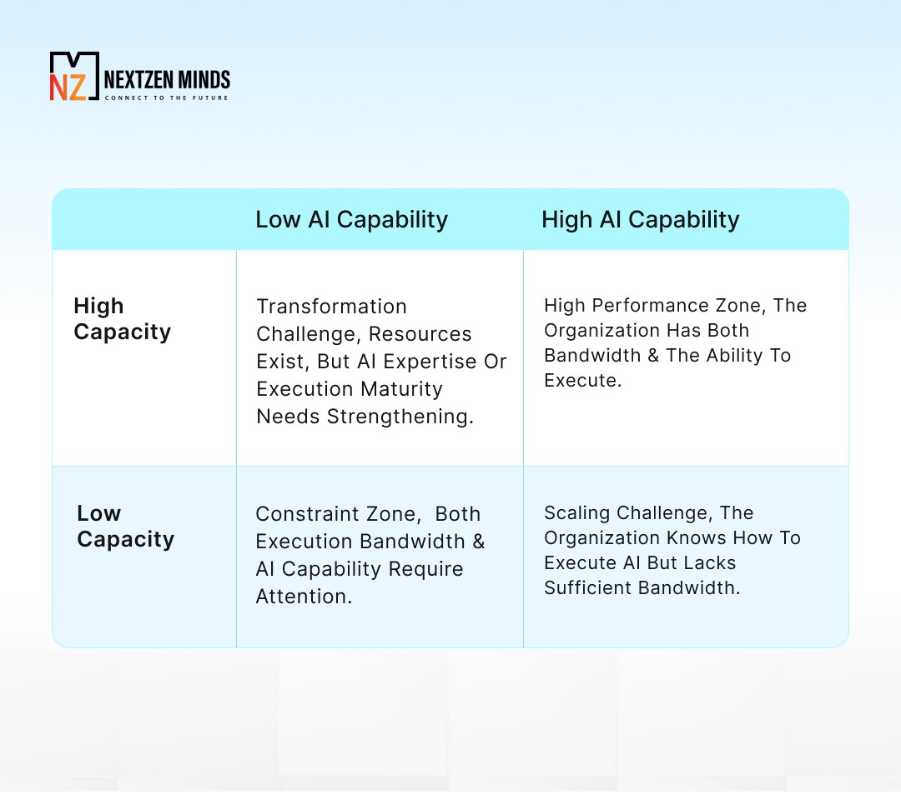
Low AI Capability
High AI Capability
High Capacity
Transformation Challenge, resources exist, but AI expertise or execution maturity needs strengthening
High Performance Zone, the organization has both bandwidth and the ability to execute
Low Capacity
Constraint Zone, both execution bandwidth and AI Capability require attention
Scaling Challenge, the organization knows how to execute AI but lacks sufficient bandwidth
The distinction changes the investment decision.
If Capacity is low but Capability is strong, expanding delivery bandwidth may unlock AI execution.
If Capacity is available but Capability is weak, adding more people may simply increase activity around an execution model that is not yet mature.
If both are constrained, aggressively scaling AI can magnify existing problems.
And when both are strong, the organization is much better positioned to move from isolated AI projects toward repeatable enterprise execution.
The Dangerous Middle: A Successful AI Pilot
One of the most important moments in an AI initiative comes immediately after something works.
A proof of concept demonstrates value.
Leadership becomes interested.
More use cases appear.
Teams want to move faster.
The organization starts thinking about scale.
This is exactly when CTOs should return to the two questions.
Do we have the Capacity to scale this?
Do we have the Capability to scale this effectively?
A successful pilot proves that a particular idea can work under a particular set of conditions.
It does not automatically prove that the organization can operationalize it across teams, systems, business units, or markets.
Scaling may introduce entirely new requirements around architecture, data, security, governance, integration, monitoring, ownership, and organizational change.
The transition from “AI works” to “AI works reliably inside our organization” is where execution readiness becomes critical.
What If the Answer to Both Questions Is “No”?
This is where sequencing matters.
When Capacity and Capability are both constrained, the instinct may be to expand the team immediately.
But increasing Capacity before strengthening an unstable execution foundation can scale the problem along with the organization.
More people can create more dependencies.
More AI initiatives can create inconsistent architectures.
More experimentation can increase governance complexity.
More teams can become dependent on the same small group of specialists.
A more sustainable path is:
Strengthen Capability → Stabilize Execution → Expand Capacity → Scale AI
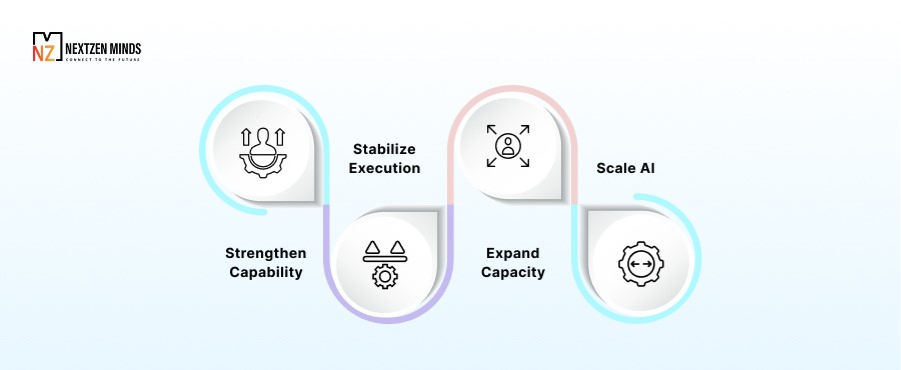
Capability comes first because the organization needs a repeatable way to execute before increasing the volume of execution.
Once architecture, engineering practices, governance, specialist expertise, and delivery patterns become stronger, additional Capacity can amplify what works rather than amplify existing weaknesses.
Five Questions to Ask Before Approving the Next AI Project
Before committing significant resources to another AI initiative, CTOs can use a simple executive check.
- Can our existing teams absorb this initiative without destabilizing current priorities?
If not, there may already be a Capacity constraint.
- Have we successfully executed something with similar technical and organizational complexity?
If not, Capability may need to be strengthened before aggressive scaling.
- Do we have the critical expertise required beyond the AI model itself?
Consider architecture, data, integration, security, governance, engineering, product, and operational ownership.
- If the pilot succeeds, can we support it in production?
AI projects should be planned around sustainable execution—not just successful demonstrations.
- What constraint are we solving by adding more resources?
If leadership cannot answer this clearly, the organization may be moving toward intervention before diagnosis.
Start With the Constraint, Not the AI
AI creates enormous opportunity for organizations willing to rethink products, operations, customer experiences, and how work gets done.
But opportunity alone does not create execution readiness.
Before starting the next AI project, CTOs should resist the temptation to begin with models, platforms, vendors, or headcount.
Start with two questions:
Do we have the Capacity?
Do we have the Capability?
If Capacity is the constraint, create the bandwidth required to execute.
If Capability is the constraint, strengthen the expertise and maturity required to execute well.
If both are constrained, strengthen the execution foundation before aggressively scaling.
Because the question that determines whether an AI initiative succeeds is not simply:
“Can we build this?”
It is:
“Can our organization execute this successfully, and continue executing when the initiative scales?”
That is the difference between starting AI projects and building an organization capable of turning AI ambition into sustained business outcomes.
Understand the Constraint Before You Scale the Technology
The Capacity & Capability Framework™ provides a practical way to examine whether execution is being limited by bandwidth, expertise, maturity, or a combination of these factors.
Explore the Capacity & Capability Framework™
For leaders who want to examine their organization's execution environment more closely, the Capacity & Capability Diagnostic™ provides a structured way to identify where Capacity or Capability may be limiting progress.
Explore the Capacity & Capability Diagnostic™