Aviation Software Development Cost in 2027: From a Single NDC Use Case to a Retail Platform
November 26, 2026
November 26, 2026

Key Takeaways
Introduction
Two airline software quotes can differ by three times, and both can be right. The reason is often not the hourly rate. It is what each vendor has agreed to build.
The aviation software development cost ranges from roughly USD 60,000 for a single NDC use case to USD 900,000+ for a retail platform rebuild. The difference comes down to scope: the systems involved, partners to certify and who takes responsibility for the outcome.
If you are budgeting an airline technology project, you need more than a headline price. This guide breaks down planning ranges by project type, the eight major cost drivers, a worked example and the hidden expenses that often catch finance teams off guard.
At NZMinds, we build airline retailing software with specialist aviation domain partners, covering NDC integration, offer and order flows, ancillary experiences and connected servicing. The figures below are planning estimates, not quotes or guaranteed delivery prices. They are intended to help you frame a realistic budget before speaking to vendors.
The important question is not simply how much you should spend. It is what you should build first.
The aviation software development cost ranges from USD 50,000 to 150,000 for a single NDC use case, USD 150,000 to 400,000 for multi-seller integration and USD 400,000 to 900,000+ for a retail platform. These are planning estimates, not vendor quotes.
The project type makes the first big difference.
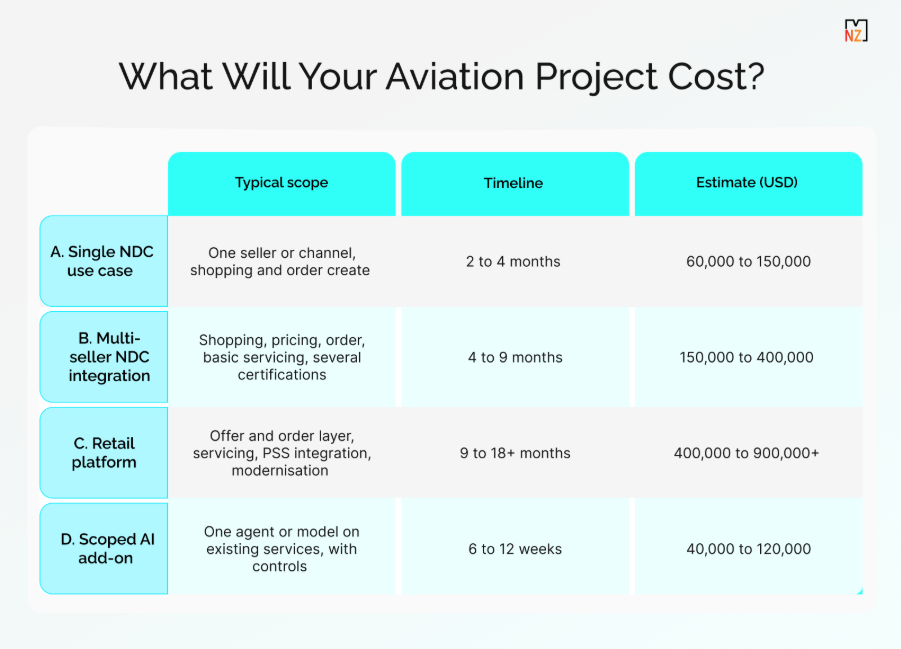
Type A: Single NDC use case. One shopping and order flow for a single channel or seller. Typical timeline: 2 to 4 months. Estimated cost: USD 60,000 to 150,000.
Type B: Multi-seller NDC integration. Shopping, pricing, order creation and basic servicing, certified with several sellers or aggregators. Typical timeline: 4 to 9 months. Estimated cost: USD 150,000 to 400,000.
Type C: Retail platform. An offer and order layer with servicing, integration with the passenger service system (PSS) and legacy modernisation. A PSS manages core passenger and reservation records. Typical timeline: 9 to 18+ months. Estimated cost: USD 400,000 to 900,000+.
Type D: Scoped AI add-on. A time-boxed pilot, such as a disruption servicing agent built on existing services. Typical timeline: 6 to 12 weeks. Estimated cost: USD 40,000 to 120,000.
These ranges assume a blended onshore/offshore team. They exclude your own staff time, vendor licences, PSS vendor charges and cloud costs. We will cover those additional expenses in Section 6.
The airline software development cost varies because market guides group projects with very different scopes under one label. A passenger booking app, an NDC integration and a complete retail platform are not comparable projects.
Published market guides quote roughly USD 8,000 to USD 900,000+. The lower end usually covers simple applications without airline system integration. The higher end reflects platform development involving multiple systems, certification and long-running dependencies.
Three common quoting habits make these numbers misleading.
First, vendors share a total without defining the scope. You cannot tell which features, integrations or testing activities are included.
Second, they quote hourly rates without stating the number of hours. A lower rate does not automatically mean a lower project cost.
Third, they leave out testing and certification. In airline software, these activities can represent a substantial part of the engineering effort.
At NZMinds, we ask four questions before estimating a project:
These answers influence the estimate more than a rate card.
When comparing vendors, put their answers side by side. Two quotes that differ by 3x often describe different scopes, not different prices. For a deeper look at how autonomy drives spend, see our guide to AI agent development cost.
Each aviation project type has a different timeline, team requirement and risk profile. The following table provides a practical starting point for estimating your airline app development cost or larger retailing investment.
All figures are planning estimates, not quotes. Actual costs depend on your PSS, data quality and partner list. The ranges assume a blended onshore/offshore team and exclude your staff time, vendor licences, PSS charges and cloud costs.
Think of these project types as stages rather than four unrelated products.
Type A proves one flow. You get actual integration experience, real test data and your first certification.
Type B makes that flow usable across several sellers. Servicing, monitoring and ongoing support now become significant parts of the work.
Type C changes how the airline sells and services its products. It can involve pricing rules, order management, legacy systems and changes to internal processes.
Moving from one type to the next does not simply add development months. It introduces more systems, owners and decisions.
Your existing PSS is particularly important. A modern system with documented APIs can keep you closer to the lower estimate. A legacy system with limited documentation and slow change cycles can push the project towards the higher end.
The aviation software development cost is largely determined by eight factors: systems touched, partners to certify, NDC versions, servicing scope, data and PSS condition, performance requirements, security and compliance, and team model.
Here is how each factor changes the estimate.
Two factors deserve particular attention: servicing and partner count.
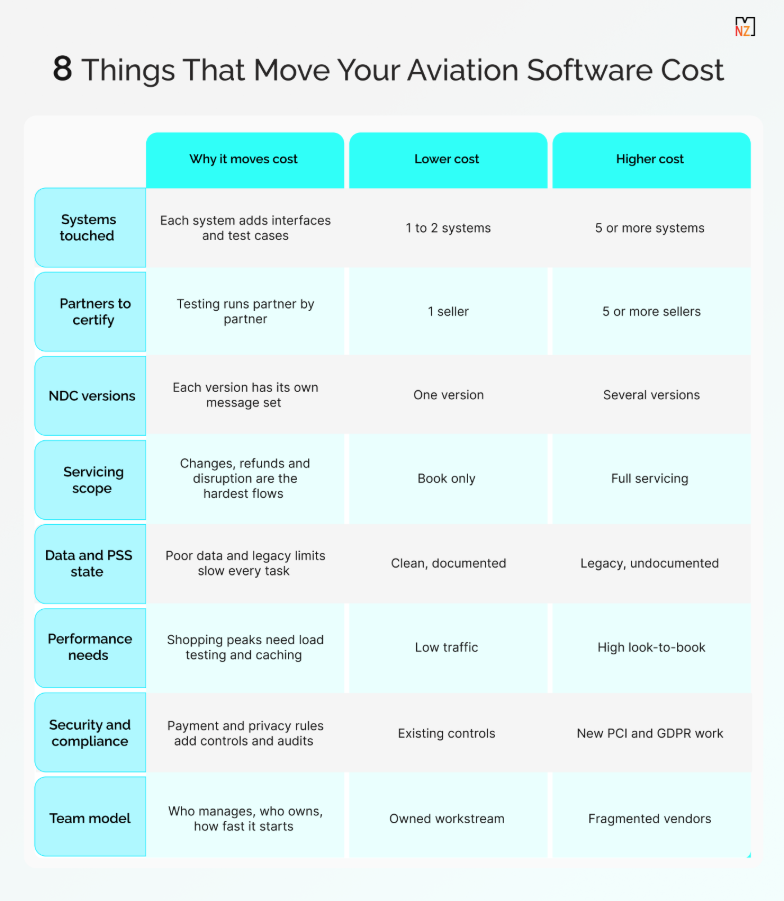
Servicing covers what happens after a booking. That includes changes, refunds, partial changes and disruption rebooking. These flows create exceptions that a straightforward booking demonstration will never reveal.
Partner count creates another layer of work. Every seller certification has its own test cycle and schedule. You cannot always control when a partner is ready to test.
Performance also matters. Look-to-book measures how many shopping requests occur for each completed booking. High look-to-book activity can place considerable pressure on airline systems.
Ask vendors to identify their assumptions against all eight drivers. If they cannot explain how many systems and partners their estimate covers, treat the number cautiously.
The NDC integration cost is approximately USD 60,000 to 150,000 for one use case with one seller. A multi-seller programme with servicing can cost USD 150,000 to 400,000. Servicing requirements and partner count create the largest differences.
NDC, or New Distribution Capability, is an airline distribution standard developed by IATA. It allows airlines to distribute richer offers and manage orders through modern connections with sellers and other distribution partners.
So, what are you paying for?
The work usually includes mapping inventory and fares to NDC offers, developing shopping, pricing and order creation, adding servicing flows, building a test harness and completing certification with each seller.
Certification means proving that your implementation meets a partner's technical and operational requirements through its prescribed tests. Documentation and monitoring are also part of the delivery.
What stretches the budget?
Three things commonly cause delays.
Partners may take longer than expected to begin testing. Your PSS may not return all the information required by the order flow. You may also introduce additional NDC versions halfway through development.
Each change adds effort and can extend the timeline, even when engineers are waiting for external dependencies.
How do you control the cost?
Start with one NDC version and one servicing flow. Build a test harness that can replay actual partner messages. Certify the lowest-risk seller first, then reuse the completed work for subsequent partners.
NZMinds' aviation software development services cover NDC integration, shopping and offer APIs, order and servicing APIs, and partner certification testing.
Airline software budgets commonly miss six expenses: test environments, certification effort, PSS vendor charges, performance testing, internal staff time and ongoing run costs.
These expenses may not appear in the initial development quote, but they still affect your total investment.
There is another number worth including in your budget: contingency.
We recommend adding a 15% contingency for integration unknowns to any aviation software estimate. You may not need all of it. However, it is easier to explain an unused contingency than an unplanned overrun.
In-house development generally costs less per hour but takes longer to start. Staff augmentation adds capacity that you manage, while an owned workstream gives a partner responsibility for a defined outcome. The right model depends on your internal gap.
Here is how the three approaches compare.
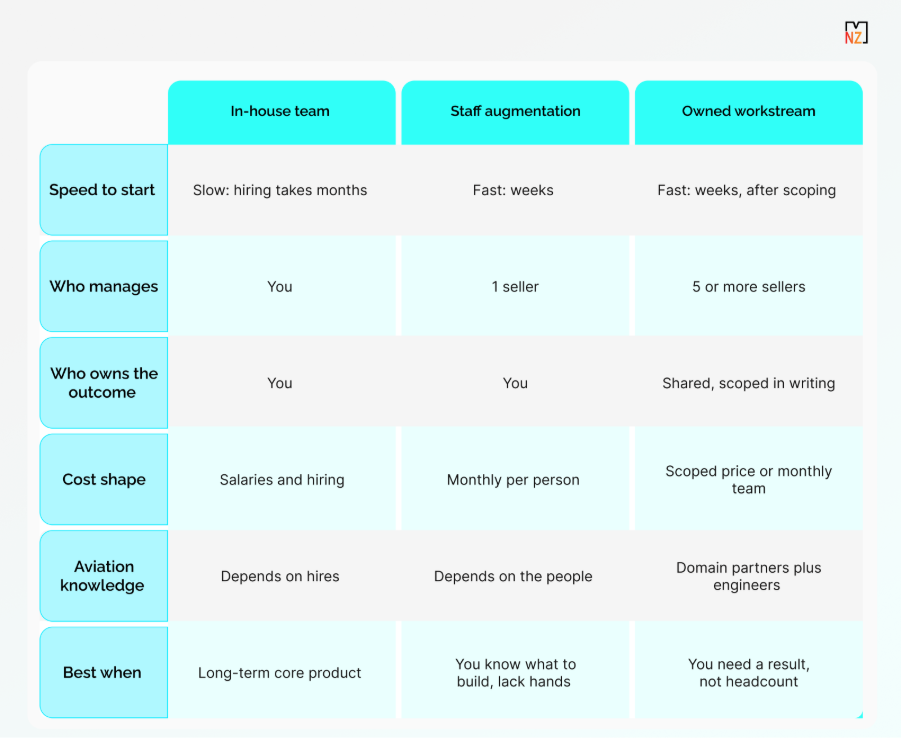
The right engagement model depends on whether you need additional engineering capacity, a specialist team or a partner to take responsibility for a defined workstream. NZMinds outlines these options across its talent engagement models.
If you know what needs to be built but lack engineers, you have a Capacity gap. You can address it through staff augmentation, where specialists join your existing team, or a dedicated engineering team for a longer-running initiative.
If your team lacks specialist knowledge in NDC, PSS or AI, you have a Capability gap. Adding more developers will not necessarily solve it.
An owned workstream costs more per month, but the partner takes responsibility for a defined scope. That shifts part of the delivery risk, provided responsibilities and acceptance criteria are documented.
The Capacity & Capability Framework explains how to identify the constraint before deciding whether to add people, bring in specialist expertise or change the delivery model.
A scoped AI pilot built on existing airline services costs an estimated USD 40,000 to 120,000 and typically takes 6 to 12 weeks. The ongoing cost depends on usage, which generally increases with transaction volume.
The initial build and the ongoing operating costs are two different things.
Build costs cover data checks, integration with offer, order and servicing APIs, evaluation, controls and a human review process. You are paying to make the AI solution work reliably with your existing airline systems.
Run costs cover model usage, monitoring and the time people spend reviewing its decisions. These costs continue after the initial development is complete.
For a broader breakdown of AI project budgets, integration expenses and ongoing operational costs, read our guide to AI development cost in 2026.
NZMinds' AI and Data services cover production AI, agentic platforms and machine learning, with controls and human oversight built into the architecture. For more information on AI in aviation and use cases,
A personalisation model cannot sell an offer that your order system cannot deliver. Get the integration working first. Then identify where AI can improve an existing process.
A worked example makes aviation software development cost easier to understand because it shows how team size, specialist involvement and scope affect the final budget. Consider the following illustrative composite.
The scenario involves a regional low-cost carrier in Southeast Asia with one Passenger Service System (PSS), a small digital team and plans to distribute through three sellers. The carrier is considering two approaches.
The first option covers shopping and order creation with one seller. The estimated team requirement is four engineers working for three months, amounting to 12 person-months. At an assumed monthly rate of USD 5,000 per engineer, the engineering cost comes to USD 60,000.
The project also requires 1.5 months of domain partner involvement at an assumed rate of USD 9,000 per month, adding USD 13,500. After including a 15% contingency, the estimated total comes to approximately USD 85,000.
The second option covers shopping, order creation, changes and refund servicing, along with three seller certifications. This requires six engineers working for six months, or 36 person-months. At an assumed monthly rate of USD 5,000 per engineer, the engineering cost is USD 180,000.
Domain partner involvement increases to three months, adding USD 27,000 at the assumed rate of USD 9,000 per month. A 15% contingency adds approximately USD 31,000, bringing the estimated total to USD 238,000.
The main cost difference comes from servicing scope and the number of certifications, not the hourly rate. Option 2 costs approximately 2.8 times as much as Option 1, while requiring three times the engineering person-months.
Look at what changed between the two options. The larger implementation was not simply a bigger version of the first. It introduced order changes, refunds and three certification requirements. These additions increased the team's involvement from 12 to 36 person-months. The domain partner's time also doubled.
Yet Option 2 costs 2.8 times as much as Option 1, rather than three times as much. The first option also creates a test harness that can be reused, so the initial investment is not wasted.
Build Option 1 first, certify one seller, measure the results and then extend the implementation. Move to Option 2 when the first flow demonstrates a revenue or cost benefit.
This is a useful way to approach the NDC integration cost question. Start with the smallest commercially meaningful scope, establish what it costs and use the evidence to decide the next investment.
If your own rates differ, the calculation still works:
People-months × assumed monthly rate + domain partner time + contingency.
It gives finance and product teams a common structure for discussing the investment.
Illustrative composite only. Rates, team sizes and timelines are assumptions, not NZMinds prices or client results. All figures are estimates, not quotes.
You can reduce the aviation software development cost by narrowing the first delivery scope, not by removing essential testing or servicing. Five practical moves can make a significant difference.
1. Start with one seller and one version. Learn from the smallest certification before adding more partners and versions.
2. Build a replayable test harness. Reusing real partner messages reduces repeated testing effort and saves time during later certifications.
3. Fix the PSS gap early. If your order flow needs information the PSS cannot return, identify that limitation in the first week. Do not wait until development is almost complete.
4. Time-box the first test. Agree on a go/no-go rule before development begins. NZMinds follows a validation-first product engineering approach, testing assumptions and confirming what needs to be built before committing to a larger investment.
5. Match the team to the gap. Buy Capacity when you lack engineers. Buy Capability when you lack specialist knowledge.
There are also two savings that are not worth pursuing.
Do not cut performance testing or servicing flows to make the initial quote look smaller. Those omissions can return later as production incidents, refunds and expensive rework.
Also, be careful with fixed-price quotes that have no written scope. When responsibilities and exclusions are unclear, changes can become commercial disputes.
Ask every vendor to document what is included, what is excluded and how change requests will be priced. Keep that scope alongside the contract.
Your airline software investment may be addressing a Capacity problem, a Capability problem or both. The NZMinds Capacity & Capability Framework helps identify the gap before you decide how to spend.
There are two challenges to consider.
Scaling Challenge: Low Capacity, High Capability.
You know what needs to be built. Your architecture and product direction are clear, but you do not have enough engineers to deliver the work.
In this situation, adding engineering capacity through staff augmentation or dedicated teams makes sense. You need more hands to execute an understood plan.
Transformation Challenge: High Capacity, Low Capability.
You already have engineers, but your team lacks the specialist expertise required for NDC, PSS integration or AI development.
Hiring more generalist developers may not close that gap. You need people who understand the domain and can guide the technical decisions.
Our rule is straightforward: if you are constrained on both, fix Capability before Capacity. Adding more people to an unclear technical direction can increase spending without improving delivery.
Identify your current constraint before deciding on your next engineering investment.
The diagnostic helps you understand whether your immediate requirement is additional engineering capacity, specialist expertise or a combination of both.
Take the free Capacity & Capability Diagnostic.
NZMinds is a product engineering and AI development partner for startups and enterprises. We help founders and product teams validate, build and scale products using AI-driven development.
Our philosophy is simple: build less, validate more, scale what works.
For aviation projects, NZMinds combines specialist domain partners with engineering capacity and AI expertise, supported by its aviation software development services.
For Capacity, we extend your existing team through staff augmentation and dedicated teams. For Capability, we design and build solutions using a control-first architecture.
That means least-privilege access, mandatory human review for destructive actions and full session replay. These controls help keep system actions accountable and provide visibility into what happened during execution.
Our focus is not simply on adding developers or delivering code. It is on helping you identify the right work, define ownership and build a solution that can be extended as your requirements grow.
Aviation software development costs approximately USD 60,000 to 150,000 for one NDC use case, USD 150,000 to 400,000 for multi-seller integration and USD 400,000 to 900,000+ for a retail platform. These
are planning estimates. Your actual budget depends on integrations, servicing requirements, certifications and the engagement model. A discovery call can help place your project in the right range.
The airline app development cost depends on what the application needs to connect to. A passenger- facing app without deep system integration costs considerably less than a retailing platform. However, costs increase when you add reservation, payment, loyalty and other airline system integrations. Define those requirements before requesting a quote.
The NDC integration cost is approximately USD 60,000 to 150,000 for one use case with one seller and USD 150,000 to 400,000 for several sellers with servicing. The number of certifications and the servicing scope are the biggest cost drivers. A project review can help narrow the estimate based on your PSS and requirements.
The main factors are the number of systems involved, partners to certify, NDC versions, servicing requirements, PSS and data quality, performance needs, security and compliance, and the team model. Hourly rates matter, but scope usually has a greater influence on the final cost. Define the integrations and servicing flows before comparing vendor estimates.
In-house teams generally cost less per hour but take longer to recruit and mobilise. Staff augmentation adds engineering capacity that you continue to manage. An owned workstream costs more per month but gives a partner responsibility for a defined outcome. The right choice depends on whether you lack engineers, specialist expertise or both. The Capacity & Capability Diagnostic can help identify the gap.
Start with one seller, one NDC version and one servicing flow. Build a replayable test harness, check PSS limitations early and establish a go/no-go rule for the first test. Keep a 15% contingency for integration unknowns. A scoped architecture review before development is also a useful starting point.

Resources