AI Agent Development Cost: A Realistic Breakdown for 2027
November 9, 2026
November 9, 2026

Key Takeaways
AI agent development cost has two parts: a one-time build cost and the ongoing cost to operate the agent. Teams often budget for the first and underestimate the second because agents use model capacity at every step. A production agent with real integrations costs more to build than a prototype, while running costs grow with usage rather than headcount.
This guide provides illustrative planning ranges and explains how to control ongoing expenses. NZMinds builds AI agents on a control-first architecture, including controls in its estimates.
The cost to build an AI agent depends mostly on scope. These illustrative planning ranges reflect team size, duration and blended monthly rates; they are not quotes.
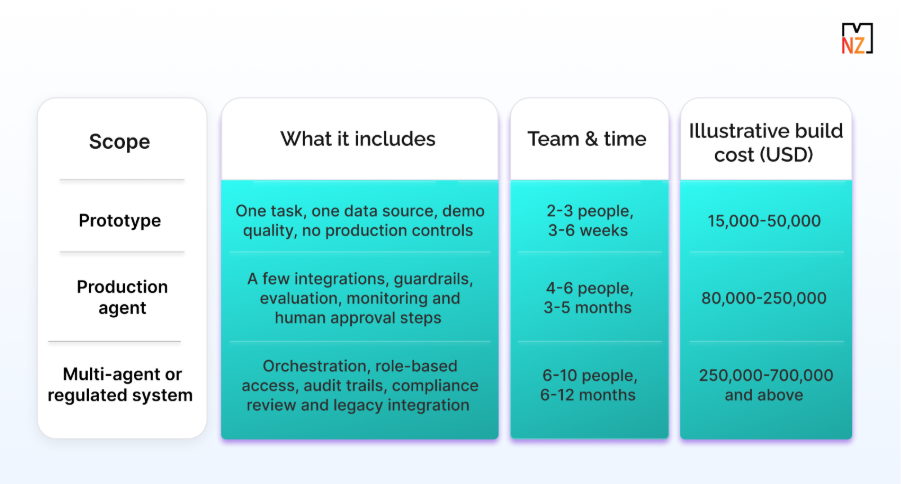
Check the numbers yourself. Build cost = team size × months × monthly cost per engineer. Five engineers for four months at a blended USD 8,000 per person per month cost USD 160,000. Offshore-heavy teams generally cost less than onshore-heavy teams.
Why prototypes mislead. A prototype proves the idea on clean data but often excludes access control, error handling, evaluation, monitoring and security review. Production work includes these requirements.
Where production effort goes. Integration, evaluation sets and controls often take more time than prompts and model calls. Estimates focused mainly on agent behaviour can understate the build.
Rates differ by seniority. Engineers with agent and security experience cost more than generalists. Production teams commonly combine a small senior core with supporting engineers.
What the ranges leave out. Discovery, scoping, user training and ongoing running costs need separate budgets.
A per-task view helps. Divide monthly running costs by completed tasks. The worked example gives USD 0.36 per task, which can be compared with the cost of a person doing the same work.
Six factors affect the estimate; the first three usually matter most.
Number and age of integrations. Every system the agent reads from or writes to adds scope. Modern APIs are generally straightforward; legacy systems and on-premise databases may need custom connectors. List every required system before requesting a price.
Data quality. Cleaning and structuring data can take as long as building the agent. Profiling data before development can prevent weeks of rework.
Level of autonomy. An agent that drafts work for approval is cheaper to build and safer than one acting independently. Greater autonomy requires more controls. Increase autonomy as evidence supports it.
Compliance requirements. Regulated data adds access controls, audit trails, data residency requirements and review cycles. These reviews can extend timelines even when engineering effort changes little.
Evaluation depth. Domain experts need time to create test sets defining correct behaviour. Skipping evaluation reduces initial cost but makes reliability harder to establish. Start with a small, representative set.
One agent or several. Multi-agent systems require orchestration and shared state, creating more potential failure points. Add agents only when one cannot meet the requirement.
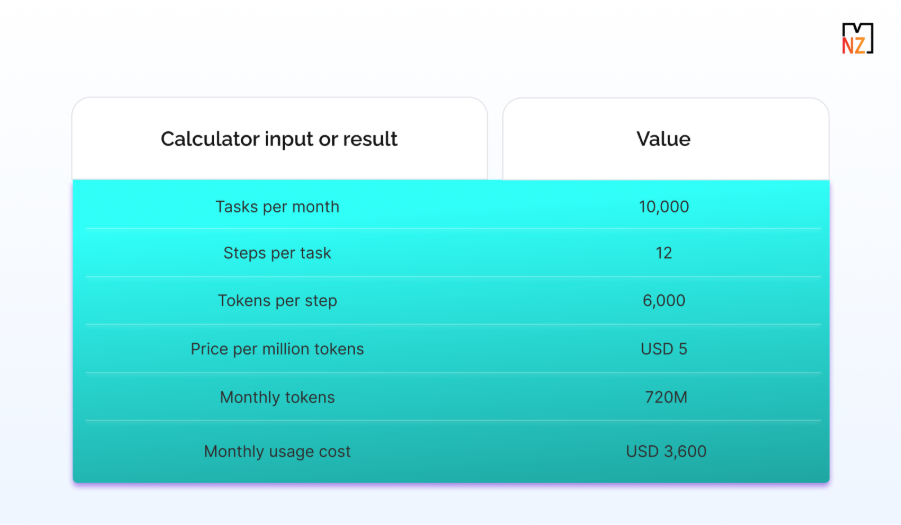
Running costs are driven largely by model usage. The formula is:
Monthly model cost = tasks per month × steps per task × tokens per step × price per token.
Assume 10,000 tasks monthly, 12 steps per task and 6,000 tokens per step, including context resent at each step. At an illustrative blended price of USD 5 per million tokens:
Fixed and variable costs. Hosting and monitoring are mostly fixed; model usage varies with volume. Separating them shows how expenses change when usage doubles.
Why context matters. Each step usually resends the conversation so far, making later steps more expensive than earlier ones. Longer tasks therefore cost more than a simple multiple of shorter tasks.
Input versus output. Providers usually charge more for output tokens than input tokens. Check current rates for both.
Model choice matters. Larger models cost more per token, sometimes substantially more. Routing simple steps to smaller models can reduce usage costs.
Other running expenses. Hosting, vector databases or search indexes, logging, observability, security tools and the time spent monitoring and improving the agent all contribute. For some production agents, staff costs exceed model usage. This is why AI agents cost more to run than many teams plan for.
Overruns often come from expenses missing from the initial estimate. Include these six categories.
Maintenance and model changes. Models are updated or retired, requiring retesting against evaluation sets and sometimes prompt changes. Budget for this quarterly.
Evaluation upkeep. Business requirements change, so domain experts must update test sets regularly.
Access reviews and security. Permissions, keys and integrations need periodic review, especially in regulated environments.
Human review time. Approving agent output adds running cost and can delay the workflow. Measure approval time.
Incident response. Investigating errors takes staff time. Session logs speed up investigations, but someone must own the response.
Provider and price changes. Pricing, limits and model availability can change. Keep prompts and tests portable so models can be switched when necessary.
Agents can get stuck when steps repeatedly check each other's output or retries make no progress. In the example above, 5% of tasks, 500 out of 10,000, loop to 60 steps instead of 12. Those tasks consume 180 million rather than 36 million tokens, raising total usage from 720M to 864M tokens: a 20% increase.
At the illustrative rate, this adds USD 720 monthly. The fix is a step limit, not simply a larger budget.
A second example. If looping tasks rise to 10%, usage reaches 1,008M tokens, a 40% increase, adding USD 1,440 per month at the same assumed rate.
Why loops happen. Common causes include open-ended goals without clear stopping conditions, agents reviewing each other indefinitely, and tools returning errors that trigger repeated retries. These design problems can be detected and capped.
What to watch. Track steps per task, tokens per task and the proportion exceeding a defined ceiling. A growing tail of expensive tasks is an early warning.
Seven levers cover the main opportunities to reduce costs without sacrificing quality.
Stop tasks that exceed their ceiling and hand them to a person. A 20-step limit for a task normally requiring 12 allows room for variation without endless loops. Require human approval before continuing beyond a limit on open-ended tasks.
Use cheaper models for simple steps and larger models for difficult ones. Classification, extraction and formatting are typical candidates for smaller models.
Formatting dates or looking up records does not require a model. Fixed code is cheaper, faster and predictable.
Summarise earlier steps and cache repeated instructions or documents instead of resending everything.
Schema checks catch invalid inputs, reducing failed calls and retries.
Alert when tasks exceed the usual step count, and review cost per task monthly against the previous month.
Tokenmaxxing describes optimising AI use for high token consumption instead of good outcomes. It can inflate costs without demonstrating value. Unlike a loop, which is a design fault within a task, tokenmaxxing is a measurement problem across an organisation. Track cost per completed task and per business outcome. Rising usage with stable cost per outcome can indicate productive work; rising usage without better outcomes signals waste.
Controls add cost but reduce risk. An agent with broad permissions can cause damage through a single wrong action.
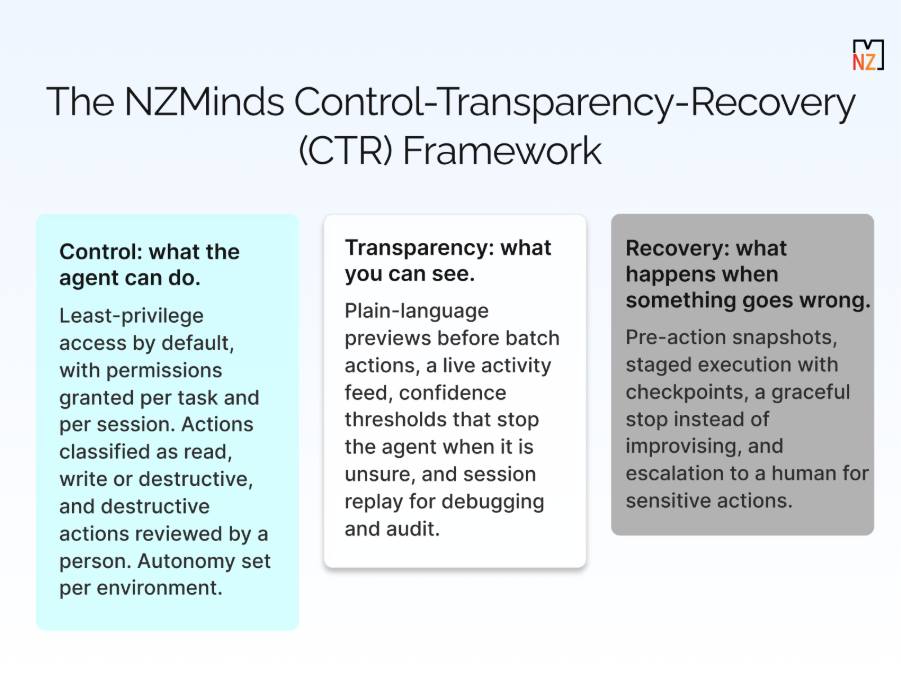
Each layer is a separate workstream in an NZMinds estimate, making its cost visible.
Controls pay twice. Step limits, budgets and alerts reduce risk and catch looping tasks, lowering running costs.
Where control costs appear. Permission design, approval workflows, logging, replay and recovery steps are separate line items.
What controls prevent. A step limit takes hours to build and prevents runaway usage. Approval adds engineering and human-review time but prevents irreversible actions. Session replay adds storage and engineering effort while making incidents investigable.
Buying a pre-built agent lowers build costs but moves some running expenses into a licence fee and limits control. The right choice depends on the workflow's business importance and your team's ability to operate what it builds. NZMinds' build-versus-buy guide uses the Capacity × Capability Matrix.
Common agentic AI pricing models include usage-based charges, per-seat licences, per-outcome pricing, and custom build plus running costs; compare each option against expected usage and required control.
When building is worth it. Ownership can cost less over time when an agent handles proprietary logic, regulated data or high volumes.
When it is not. A vendor agent is usually cheaper for generic, low-risk workflows with low usage because it avoids custom build effort.
A simple decision rule. For generic, low-volume workflows, price a vendor agent first. For business-specific, regulated or high-volume workflows, compare both options at expected volume, including running costs.
Revisit the decision as volume changes. Buying may be cheaper at 500 tasks monthly, while ownership may become cheaper at 50,000.

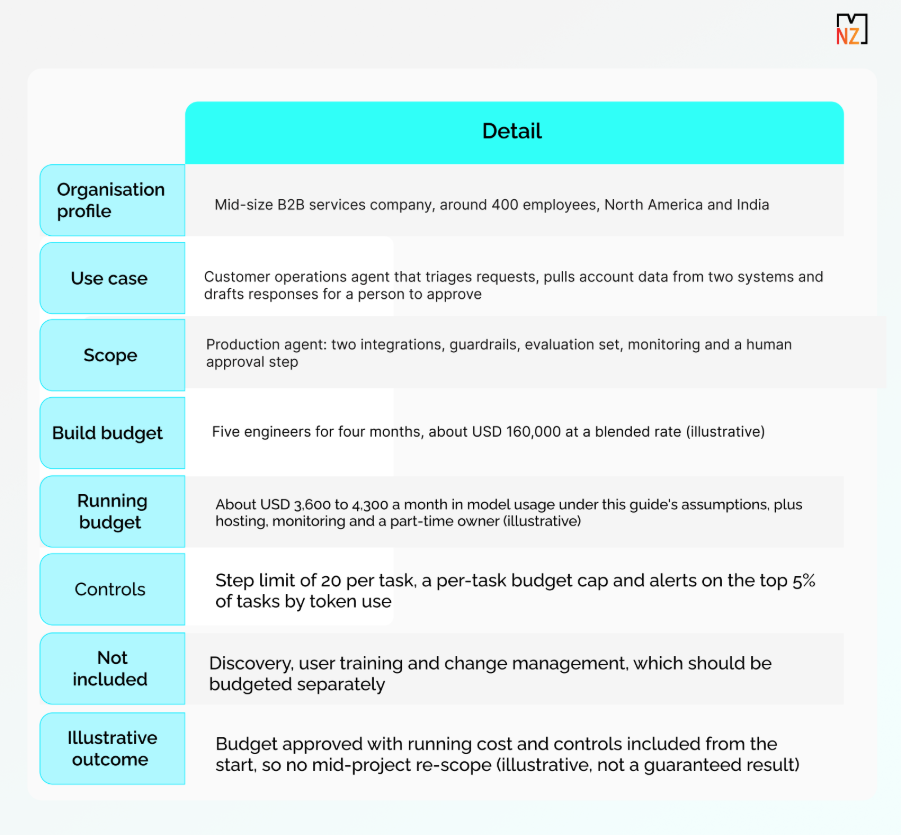
This illustrative composite is a planning scenario, not a specific engagement.
What to look for. Monthly running costs are about 2-3% of the build budget, so the first year is dominated by development while later years shift towards operations. A change in the share of looping tasks can move monthly costs more than the same percentage change in normal tasks.
NZMinds builds AI agents with least-privilege access, mandatory human review for destructive actions and full session replay for every deployment. NZMinds also develops AIngage, its own AI product, and scopes running costs as carefully as build costs.
Estimate before you commit. A scoping conversation sizes development, controls and running costs against your workflow.
Validate before automating. NZMinds tests the use case on real examples before full development begins.
Capacity when you need it. Staff augmentation or a dedicated team can extend your existing team when the design is ready.
Controls in every deployment. NZMinds' stated approach is to include layered safety controls because mistakes at scale can cost more than building safeguards.
Estimates you can check. NZMinds presents the assumptions behind its figures so finance teams can adjust them.
Honest scoping. If a vendor product is the better answer, NZMinds says so. A cheaper, safer option is preferable to an unnecessary custom build.
Read more: Scaling a Global Audit Analytics Platform with a Dedicated NZMinds Engineering Team
A: It depends on scope. These illustrative planning ranges are USD 15,000-50,000 for a prototype, USD 80,000-250,000 for a production agent and USD 250,000 upward for a multi-agent or regulated system. Integrations, data quality and compliance requirements have a major effect on the estimate. A scoped estimate is the most reliable way to establish the likely cost, and NZMinds offers one free.
A: A prototype takes a few weeks. A production agent with integrations, guardrails and evaluation commonly takes three to five months. A multi-agent or regulated system can take six months to a year. Data access and security reviews are common sources of delay, so plan for both early in the project.
A: Multiply tasks per month by steps per task, tokens per step and your price per token, then add hosting, monitoring and the time of the person who owns the agent. In the illustrative example, 10,000 tasks at 12 steps cost about USD 3,600 monthly in model usage at an assumed USD 5 per million tokens.
A: Usually, some tasks loop or retry far more than planned. In the illustrative example, 5% of tasks looping to 60 steps added 20% to monthly usage. Step limits, per-task budgets and alerts for high-usage tasks help identify the problem before it drives up the bill.
A: Often, yes, for generic, low-risk workflows because build effort and part of the running work shift to the vendor. For workflows involving proprietary logic, regulated data or high volumes, owning the agent can cost less over time. Compare both options against expected usage and control requirements, or book a Discovery Call to discuss your workflow.
A: Controls add to build costs but reduce risk and can lower running costs. Step limits and monitoring help prevent harmful actions and looping. NZMinds scopes controls as a separate workstream so the cost is visible. A review can help establish which safeguards your workflow needs and how they affect the estimate.

Resources