AI in Aviation: 7 Practical Use Cases, Benefits and ROI
November 25, 2026
November 25, 2026

Key Takeaways
Introduction
Investing in AI does not guarantee a return. A pilot may fail to connect with booking systems, an assistant may mishandle a refund, or a personalisation model may suggest offers the airline cannot fulfil. Success depends as much on processes, data and controls as on the model.
The clearest commercial opportunities for AI in aviation are in retailing, disruption servicing, demand forecasting and back-office tasks. These applications can increase revenue, reduce repetitive work and expand team capacity without making every decision autonomous.
This article explores seven practical uses of AI in aviation, their potential benefits and the limits of their returns. It also explains the engineering, integration and governance choices needed to move from pilot to production. The focus is commercial airline technology, especially retailing and passenger servicing, not autonomous flight or safety-critical systems.
AI in aviation uses machine learning, language models and predictive systems to support decisions or automate tasks across airlines, airports and related services. Applications include passenger tools, commercial planning, maintenance and ground operations. The required technology and oversight depend on what the system can do.
Airline applications broadly fall into four groups:
This article concentrates on commercial and corporate workflows that airline technology teams can assess against business measures: retailing, passenger servicing, forecasting and back-office automation.
Risk varies by use case. A drafted customer email can be reviewed before sending; a system that informs flight-safety decisions carries greater consequences and may require formal assurance and certification.
NZMinds starts by assessing the consequences of a proposed use case rather than the technology alone. This clarifies where automation is suitable, where people must approve actions and where a specialist regulated programme is needed.
Assess the business benefits of AI in aviation through four measures: revenue per passenger, cost per customer interaction, capacity utilisation and disruption recovery time. Each needs a baseline; faster activity alone does not demonstrate a better business outcome.
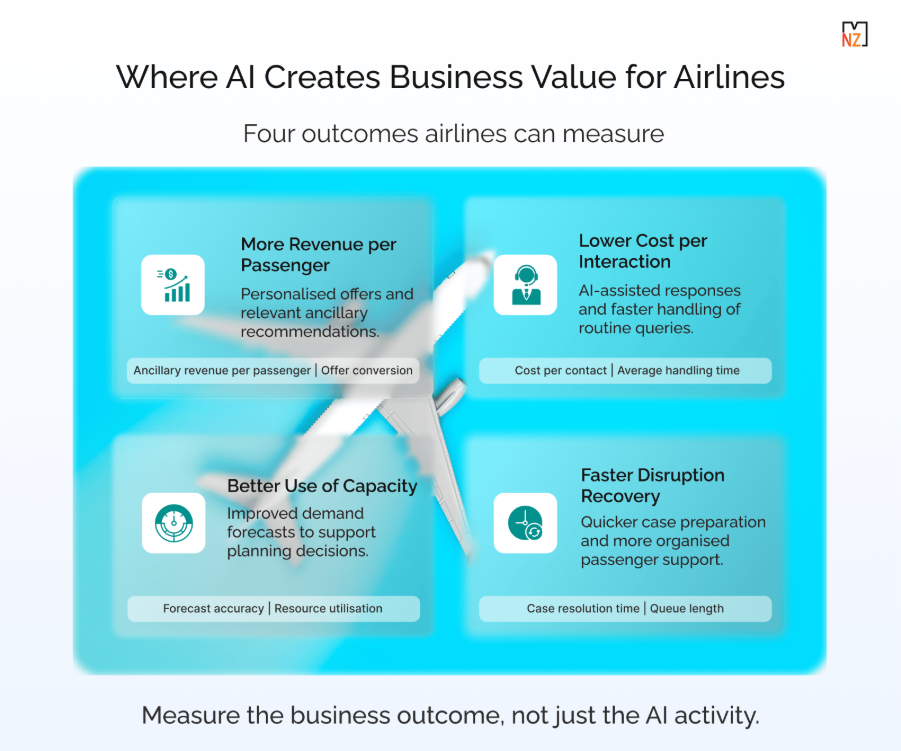
Higher revenue per passenger. Relevant offers, bundles and ancillary recommendations can encourage purchases of baggage, seats, meals and upgrades. Track ancillary revenue per passenger, offer conversion and revenue by channel, not clicks alone.
Lower interaction costs. AI assistants can retrieve policies, draft replies and prepare rebooking options within approved rules. Measure handling time, cost per contact, first-contact resolution and escalation volumes.
Better capacity utilisation. Demand and load forecasts can give commercial and operations teams stronger planning information. Compare forecast errors with the existing method across routes, seasons and demand conditions.
Quicker disruption recovery. During delays and cancellations, AI can help staff identify options, draft messages and organise cases. Track resolution time, queue length and the number of passengers awaiting help.
Full autonomy is not necessary to achieve these gains. AI can prepare information or recommend actions while employees retain approval responsibility, increasing capacity without weakening accountability.
AI solutions for aviation that deliver returns first typically combine high transaction volumes, existing data, a measurable baseline and outputs people can verify. The seven examples below are ranked by how directly the work links to a business measure, not by technical sophistication.
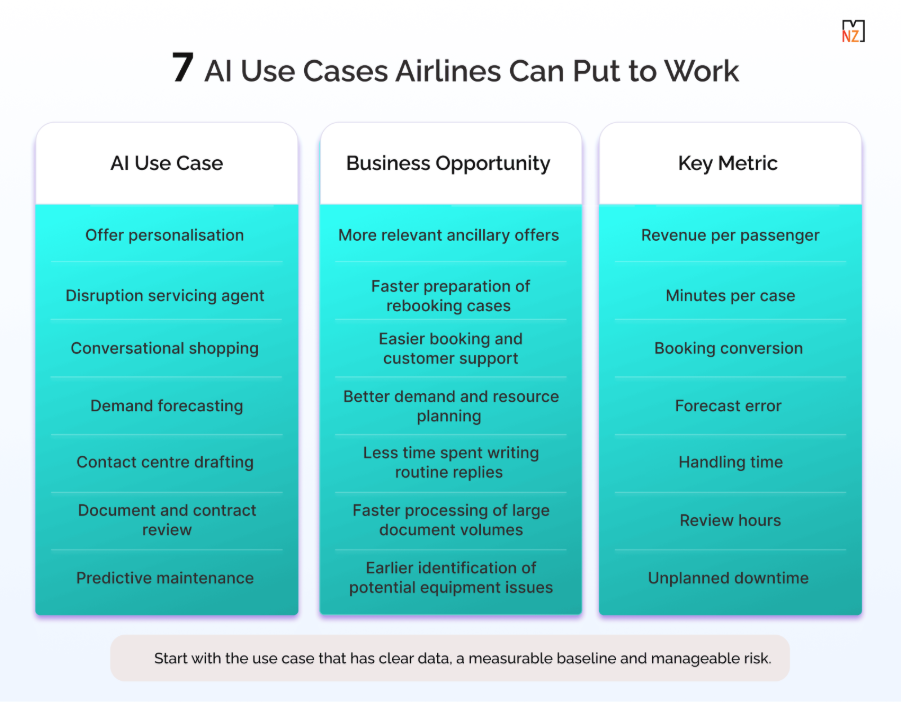
The first six use cases are generally easier to test in commercial or corporate workflows. Predictive maintenance is also an established area of aviation AI interest, but it needs specialist maintenance expertise and separate assurance. It is not a simple extension of a customer-service pilot.
Do not pursue all seven at once. Start where the baseline is clearest, data is available and a business owner can judge the outcome. A successful implementation also establishes integration, evaluation and review practices that later projects can reuse.
Airline AI can help choose which offer a passenger sees, when it appears and how it fits their journey. The opportunity is not to display more offers, but to match customers with relevant products the airline can fulfil.
Traditional airline retailing often begins with a fare, then adds products during or after booking. New Distribution Capability (NDC) and the shift towards Offers and Orders give airlines more flexibility to assemble and manage products throughout the customer journey.
AI can analyse booking and customer information, rank relevant products, support bundle selection and help teams test offers. These may include seats, baggage, meals, upgrades and other ancillary services.
Personalisation relies on the systems behind each offer. Airlines need reliable passenger and booking data, access to offer and order services, and records of what customers saw and bought. These records enable comparisons of conversion and revenue.
Offers can still conflict with fare conditions, advertise unavailable products or be unsuitable for a passenger or market. Business teams should own pricing and eligibility rules, with AI operating within those boundaries.
For airlines using legacy reservation or distribution systems, integration may come first: a model cannot sell products that order and servicing systems cannot support. NZMinds offers NDC and API enablement, offer and ancillary experiences, order and servicing integration, and commerce platform engineering. These describe service capabilities, not completed client projects for every use case.
AI agents can handle routine preparation during disruption: finding options, drafting passenger messages and organising cases for review. They should not approve every refund, compensation payment or fare-rule exception automatically. Autonomy should reflect the action, its financial consequences and airline policy.
A disruption-servicing agent can review case information, check permitted options, propose a rebooking and draft a passenger message. Routine cases can follow an approved workflow, while exceptions go to employees.
This preparation can ease sudden contact-centre workloads. Rather than searching multiple systems and repeating steps, staff receive a prepared case with relevant information and a suggested action.
Practical risks include endless API retries, stale inventory, misinterpreted compensation rules and unchecked usage-based spending. Controls should include step limits, per-task budgets, approved actions and explicit stop conditions.
An incorrect rebooking can increase costs, frustrate passengers and create legal exposure. Airlines must be able to reconstruct the agent’s actions. Recording inputs, sources, proposals, approvals and overrides is therefore a design requirement, not an optional reporting feature.
AI in aviation is a poor investment when its business case assumes full autonomy, immediate integration, flawless accuracy or automatic headcount savings. Such assumptions overlook integration, exception handling and accountability. Test them before committing to production.
Full autonomy. Success in a clean demonstration does not prove an agent can handle unusual cases, conflicting information or missing records. Errors can have consequences beyond customer experience. Retain human review for financial actions, bookings and significant policy exceptions.
Instant integration. A chat interface does not connect a model to reservation, inventory, payment and order systems. Permissions, API behaviour, data quality and testing can make integration a major part of delivery.
Guaranteed accuracy. AI can sound confident while being wrong. Answers about fares, baggage, travel documents and compensation should use approved sources, show their provenance and refer uncertainty to a person.
Automatic headcount savings. Increased capacity is a more realistic initial benefit: employees may handle more cases or fewer repetitive tasks. Immediate workforce-reduction assumptions can ignore review, exceptions and ongoing maintenance.
Safety-critical decisions. Flight operations and maintenance need specialist engineering, safety assurance and regulatory consideration. Treat these as regulated programmes rather than standard commercial automation.
AI may still be useful in these areas; the risk is promising more than it can safely deliver. Ask vendors how their systems handle difficult cases, not just successful demonstrations.
More Read: How to Choose the Right AI Agent Development Company in 2026 (Before You Spend a Dollar)
The future of AI in aviation is likely to be less about full autonomy and more about closer links with the systems airlines already run: offers, orders and servicing. As airlines move towards Offers and Orders, AI will have better data and cleaner places to act. Regulation, including the EU AI Act and EASA’s work, will shape the pace. Expect steady, measurable gains before any big leaps.
Regulatory expectations emphasise trustworthiness, assurance, human involvement and accountability, especially where AI can affect safety. Requirements depend on the intended use, jurisdiction and risk. A single general AI policy will not necessarily cover every application.
In May 2023, the European Union Aviation Safety Agency (EASA) published Artificial Intelligence Roadmap 2.0 - A human-centric approach to AI in aviation. It outlines an approach to AI integration that considers safety, human factors and assurance. EASA has also continued developing AI trustworthiness work and aviation guidance.
Colombia submitted the impact of artificial intelligence on the aviation sector to the International Civil Aviation Organization (ICAO) 42nd Assembly in 2025. The paper raised sector-wide adoption issues. It is an Assembly working paper, not an adopted ICAO regulation.
Other rules may apply. The EU AI Act, for example, sets documentation, record- keeping and human-oversight requirements for certain high-risk systems. Classification depends on intended purpose and the relevant provisions; commercial airline AI tools are not automatically high-risk.
Commercial airline technology teams should assign accountability, log activity, protect accessed data and provide stop and override controls. Before deployment, confirm applicable regulatory and certification requirements with the airline’s compliance team and the relevant authority.
Useful model outputs are only one part of safe airline AI. Systems also need controlled operational access, traceable decisions and reliable handovers to employees. NZMinds addresses these needs through its Control-Transparency- Recovery framework.
Grant only the access the system needs. Define approved actions, step and spending limits, and human approval for refunds, compensation, schedule changes and other consequential actions. Reservation, order and payment access must follow airline security and authorisation policies.
Log workflow inputs, sources, outputs, actions and human overrides. Link offer and rebooking decisions to the relevant business rules. Policy answers should reference approved information rather than unsupported model responses.
Enable staff to take over cases, reverse actions where possible and stop agents during incidents. Disabling an AI workflow should not interrupt the wider booking or servicing operation.
Agree ownership before development. Assign a business owner to the outcome and involve engineering, security, revenue and compliance teams in review.
Test against the airline’s own data and an agreed baseline. A two-to-four-week test of one process can indicate whether to expand. NZMinds’ build-measure- validate approach is designed to avoid approving lengthy development on the strength of a demonstration alone.
Design cost controls from the outset. Model and API charges can grow with transaction volumes, so set workflow budgets and monitor costs alongside business results. NZMinds’ guides to AI agent development cost and token usage explain these operating expenses.
A controlled disruption-servicing workflow can shorten routine rebooking preparation while leaving exceptions with staff.
(The example below is an illustrative composite, not a named NZMinds client or a verified project result. Its figures illustrate a possible business case, not a guaranteed outcome.)
The agent prepares work; it does not remove staff responsibility. Employees retain judgement-based decisions, while activity logs reveal where the workflow can improve.
The first question is not whether another airline can achieve the same six- minute result. It is whether its process contains enough repeatable work, accessible data and a dependable baseline to justify a controlled test.
Start with one high-volume use case, a measured baseline and a business owner. A four-to-eight-week test can assess technical viability and commercial value before a larger build. Costs depend on integration, usage and oversight, not the AI model alone.
Follow these five steps:
1. Select one use case. Choose an application from the table with a well- understood process and baseline.
2. Check data and systems. Confirm available information and connections to reservation, order and payment systems.
3. Define review rules. Specify acceptable outputs, permitted actions and cases that require employee attention.
4. Run a time-boxed test. Use real or appropriately controlled cases, measure results and agree go-or-no-go criteria in advance.
5. Scale or stop. Expand only when agreed measures are met; otherwise retire or redesign the workflow.
Budget for data preparation, API integration, evaluation, monitoring, security review and employee review time, not just model development. Usage-based charges can grow with case volumes, so pilot spending is not a dependable estimate of production costs.
Build-versus-buy choices depend on existing systems, internal expertise, timelines and control requirements. Packaged products may suit standard workflows; custom aviation software development may better serve proprietary systems, specific business rules or distinctive retailing experiences.
Choose the option that meets airline requirements without unnecessary integration or maintenance. Compare total ownership costs, including ongoing support.
To estimate the ROI of AI in aviation, compare today’s baseline with the expected change, then divide the net gain by total cost: build, integration, running costs and review time.
Some airlines understand the problem but lack specialist AI expertise; others have the expertise but too few engineers to deliver. The NZMinds Capacity & Capability Framework distinguishes these constraints so teams can address the right gap.
A Capability gap means engineering capacity is available, but expertise in AI architecture, retrieval, evaluation, agent controls or governance is missing. The framework calls this the Transformation Challenge: high capacity with limited capability.
A Capacity gap means the team knows what to build but lacks enough people to deliver. This Scaling Challenge can be addressed through staff augmentation or a dedicated team.
When both gaps exist, adding people before securing the right expertise can increase risk. The framework recommends building capability first, then scaling around an established technical and delivery approach.
NZMinds provides product engineering and AI development for startups and enterprises. Its aviation services cover NDC and API enablement, offer and ancillary experiences, order and servicing integration, and commerce platform engineering. Specialist domain partners join the engineering team when aviation-specific expertise is needed.
Its control-first AI approach combines least-privilege access, human review of consequential actions and session-level records. Staff augmentation and dedicated teams address capacity needs.
Use the Capacity & Capability Diagnostic to identify the delivery constraint and decide whether to develop an AI solution, expand the engineering team or tackle both in sequence.
AI in aviation applies machine learning, language models and predictive systems to decisions and tasks across airlines, airports and related services. Uses include personalised offers, passenger servicing, demand forecasting, document processing and maintenance. The system’s purpose and potential consequences determine the human oversight and regulatory assurance required.
Potential benefits include higher ancillary revenue per passenger, lower servicing costs, better demand forecasts and faster disruption recovery. Measure each against an existing baseline. Assess personalisation through conversion and ancillary revenue, and servicing automation through handling times and resolution rates.
Airline use cases include personalised offers, conversational shopping, disruption servicing, demand forecasting, contact-centre drafting and document review. Predictive maintenance is another established area, but requires specialist data and safety assurance. Assess each application’s value, data availability, integration requirements and consequences of error.
Responsible use requires appropriate access controls, human oversight, activity records and dependable stop or override mechanisms. Flight-safety and maintenance applications need specialist assurance and may require certification. Commercial tools also need controls when they affect bookings, payments, refunds or passenger rights.
Choose one high-volume process with a measurable baseline and an accountable owner. Check data and integration needs, define human review rules and run a time-boxed test. Scale only when agreed business and operational measures are met. A scoped review can help select the first use case.

Resources