
IT Support Services and Its Impact on Businesses
July 18, 2025
July 18, 2025
.jpg)
A busy business day. A sudden system crash. Emails stop syncing, customer service stalls, and sensitive data becomes vulnerable. Now imagine the same scenario, but with a dedicated IT support team resolving the issue before anyone even notices. That’s the difference between surviving and thriving in the tech-driven business ecosystem.
IT support is no longer a back-office function meant for hardware issues or printer jams. It has evolved into a central business enabler, powering productivity, securing digital assets, and ensuring 24/7 uptime. The shift toward cloud computing, remote work, and digital transformation has only accelerated this evolution.
Businesses today are leaning on IT support services to not just solve problems but to prevent them. With advancements like AI-driven helpdesks, proactive system monitoring, and cloud-based support, companies are transforming their IT from a reactive necessity to a strategic advantage.
This article dives deep into how IT support has evolved, why it matters more than ever, and how the right strategy can boost business performance across the board.
IT support services encompass a wide range of technical assistance designed to ensure the optimal performance, security, and reliability of a business's IT infrastructure. From maintaining servers to resolving user issues, these services help companies avoid costly downtimes, safeguard digital assets, and remain competitive in a tech-first marketplace.
Helpdesk Services: Front-line support for troubleshooting software, hardware, and system issues.
Infrastructure Management: Maintenance and optimization of servers, networks, storage, and other backend systems.
Network Support: Ensuring reliable internet connectivity, firewall protection, and router/switch configurations.
Cybersecurity Support: Protecting systems from threats like malware, phishing, and ransomware.
Types of IT Support Services:
1. Managed IT Support:
A managed IT support service involves outsourcing all or part of a business’s IT operations to a third-party provider. These IT support companies proactively monitor, manage, and improve systems around the clock. This includes regular patching, monitoring, backups, and end-user support.
Best for: Small to mid-sized businesses needing predictable costs and expert care.
2. Break/Fix Support:
This traditional model offers technical assistance only when something breaks. Businesses pay for repairs or consultations as needed, with no ongoing relationship.
Drawback: No preventive care; issues may grow costly before they are resolved.
3. Cloud IT Support:
As businesses migrate to platforms like AWS, Azure, and Google Cloud, cloud IT support focuses on maintaining these environments. Services include cloud architecture, application migration, monitoring, and cost optimization.
Relevance: Enables remote work, scalability, and cost efficiency.
4. Remote & On-Site Support:
Remote Support: Technicians resolve issues via the internet, ideal for quick fixes and 24/7 availability.
On-Site Support: Technicians physically visit your business location, used for hardware setups or network installations.
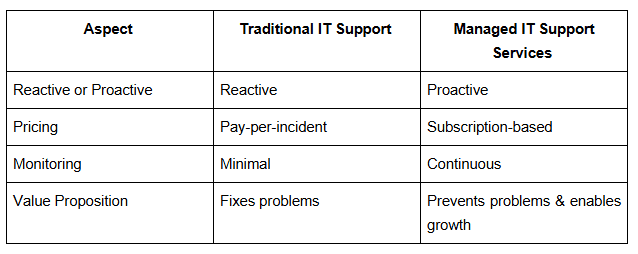
Today, business IT support must be agile, preventive, and closely aligned with strategic objectives, far beyond mere troubleshooting.
Modern businesses operate in an increasingly digital and unpredictable environment. The need for reliable IT support services has never been more critical, given the following shifts:
1. Remote and Hybrid Work Models:
With employees scattered across geographies, businesses must support a wide range of devices, networks, and communication platforms. IT support ensures seamless connectivity, secure access, and productivity for remote teams.
2. Escalating Cybersecurity Threats:
Cyberattacks are no longer a possibility, they're a certainty. From ransomware to phishing, businesses face daily threats. A strong IT support company embeds cybersecurity into every layer of operations, ensuring threat detection, response, and compliance.
3. Cloud Dependency and SaaS Integration:
Businesses now rely on dozens of SaaS tools, cloud storage, and virtual servers. Cloud-based IT support ensures these tools function flawlessly and scale with the business.
4. 24/7 Customer Expectations:
Customers expect round-the-clock access to your services. Downtime means lost revenue and damaged reputation. Managed IT support services proactively prevent disruptions and optimize uptime.
In this evolving landscape, IT support isn’t just about fixing glitches, it’s about enabling sustainable, secure, and scalable operations.
Improved Business Continuity & Reduced Downtime:
Downtime isn’t just frustrating, it’s expensive. Effective IT support services monitor systems 24/7 and intervene before minor issues become major disruptions. Automated backups and disaster recovery plans further ensure resilience.
Strengthened Cybersecurity Posture:
A proactive IT support company safeguards your systems with firewalls, endpoint protection, vulnerability assessments, and real-time monitoring. Compliance with industry standards (like GDPR, HIPAA) becomes easier, reducing legal and financial risks.
Boost in Employee Productivity & Satisfaction:
Employees depend on technology to do their jobs efficiently. When systems fail, productivity suffers. With prompt IT support and services, issues are quickly resolved, and employees stay focused on business goals.
Cost Optimization & Predictable IT Spending:
Managed IT support services typically operate on monthly subscriptions, providing predictable costs. They also reduce the need for expensive emergency repairs or unplanned downtime, helping control IT budgets more effectively.
Enhanced Customer Experience Through Seamless Tech:
Whether it's a website, mobile app, or customer support portal, technology is the front line of customer interaction. Well-maintained IT systems ensure smooth, fast, and reliable experiences, leading to higher customer satisfaction and loyalty.
The ROI of business IT support goes beyond cost-saving, it lies in business agility, performance, and peace of mind.
The landscape of IT support services is rapidly evolving, thanks to cutting-edge technologies and changing business demands.
1. AI-Powered IT Helpdesks & Chatbots:
Modern IT helpdesks are no longer human-only. AI chatbots handle tier-1 issues, password resets, ticket creation, basic troubleshooting, freeing human agents for complex tasks. AI also prioritizes and routes tickets intelligently.
2. Proactive Monitoring & Predictive Maintenance:
Traditional break/fix support is being replaced by proactive monitoring tools. These solutions detect anomalies and alert technicians before failures happen, reducing downtime and increasing equipment longevity.
3. Cloud-Based IT Support Tools:
Tools like cloud RMM (Remote Monitoring and Management) allow real-time, centralized control over distributed networks. Businesses benefit from faster incident resolution and improved scalability.
4. Cybersecurity as a Core Component of IT Support:
Security can no longer be siloed. Advanced IT support companies now include cybersecurity services like Zero Trust frameworks, EDR (Endpoint Detection & Response), and compliance audits as standard offerings.
5. Automation of Routine IT Tasks:
Routine maintenance, like patch updates, backups, and system scans, are increasingly automated. This not only reduces human error but also improves system health and security posture.
6. IT Support for Remote & Hybrid Workforces:
Support now spans multiple environments, home networks, cloud platforms, mobile devices. Businesses rely on tools like MDM (Mobile Device Management), VPNs, and secure file sharing, enabled and managed by IT support providers.
These trends signal a shift in mindset: from solving problems to designing infrastructure that avoids them.
In-house IT support offers immediate access and company-specific knowledge but can be expensive and limited in scalability.
Outsourced IT support services, on the other hand, provide specialized expertise, 24/7 monitoring, and cost efficiency. Providers stay current with the latest tools and threats, offering businesses a strategic advantage.
An emerging model - Co-Managed IT Support, blends both. Businesses maintain an internal IT team while collaborating with a managed IT provider for specialized or overflow support. This model offers flexibility, scalability, and continuous improvement.
The choice depends on your business size, complexity, and long-term goals, but managed IT support services often offer the best blend of cost-efficiency and cutting-edge support.
IT support isn’t just about keeping the lights on, it’s a springboard for innovation.
By automating routine tasks and handling day-to-day tech issues, IT support services free up internal teams to focus on core objectives. With a reliable IT backbone, businesses can confidently launch new products, adopt emerging technologies, and streamline operations.
Moreover, IT support helps businesses embrace digital transformation, moving from legacy systems to modern platforms that support scalability, agility, and data-driven decisions. Whether it’s transitioning to a hybrid cloud model or implementing real-time analytics, IT support makes innovation feasible.
A scalable IT support company grows alongside your business, removing technological roadblocks and enabling smooth expansion into new markets or verticals.
The right IT support partner can define your operational efficiency, security, and growth trajectory. Here’s what to look for:
Common Mistakes to Avoid:
Remember, the right IT support services partner is not just a vendor, they're an extension of your team.
Businesses embracing these trends will not just survive, they’ll thrive with technology at the core.
Redefining Business IT Support with Intelligence and Innovation:
At NextZen Minds, we don’t just fix issues, we future-proof your business.
As a trusted IT support company, we offer a comprehensive suite of IT support services tailored to meet your evolving needs. From cloud infrastructure to cybersecurity, helpdesk to automation, we ensure your technology works for you, not against you.
NextZen Minds is more than a managed IT support services provider, we’re your technology growth partner. Let us help you streamline operations, secure your systems, and innovate with confidence.
IT support services refer to technical assistance provided to businesses for managing and maintaining their IT systems, including hardware, software, networks, and data security.
Businesses need IT support to minimize downtime, safeguard digital assets, ensure data compliance, and enhance employee productivity through smooth technology operations.
Traditional IT support is reactive and pay-per-use. Managed IT services are proactive, subscription-based, and include monitoring, maintenance, and strategic IT management.
Yes, outsourcing is often more cost-effective than hiring a full-time internal team, offering 24/7 support, expert insights, and scalable services at a predictable cost.
IT support strengthens cybersecurity by implementing firewalls, antivirus, multi-factor authentication, regular updates, and continuous threat monitoring.
Absolutely. Small businesses gain access to expert help, modern tools, and enterprise-grade security without heavy upfront investments.
IT support is no longer a reactive cost center, it’s a strategic growth enabler. From improving security to ensuring business continuity, IT support services have become the backbone of modern business operations. Whether it’s managing cloud infrastructure, safeguarding against cyber threats, or empowering remote teams, the right IT strategy can transform how businesses operate and compete.
Businesses that treat IT support as a partner, not just a service, are better positioned for innovation, efficiency, and long-term resilience.
Reimagine how IT can power your business resilience and innovation.
With NextZen Minds, you're not just choosing IT support. You’re choosing transformation.