
AI Doesn't Scale on Models Alone: The Role of RAG in AI Development
June 16, 2026
June 16, 2026
.jpg)
Most enterprise RAG systems work in the demo and fall apart in production, and the failure is almost never the language model. Retrieval-augmented generation grounds an AI model in your own data, yet industry research suggests a large majority of enterprise RAG projects break before they deliver reliable value. This article explains what RAG is, how the pipeline works, when it beats fine-tuning, and the specific layers where it fails at scale. NZMinds builds RAG systems validation-first: prove retrieval quality on the real corpus before committing the stack, so the system that ships is the one that already works.
RAG is an architecture that retrieves relevant information from your own data at query time and feeds it to a language model before the model answers. The problem it solves is simple: a model only knows what it learned in training, which is finite, generic, and already stale. RAG gives the model an open-book exam instead of a closed-book one. The model's underlying capability stays the same, but it can now consult your documents, policies, and records before responding.
A standalone model recalls facts from its parameters and guesses when it does not know. A RAG system looks up the answer in a source you control, then grounds the response in what it found.
RAG connects a model to proprietary, frequently changing, or domain-specific information without retraining. That makes it the default pattern for enterprise generative AI solutions where answers must reflect current, internal truth.
An internal support assistant that answers from current policy documents, a customer-facing AI chatbot with RAG grounded in live product data, a research tool that cites source passages, and a compliance assistant that retrieves the exact clause it relies on. In each case the value comes from grounding answers in a controlled source rather than the model's general memory.
Related Read: How to Develop AI Applications: A Practitioner's Build Guide
A RAG pipeline has more moving parts than the three-word name suggests, and every arrow between them is a place answers can degrade. The headline steps are retrieve, augment, generate, but the steps before retrieval decide whether retrieval can succeed at all.
Raw documents are read and converted into clean, structured text. This is the most underrated stage. A parser that flattens a table into a row of pipe characters destroys meaning no downstream step can recover.
Documents are split into passages and converted into vectors that capture meaning. Chunk too large and retrieval gets noisy; too small and answers lose context.
The user query is embedded and matched against the vector store to pull the most relevant passages. A vector database for RAG stores and searches these embeddings at scale.
The retrieved passages are combined with the user question into a prompt, and the model generates an answer grounded in that evidence rather than its own memory. The instruction that frames those passages matters as much as the passages themselves: a weak prompt lets the model drift back to its training data and ignore the evidence you worked to retrieve.
Each handoff loses a little signal. Parsing can drop a table, chunking can split a sentence mid-thought, retrieval can rank the wrong passage first, and generation can over-summarize. A RAG system is only as strong as its weakest stage, which is why evaluating the pipeline stage by stage matters more than judging the final answer alone.
Many enterprise teams evaluate RAG and fine-tuning as if they are mutually exclusive approaches. In practice, a third architecture is becoming increasingly common: Agentic RAG.
Traditional RAG retrieves information and generates an answer. Fine-tuning modifies model behavior through additional training. Agentic RAG extends retrieval by allowing AI agents to reason through multiple retrieval steps, evaluate information sources, and perform actions based on retrieved data.
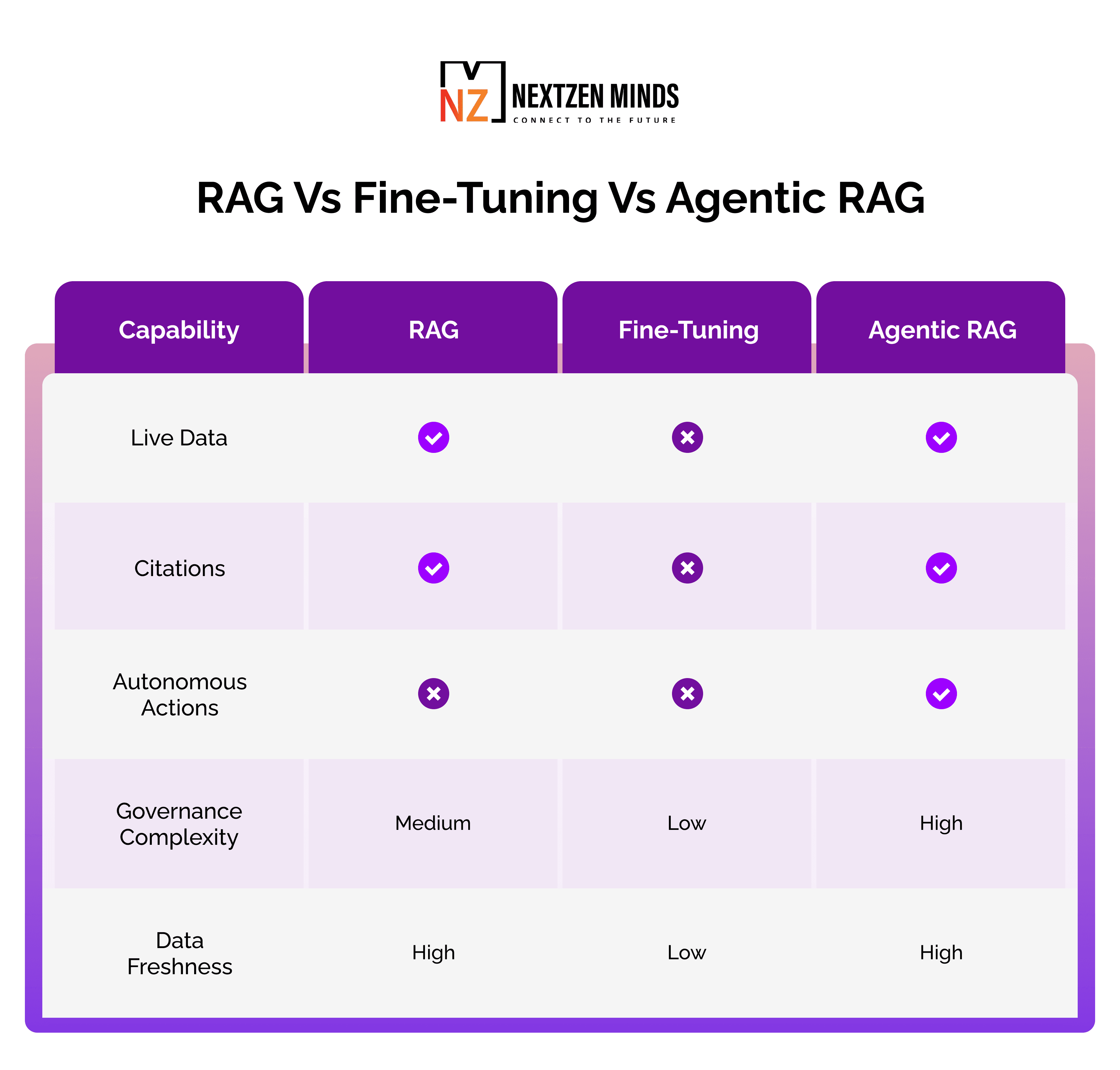
For most enterprise deployments, RAG remains the recommended starting point because it provides transparency, traceability, and faster implementation. Agentic architectures become valuable when the system must retrieve information, make decisions, and execute actions across multiple systems.
Most RAG failures occur long before the language model generates an answer. Industry research from enterprise AI adoption studies consistently shows that organizations struggle to move AI initiatives from pilot environments into reliable production systems. The challenge is rarely model capability. Instead, failures typically originate in data quality, retrieval effectiveness, governance controls, and operational monitoring.
The gap between a successful demonstration and a successful deployment is significant. Demo environments usually rely on a curated dataset, a limited set of user questions, and static content. Production environments introduce millions of documents, changing data sources, access-control requirements, ambiguous user intent, and strict latency expectations.
When retrieval quality declines, most RAG systems continue generating confident answers even when supporting evidence is weak or missing. This creates a dangerous illusion of accuracy. Organizations often respond by upgrading the model, but larger models cannot recover information that was never retrieved in the first place.
The most successful enterprise RAG deployments treat retrieval as an engineering discipline rather than a prompt-engineering exercise. Data quality, retrieval performance, source freshness, and governance become measurable system components rather than assumptions.
A demo runs on a small, clean dataset with simple queries and no time pressure. Production brings ambiguous queries, a sprawling corpus, latency limits, and changing source data. Retrieval quality drops, and a naive system keeps answering anyway, hiding the failure until users complain.
Teams blame the model and swap in a bigger one. The fault is usually in ingestion, retrieval, or freshness. A better model cannot fix evidence it never received.
RAG failures cluster into four layers. Most teams optimize the middle two and ignore the bookends, which is exactly where the damage starts. Each layer below lists the symptom, the cause, and the fix.
Symptom: confident answers from the wrong or outdated document. Cause: stale, poorly structured, or unverified source content producing weak embeddings. Fix: govern the knowledge base before tuning retrieval mechanics.
Symptom: plausible but incorrect answers. Cause: the right passage was never retrieved, often because short or vague queries miss it. Fix: hybrid search, reranking, and query expansion to raise recall.
Symptom: the answer blends two sources that disagree, with no indication why. Cause: no resolution policy when evidence conflicts. Fix: require per-claim citations and an explicit conflict-handling instruction.
Symptom: quality decays silently over weeks. Cause: no evaluation rig and no freshness tracking. Fix: treat retrieval evaluation and re-indexing as first-class engineering, not background tasks.
The pattern across all four. Three of the four layers fail before generation, yet teams spend most of their effort on the model. Naive RAG masks every one of these failures because it returns a confident answer regardless of whether retrieval succeeded. The discipline that prevents this is measuring each layer rather than trusting the fluent output at the end.
Retrieval quality is the single strongest predictor of production success in RAG development. Yet many teams evaluate only final answers and never measure whether the correct source information was retrieved in the first place.
At NZMinds, retrieval validation begins with a production-readiness scorecard.
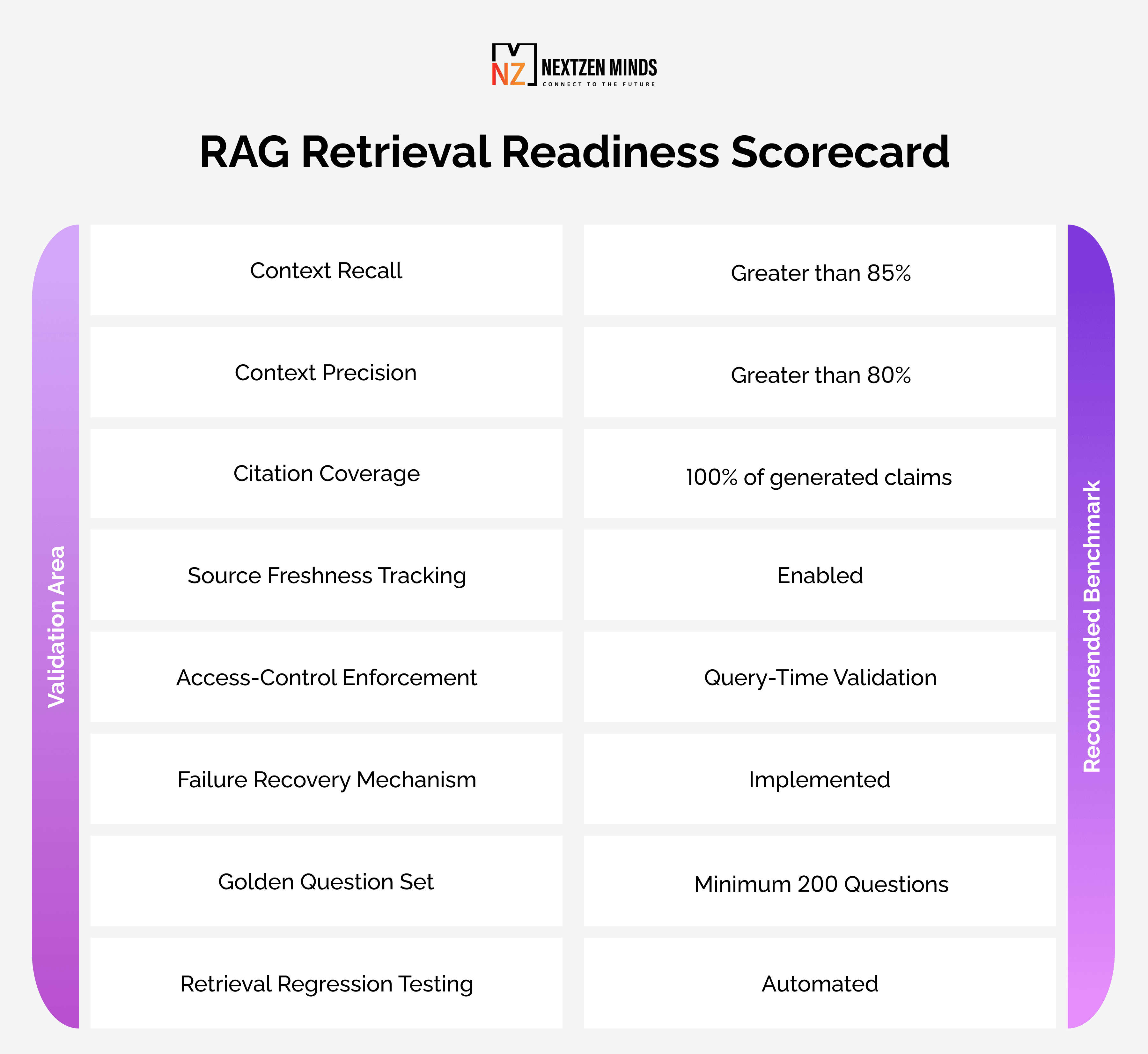
Organizations that establish measurable retrieval benchmarks before deployment can identify failures at the source layer rather than discovering them through user complaints after launch.
The objective is not simply generating fluent answers. The objective is reliably retrieving the information required to generate correct answers.
The teams that succeed assemble 200 or more real user questions with human-validated reference answers, not synthetic questions generated by another model. This is the rig that catches a recall regression before users do.
A single end-to-end score hides which layer failed. Measure retrieval and generation separately so a drop points to a cause.
RAG promises current answers, and that promise breaks quietly. A common production failure is a chatbot answering from a policy that changed months ago because the system never re-indexed it. The link works, the model answers fluently, and the number is wrong. Nothing on the dashboard tracked source freshness against retrieval, so no one noticed.
Every chunk needs an indexed-at timestamp carried through the pipeline. If you cannot answer when a chunk was last refreshed, you cannot trust answers built on it.
When retrieval confidence is low, return a no-answer or a clarifying question rather than letting the model guess. This is the Recovery behaviour the CTR framework requires, covered next.
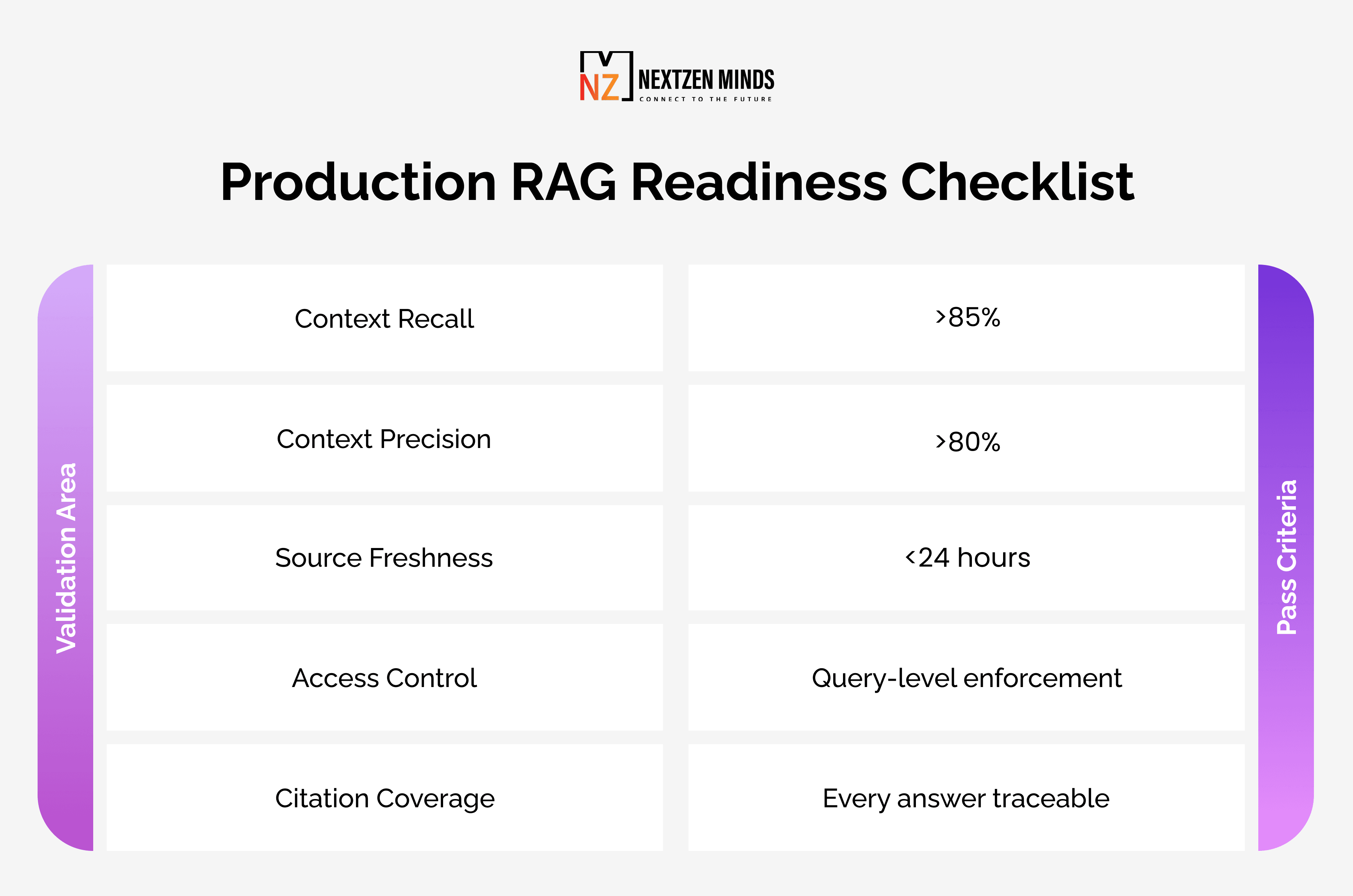
Before selecting a vector database, framework, or language model, enterprise teams should verify that the foundational requirements for retrieval are already in place.
Production Readiness Checklist:
✓ Knowledge sources identified and governed
✓ Structured and unstructured data inventory completed
✓ Document parsing validated for tables and forms
✓ Chunking strategy tested
✓ Retrieval evaluation framework established
✓ Golden dataset created
✓ Role-based access controls defined
✓ Source freshness monitoring enabled
✓ Citation requirements documented
✓ Recovery behavior defined for low-confidence retrieval
Many enterprise RAG initiatives fail because architecture decisions are made before retrieval readiness is validated. The order should be reversed. First validate the corpus. Then validate retrieval. Only then should implementation decisions be finalized.
Enterprise RAG touches sensitive, regulated, and access-controlled data, so governance cannot be an afterthought bolted on at the end. Access must be enforced at query time: a retrieval call should return only what the requesting user is permitted to see. NZMinds structures this with the Control-Transparency-Recovery framework, which gives RAG the same layered safety we apply to every agent we build.
Building RAG on regulated data?
NZMinds designs enterprise RAG with least-privilege retrieval, source traceability, and fail-safe recovery built in from the first commit. Ask us for a scoped architecture review.
The validation-first approach to RAG is straightforward: prove retrieval quality on your real corpus before you commit to the stack. NZMinds calls this Scope-Before-Stack. Most RAG failures trace back to teams building the full pipeline on faith, then discovering at scale that retrieval on their actual documents never cleared the bar.
Assemble the golden question set, measure recall and precision against the live corpus, confirm the parser preserves tables and structure, and only then commit to vector store, model, and interface choices.
The cheapest RAG system to fix is the one you scoped correctly before building. Validation is not overhead; it is the work that prevents the 80 percent failure outcome.
Building RAG with NZMinds follows the build-measure-validate loop. We start from the question the system must answer, measure whether retrieval can answer it on your data, and validate each layer before adding the next. The worked example below shows the sequence. It is hypothetical and illustrates method, not a client result.
Why the sequence matters.
Retrieval quality is proven on the real corpus first, and the stack is committed second. That order is what separates a RAG system that survives production from one that demos well and dies.
Successful RAG implementations in AI development begin with a business problem, not a technology stack. Before selecting a vector database, framework, or model provider, organizations should verify that retrieval can consistently locate the information required to answer real user questions.
The most common mistake in RAG development is building first and validating later. Production-ready systems reverse that order. Retrieval quality is measured before deployment, source freshness is monitored continuously, and governance controls are designed into the architecture from the beginning.
If your organization is evaluating enterprise RAG solutions, start by testing retrieval quality on your existing corpus. A small, validated question set can reveal more about deployment success than any benchmark comparison or vendor demonstration.
The organizations achieving the strongest outcomes with RAG are not necessarily using the largest models. They are the organizations that validate retrieval, governance, and operational readiness before scaling implementation.
The first move.
Assemble a small golden set of real questions and measure retrieval against your documents. That single step tells you more about your RAG project's odds than any vendor benchmark.
A: For most enterprise use cases, yes, as a starting point. RAG keeps answers current, supports source citations, costs less upfront, and reaches production faster. Fine-tuning is better when you need consistent tone or format, or a small high-volume model. Many mature systems use both. NZMinds helps teams decide which fits before they build.
A: Most failures sit upstream of the model. Poor source data, weak retrieval, missing evaluation, and stale indexes cause confident wrong answers. A demo on clean data hides these problems; production exposes them. The fix is governing data quality, measuring retrieval recall and precision, and tracking source freshness rather than swapping in a bigger model.
A: RAG has lower upfront cost than fine-tuning because it needs no training compute, but ongoing costs include vector storage, embeddings, and engineering time for evaluation and re-indexing. The real cost driver is rework from skipping validation. Scoping retrieval quality before building is the cheapest way to control total cost.
A: A vector database is one component inside a RAG system. It stores and searches the embeddings used during retrieval. RAG is the full architecture: ingestion, chunking, embedding, retrieval, augmentation, and generation. The vector database handles the search step; it does not handle parsing, evaluation, or generation.
A: Measure retrieval and generation separately. For retrieval, track context recall and context precision against a golden set of real questions with validated answers. For generation, check whether claims are grounded in the retrieved sources. A single end-to-end score hides which layer failed, so component-level evaluation is essential.
A: Yes, when access control is enforced at query time so retrieval returns only what the user is permitted to see. NZMinds applies the Control-Transparency-Recovery framework: least-privilege retrieval, source traceability, and fail-safe recovery on low-confidence answers. For BFSI and healthcare data, this layered control is the starting point, not an add-on.