IT Staff Augmentation: How to Scale Engineering Teams Without the Hiring Delay
November 8, 2026
November 8, 2026

Key Takeaways
Introduction
Technology roadmaps rarely slow down because engineering teams lack ambition. More often, the challenge is execution.
A product launch moves forward. A cloud migration becomes business-critical. An AI initiative enters the roadmap. A new integration creates unexpected demand. Yet the engineering team expected to deliver these priorities is already operating near its limits.
The immediate response is often straightforward:
We need more developers.
But adding people is not always the same as removing the constraint.
Before expanding an engineering team, technology leaders need to understand what is actually limiting execution.
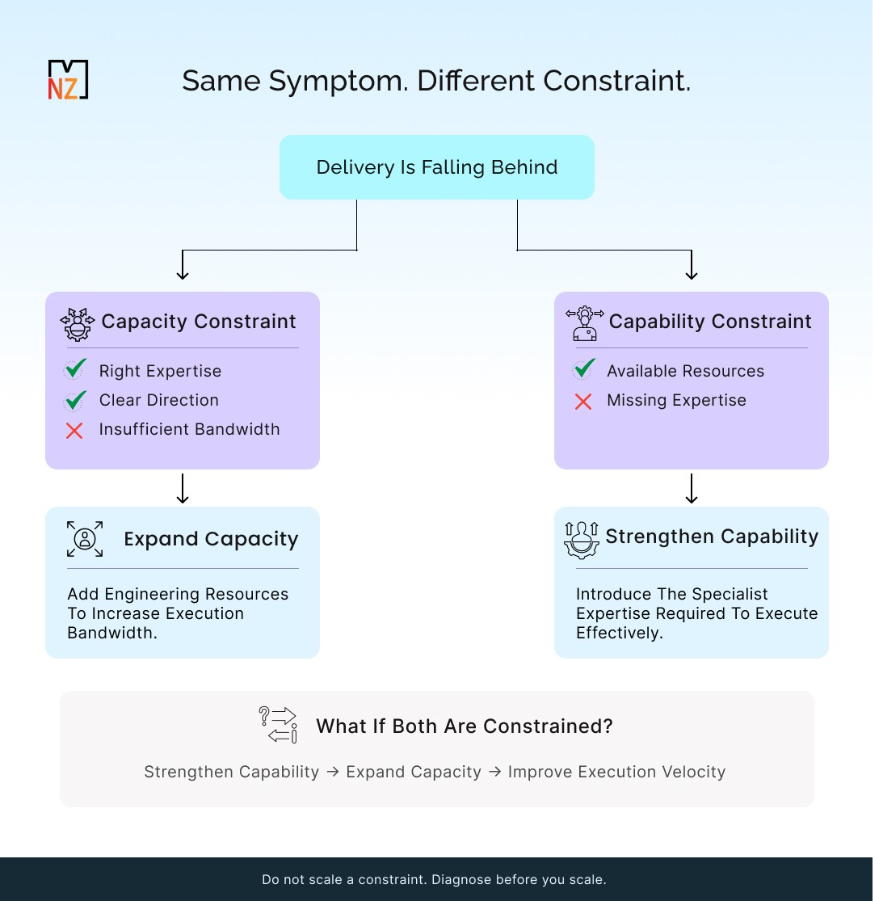
Is it a capacity constraint- the team has the right expertise but not enough bandwidth?
Or a capability constraint: the organisation lacks the specialist expertise, technical maturity, architecture knowledge, or transformation experience required?
Sometimes, it is both.
IT staff augmentation can address these gaps by bringing external engineers into an existing delivery environment without immediately expanding permanent headcount.
But it is not a universal solution.
The more important question is not:
“How quickly can we add engineers?”
It is:
“What is preventing our engineering organisation from delivering what the business needs?”
This guide explores where IT staff augmentation fits, when it works, what it costs, how to evaluate a partner, and how to determine whether additional capacity or capability is actually the right intervention.
IT staff augmentation is a flexible engineering model that allows organisations to add external technology professionals to an existing team for a defined requirement or period.
Unlike project outsourcing, augmented engineers typically work within your organisation's existing tools, sprint cadence, development processes, and technical leadership.
In practical terms, you are extending the team rather than handing the work to a separate delivery organisation.
Staff augmentation can support product releases, cloud migrations, application modernisation, AI and data initiatives, customer integrations, compliance requirements, or temporary increases in development demand.
It can also solve two different types of engineering constraints.
When the existing team has the expertise but lacks sufficient bandwidth, augmentation can expand capacity.
When the team has people available but lacks specialised expertise, such as AI/ML, cloud, cybersecurity, DevOps, or data engineering, it can introduce capability.
The distinction matters because the solution should follow the constraint.
More people can address a bandwidth problem. The right expertise can address a capability problem.
And when both are constrained, simply increasing headcount may not be enough.
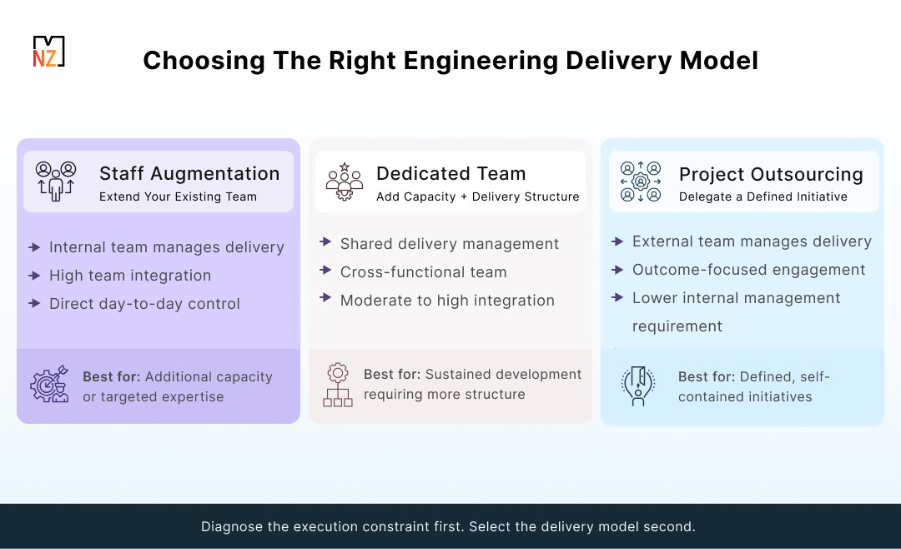
Staff augmentation, dedicated teams, and project outsourcing all provide access to external technology talent, but they differ in ownership, management responsibility, and integration.
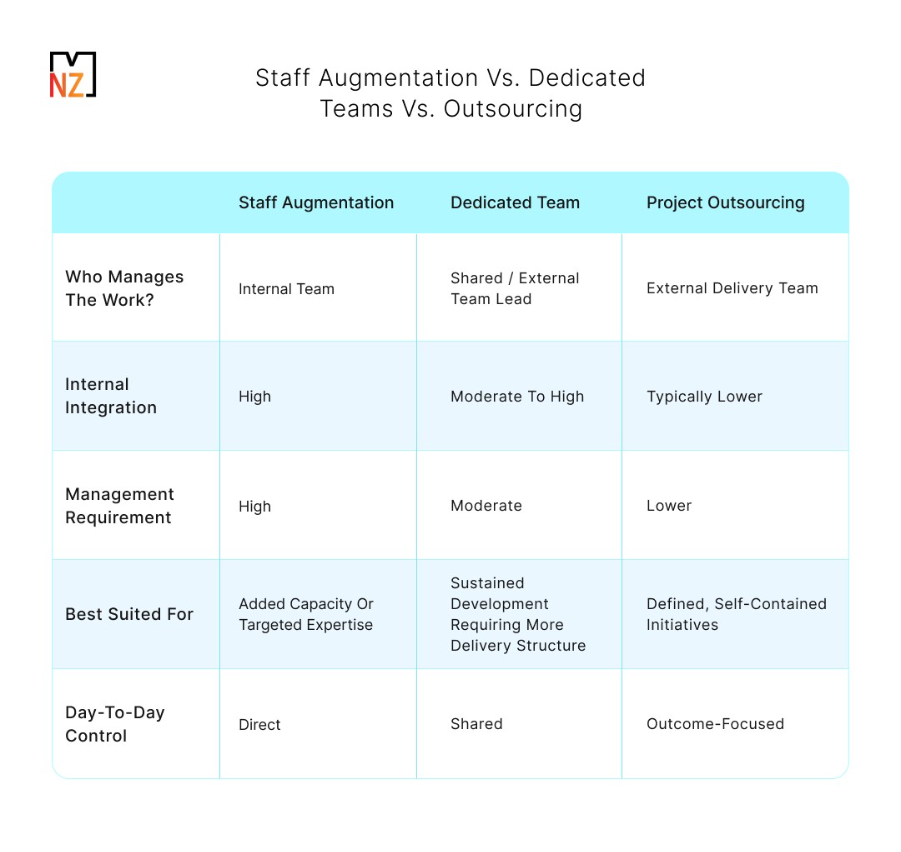
With staff augmentation, your organisation retains direct control over priorities, architecture, and delivery.
A dedicated team can provide engineering capacity alongside greater delivery structure and management support.
With project outsourcing, more responsibility for executing an agreed scope shifts to the external provider.
There is no universally superior model.
The appropriate choice depends on what your organisation already has, and what it is missing.
Diagnose the execution constraint first. Select the delivery model second.
Staff augmentation works best when additional engineers can enter a delivery environment that is ready to use them effectively.
When It Works
You need more execution bandwidth.
The architecture, roadmap, technical leadership, and required expertise are in place, but the existing team cannot absorb the workload.
You need targeted expertise.
The team is capable overall but lacks specialist knowledge required for a particular initiative.
Business timelines cannot wait for permanent hiring.
A launch, migration, regulatory requirement, or new customer demand creates a defined need for additional engineering resources.
You want to validate a capability before building it internally.
External specialists can support an emerging technical requirement while the organisation determines whether it needs that capability permanently.
Staff augmentation becomes less effective when the bottleneck is not engineering headcount.
If product direction is unclear, architecture decisions remain unresolved, or requirements constantly change, adding developers may create more activity without more progress.
The same applies when engineering leadership is already overloaded. External engineers still require onboarding, prioritisation, technical direction, code reviews, and feedback.
The organisation can therefore end up with more development capacity but insufficient leadership capacity to use it.
Staff augmentation may also be the wrong choice when a role requires deep institutional knowledge or long-term ownership. In those situations, permanent capability building may make more sense.
Before augmenting, ask three questions:
What is the constraint?
Bandwidth, expertise, or both?
Is the work ready?
Are priorities, ownership, architecture, and expected outcomes sufficiently clear?
Can the organisation absorb additional engineers?
Does the team have the leadership and processes required to make them productive?
If those answers are clear, staff augmentation becomes a targeted intervention rather than simply a faster form of hiring.
There is no single standard price for IT staff augmentation.
Cost varies based on engineer seniority, technical specialisation, location, engagement duration, and the support included by the provider.
But the headline rate tells only part of the story.
A more useful question is:
“What will it cost us to add the capacity or capability we actually need?”
Seniority and expertise: Senior engineers, architects, and specialists typically carry higher rates than generalist or less experienced developers.
Technical specialisation: Skills in areas such as AI/ML, cybersecurity, cloud architecture, data engineering, or DevOps may carry different pricing from more widely available development skills.
Location: Onshore, nearshore, and offshore models have different cost structures, along with different considerations around working-hour overlap and collaboration.
Duration and structure: One specialist for a short engagement has a different commercial profile from several engineers supporting a longer programme.
Also Read: A Detailed Guide on AI & ML Development Services: Unlocking Intelligent Business Solutions
The organisation also needs to consider internal costs such as onboarding, management time, code review, security access, coordination, and ramp-up.
This is why comparing an augmented engineer's rate directly with an employee's salary can be misleading.
The better measure is total execution cost.
Ask:
The cheapest resource is not necessarily the lowest-cost path to delivery.
Choosing among staff augmentation companies should involve more than comparing CVs, rates, and availability.
A strong partner should understand why you need the engineer, not simply which role you want filled.
A transactional provider asks:
“What role do you need?”
A technology partner should also ask:
“What are you trying to deliver, and what is preventing the current team from getting there?”
The answer may reveal a capacity shortage, a capability gap, overloaded leadership, or another delivery constraint.
Technical evaluation should reflect the actual requirement.
For a capacity gap, you may prioritise engineers who can quickly become productive in the existing stack.
For a capability gap, specialist depth and experience solving similar problems become more important.
The question is not simply whether the engineer is qualified. It is whether they are qualified for the constraint you need to remove.
Speed matters, but relevance matters more.
Receiving ten loosely matched profiles quickly can create more work for your internal team.
The objective should be:
Speed to relevant talent, not simply speed to CV.
Clarify how engineers will fit into sprint planning, development workflows, code reviews, documentation standards, communication channels, and security requirements.
Also establish where the provider's responsibility ends and your team's management responsibility begins.
Technology requirements change.
You may initially need additional capacity and later require specialist capability. Or an engagement may need to evolve toward a dedicated team as management requirements increase.
A useful staff augmentation model should be able to adapt as the constraint changes.
Adding an engineer increases headcount immediately.
It does not increase productive capacity immediately.
Even experienced engineers need context around your architecture, codebase, development standards, tools, security requirements, business priorities, and ways of working.
A practical onboarding process moves through four stages:
The progression is straightforward:
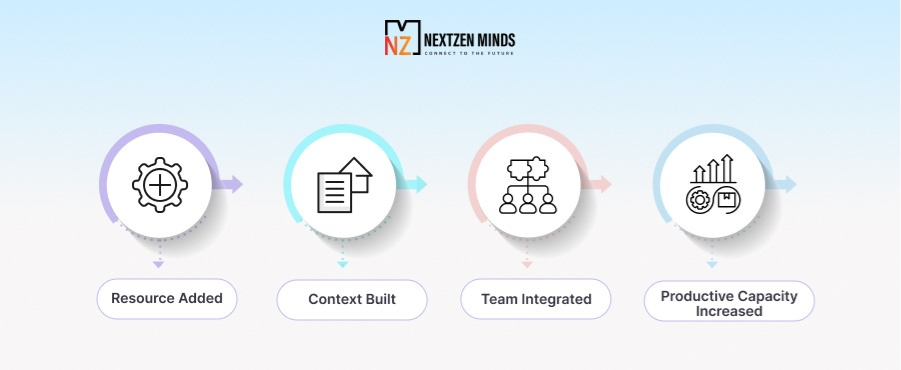
Good onboarding is therefore not simply an HR or administrative process.
It is part of engineering execution.
Also Read: Custom AI Development vs Off-the-Shelf AI: When to Build and When to Buy - The NZMinds Decision Framework
Staff augmentation can increase engineering capacity quickly, but its effectiveness depends on how and where it is applied. When organisations add resources without first understanding the underlying delivery constraint, they can increase headcount without improving execution.
The following mistakes can limit the impact of staff augmentation.
Slower delivery does not automatically mean the organisation needs more developers.
Architecture, technical debt, missing expertise, unclear requirements, or overloaded leadership can all create similar symptoms.
Diagnose before you scale.
Adding engineers to unclear work rarely makes the work clearer.
Before expanding the team, establish sufficient clarity around priorities, technical ownership, dependencies, and expected outcomes.
Staff augmentation does not remove management responsibility.
If technical leaders are already overloaded, every additional engineer can increase coordination pressure.
In that situation, another delivery model with stronger management support may be more appropriate.
The engagement should not be considered successful simply because the requested engineers started on time.
Ask whether roadmap delivery is becoming more predictable, pressure on the internal team is decreasing, and the original constraint is actually being removed.
Measure the outcome of added capacity, not simply the presence of additional resources.
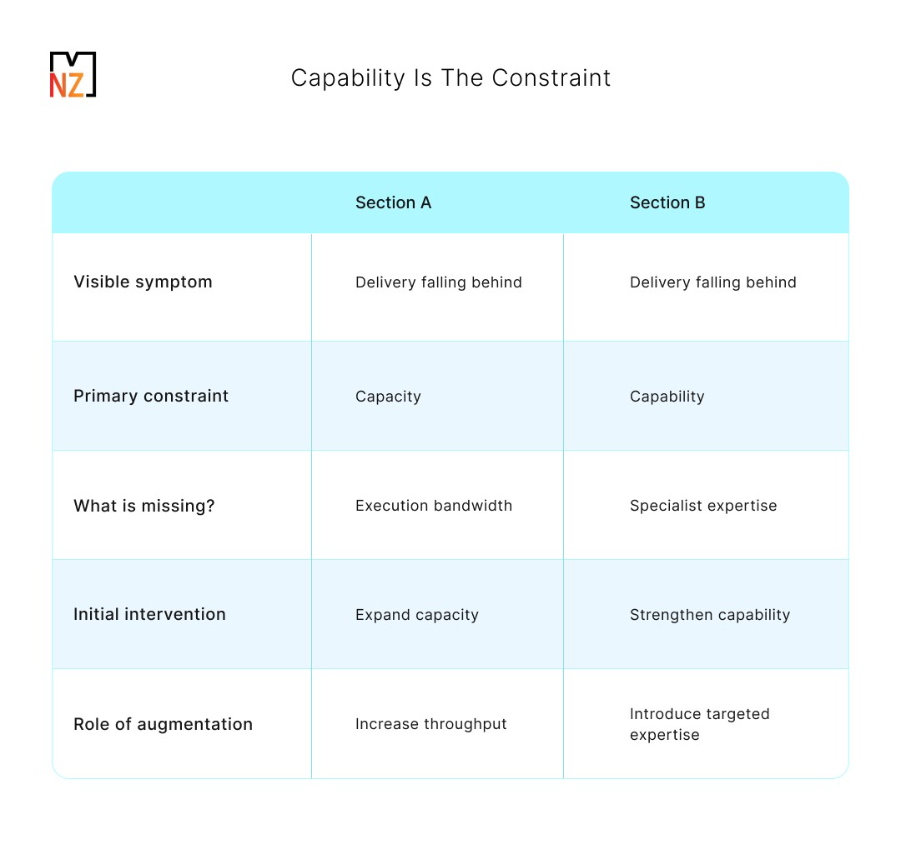
Consider two organisations experiencing the same symptom:
Engineering delivery is falling behind the business roadmap.
A SaaS team has established architecture, clear requirements, strong technical leadership, and the expertise required for an upcoming release.
But additional integrations have increased the workload beyond what the existing team can absorb.
Additional engineers who can integrate with the existing technology stack may help expand delivery throughput.
Another organisation is beginning a cloud modernisation programme.
Developers are available, but the team has limited experience with cloud-native architecture and complex migration planning.
The visible symptom is again slower delivery.
But this time, adding generalist developers may not solve it.
The organisation first needs capability, specialist expertise that can strengthen its technical direction.
And sometimes both are constrained.
In those situations, the sequence matters:
The lesson is simple:
Do not scale a constraint.
At NZMinds, staff augmentation is considered as one possible intervention within a broader Capacity & Capability approach.
We start with the execution problem.
What is preventing the technology organisation from delivering?
Does the team need more bandwidth?
Is specialist expertise missing?
Does engineering leadership have enough capacity to manage additional resources?
Is this a temporary requirement, or a capability the organisation needs to own long term?
Once the constraint is understood, the delivery model becomes easier to determine.
Staff augmentation can extend an established team when additional bandwidth or targeted expertise is required.
A dedicated team may provide a better fit when capacity needs to increase alongside delivery structure and management support.
Permanent hiring may make more sense when long-term ownership and institutional capability are the priority.
The principle remains:
Do not start with the delivery model. Start with the constraint.
Staff augmentation is not the destination. It is one lever technology leaders can use to improve execution when the diagnosis shows that additional capacity or targeted capability is required.
Q1. What is IT staff augmentation?
IT staff augmentation allows external engineers to join an existing technology team for a defined requirement or period. They typically work within the organisation's tools, processes, sprint cadence, and technical leadership.
Q2. What is the difference between staff augmentation and outsourcing?
Staff augmentation adds engineers to your existing team under your management. With project outsourcing, an external provider takes greater responsibility for managing and delivering an agreed scope.
Q3. How long does it take to onboard a staff augmentation engineer?
It depends on the role, codebase, domain, and technical environment. Effective onboarding should provide access and context quickly, followed by defined work and progressive integration into normal delivery.
Q4. Is staff augmentation cheaper than permanent hiring?
Not necessarily. Cost depends on expertise, geography, duration, and management requirements. Staff augmentation can offer flexibility for temporary capacity or specialist needs, while permanent hiring may make more sense for long-term ownership.
Q5. Can staff augmentation provide specialist technical expertise?
Yes. It can provide targeted capabilities such as AI/ML, cloud, DevOps, cybersecurity, data engineering, and specialised technology-stack expertise.
Q6. What should I look for in an IT staff augmentation company?
Evaluate technical vetting, relevant experience, integration approach, collaboration model, flexibility, and whether the provider understands the execution problem before recommending resources.
Q7. Scale the Constraint, or Remove It?
When engineering demand increases, adding people can seem like the obvious response.
Sometimes it is.
But more headcount does not automatically create more execution velocity. The organisation may need additional bandwidth, specialist expertise, stronger delivery capability, or a combination of these.
That is why the most important decision happens before the staffing model is selected.
Do not treat every technology execution problem as a hiring problem.
Diagnose the constraint. Strengthen what is missing. Then scale what works.

Resources