
How to Hire AI Developers in 2026: Vetting, Costs, and Sourcing Strategies
June 9, 2026
June 9, 2026
.jpg)
Artificial intelligence is no longer an experimental technology sitting inside innovation labs. In 2026, it is being used to automate customer service operations, process insurance claims, assist medical professionals, optimize supply chains, generate software code, analyze financial risk, and power intelligent business workflows across industries.
As adoption accelerates, one challenge continues to surface across startups, enterprises, and growing businesses in Singapore:
How do you actually hire the right AI talent?
The answer is not as straightforward as it appears.
Thousands of developers now claim AI expertise. Many have completed online courses, experimented with large language models, or built chatbot demos. Yet only a small percentage have experience deploying AI systems into production environments where reliability, cost control, governance, security, and business outcomes matter.
This gap is creating a significant hiring problem.
Organizations often spend months recruiting AI engineers only to discover that the person they hired can build a prototype but struggles when the project needs to scale, integrate with existing systems, or operate safely with real business data.
Learning how to hire AI developers in 2026 requires a completely different mindset than traditional software hiring.
The goal is no longer finding someone who understands machine learning concepts.
The goal is finding someone who can deliver business outcomes with AI.
At NZMinds, we help companies (see how) across Singapore and international markets build AI products, deploy AI agents, and scale AI-powered platforms. Through that experience, we've seen what separates successful AI hires from expensive mistakes.
This guide walks through the exact framework businesses can use to identify the right talent, avoid common hiring traps, and make informed decisions about costs, sourcing strategies, and technical vetting.
A decade ago, software hiring focused primarily on coding ability.
Companies evaluated programming languages, frameworks, and development experience.
That model no longer works for AI hiring.
Today's AI systems involve far more than writing code.
A modern AI application may include large language models, retrieval systems, vector databases, orchestration frameworks, evaluation pipelines, prompt engineering strategies, monitoring systems, security controls, and governance layers.
The complexity has shifted.
The hardest part is no longer building software.
The hardest part is making the right decisions.
Consider two candidates.
Both can build a chatbot.
Candidate A can connect an API to a frontend interface and generate responses.
Candidate B can explain:
Both candidates technically "know AI."
Only one is likely to succeed in production.
This distinction matters because AI projects now touch core business processes.
A poorly designed recommendation engine may affect revenue.
A flawed AI support system may damage customer experience.
An autonomous agent with excessive permissions could trigger operational issues across multiple departments.
The financial impact of a bad hire has increased significantly.
In traditional software projects, mistakes often affect a single feature.
In AI projects, mistakes can influence thousands of decisions every day.
That is why hiring AI talent has become less about technical syntax and more about engineering judgment.
The best AI developers think like product builders, system architects, and risk managers simultaneously.
They understand that model accuracy is only one piece of the puzzle.
Scalability, cost, governance, reliability, and user experience matter just as much.
For businesses in Singapore, this is especially relevant.
Many organizations operate in regulated industries such as healthcare, financial services, insurance, logistics, and education. These sectors require careful handling of data, explainable decision-making, and strong operational controls.
An engineer who has only built experimental AI projects may struggle in these environments.
An engineer who has deployed production AI systems understands these realities from day one.
One of the most expensive hiring mistakes happens before recruitment even begins.
Companies decide they need an AI developer.
They start posting job descriptions.
They begin reviewing resumes.
Yet nobody has clearly defined what needs to be built.
This sounds obvious, but it happens constantly.
Many businesses are solving for talent before solving for clarity.
The result is predictable.
They hire the wrong person.
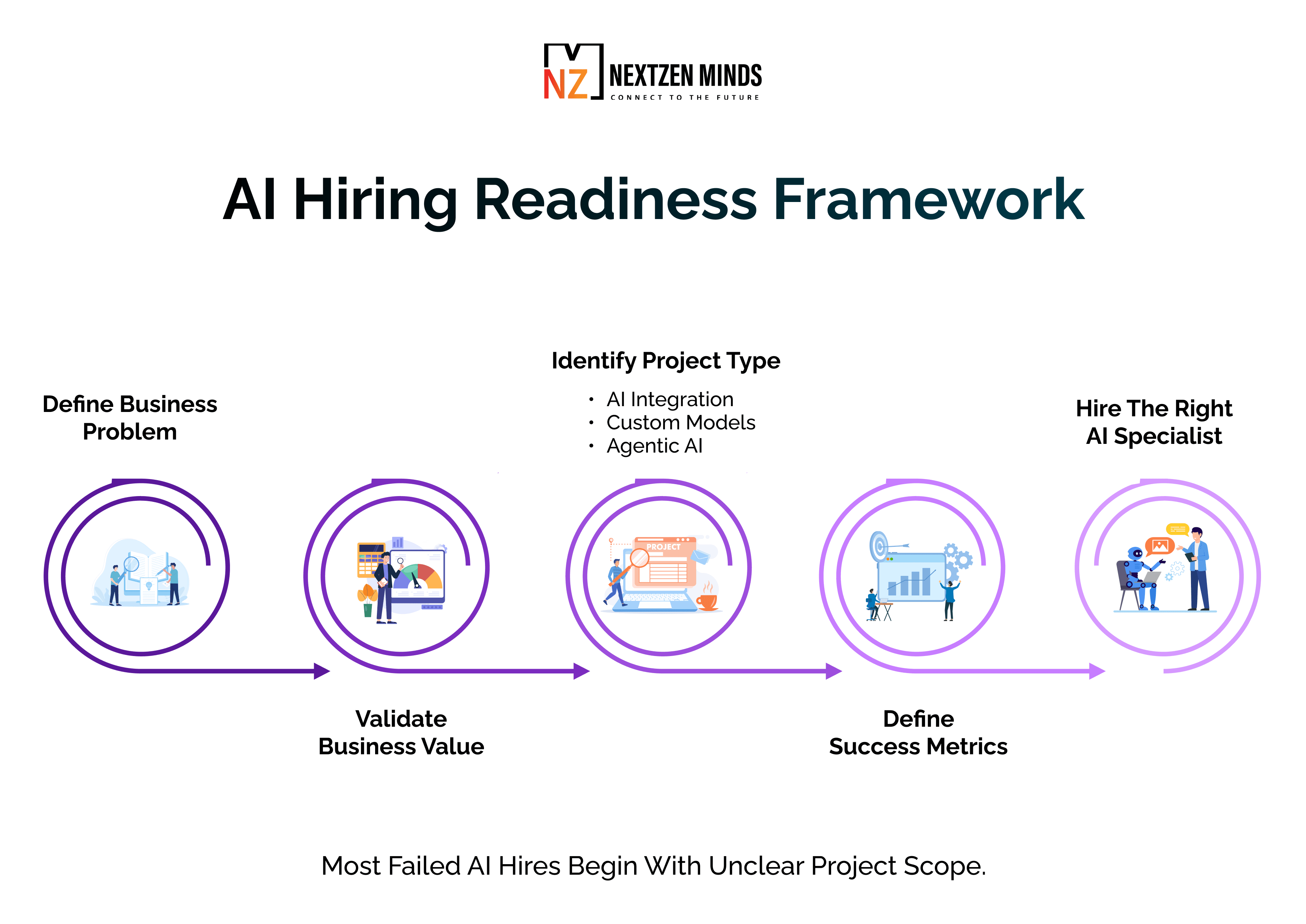
Before evaluating candidates, define the project.
Most AI initiatives fall into one of three categories.
These projects use existing foundation models from providers such as OpenAI, Anthropic, Google, or Meta.
The primary challenge is not building models.
The challenge is integrating them into workflows, applications, and business processes.
Examples include:
For these projects, companies often need strong product-oriented engineers rather than machine learning researchers.
These initiatives require proprietary data, specialized training, or domain-specific optimization.
Examples include:
These projects demand expertise in machine learning pipelines, data preparation, evaluation methodologies, and model lifecycle management.
Agentic systems represent one of the fastest-growing AI categories in 2026.
Unlike traditional AI applications, agents can:
Building these systems requires specialized knowledge around orchestration, permissions, state management, observability, and recovery mechanisms.
Companies planning to hire agentic AI developers must recognize that these requirements differ significantly from standard AI integration projects.
This is why role definition matters so much.
A company building an AI-powered document assistant does not necessarily need the same engineer as a company building autonomous procurement agents.
The technology may sound similar.
The skills required are not.
Before hiring anyone, answer one question:
"What business outcome are we trying to improve?"
If the answer is unclear, hiring should wait.
The most successful AI initiatives begin with a business objective.
Reduce support costs.
Increase conversion rates.
Improve operational efficiency.
Accelerate document processing.
Lower fraud risk.
The objective comes first.
The technology follows.
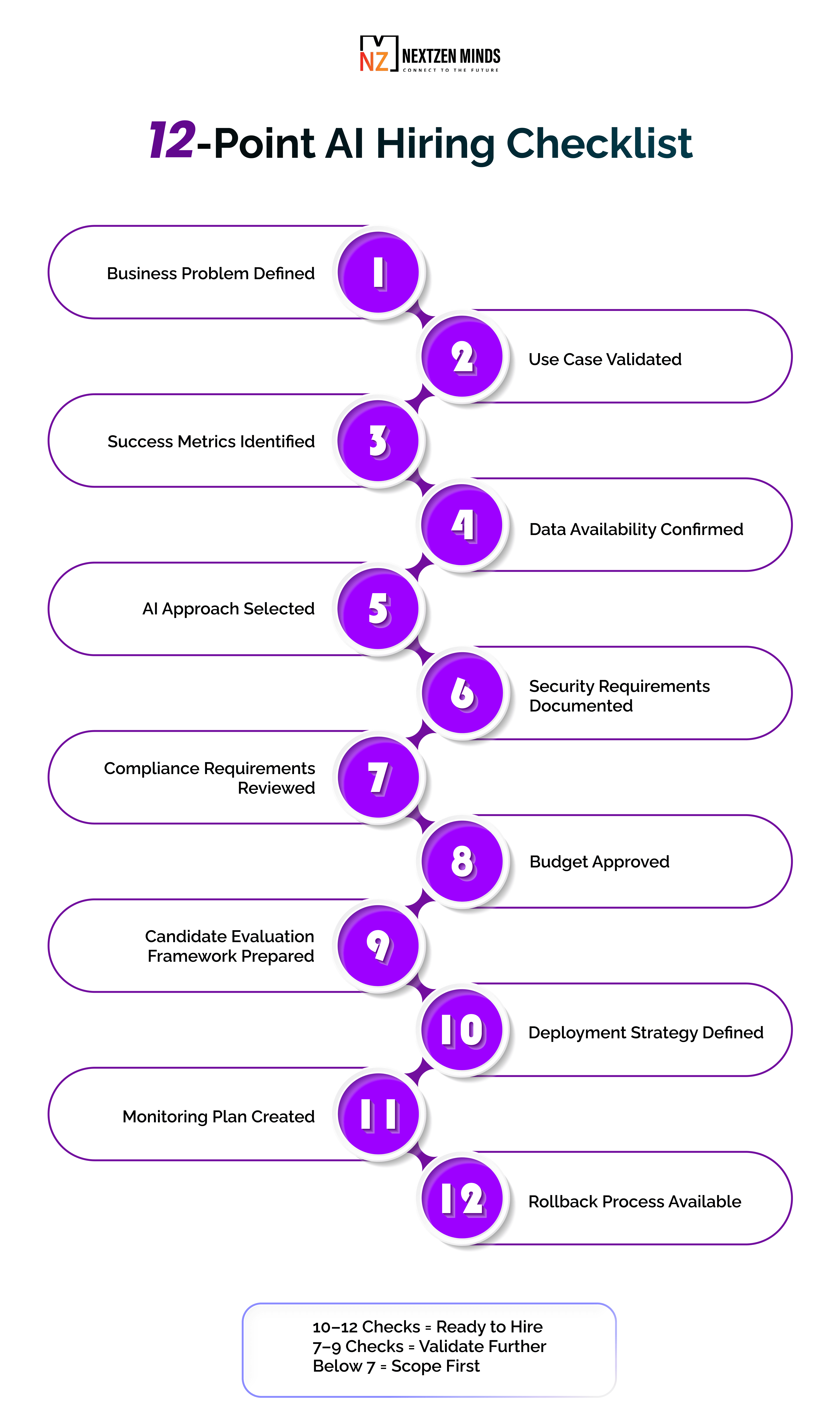
At NZMinds, we frequently see companies attempting to hire before validating the use case. In many situations, a short validation exercise reveals that the project requires fewer resources, different expertise, or an entirely different technical approach.
Hiring becomes dramatically easier when the destination is clear.
Related Read: Agentic AI governance framework for startups and product teams. 3-layer approach to prevent catastrophic failures
Founders often search for guidance on how to hire AI engineers because startup hiring presents a unique challenge.
Resources are limited.
Timelines are aggressive.
Every hire has outsized impact.
In these situations, many founders make a costly assumption.
They believe they need the most technically advanced AI expert they can find.
In reality, early-stage companies usually need builders.
There is a significant difference between a researcher and a builder.
Researchers excel at advancing models.
Builders excel at shipping products.
Most startups need the second category.
When evaluating candidates, look for evidence that they can:
They care less about theoretical perfection and more about solving customer problems.
This distinction becomes especially important for founders reading guides about how to hire AI engineers startup guide strategies.
The temptation is often to recruit for future complexity.
The smarter approach is recruiting for current needs.
Suppose a startup wants to launch an AI-powered customer onboarding platform.
Hiring a highly specialized machine learning researcher may seem impressive.
But if the product primarily relies on existing foundation models, that expertise may go unused.
A full-stack AI engineer capable of building, testing, deploying, and iterating the product could create significantly more value.
The specialist can always be hired later.
The builder creates momentum today.
Another characteristic worth prioritizing is commercial awareness.
Strong startup AI engineers understand that technical decisions affect business outcomes.
They consider infrastructure costs.
They evaluate model usage expenses.
They think about scalability before problems emerge.
They understand that an elegant technical solution that destroys profitability is not actually a solution.
This mindset becomes increasingly important as AI adoption scales.
Founders should also pay attention to communication skills.
The best engineers can explain complex ideas simply.
If a candidate cannot clearly describe what they built, why they built it, and what challenges they encountered, collaboration becomes difficult.
Technical brilliance without communication often creates friction.
The strongest startup hires combine technical capability with business understanding.
That combination is far more valuable than credentials alone.
One of the most misunderstood areas of AI hiring involves custom model development.
Many companies assume that building custom models automatically creates competitive advantage.
In reality, most projects fail long before model training becomes the challenge.
The real problem is usually data.
Poor-quality data creates poor-quality models.
Unfortunately, many organizations spend weeks evaluating engineers while spending only a few hours evaluating the data that will ultimately determine project success.
This is one reason businesses researching how to hire a reliable ai engineer for custom models often end up hiring the wrong profile.
They focus heavily on machine learning theory and overlook operational experience.
A reliable AI engineer for custom models should be able to discuss the entire lifecycle of model development, not just model training.
That lifecycle includes:
When reviewing portfolios, pay attention to the types of projects candidates have worked on.
A common red flag is a portfolio filled with notebooks and academic experiments but lacking production deployments.
There is nothing wrong with experimentation.
However, experimentation and production engineering are very different disciplines.
A production engineer understands that models degrade over time.
User behavior changes.
Business requirements evolve.
Data quality fluctuates.
Regulatory expectations shift.
The real challenge is not getting a model to work once.
The real challenge is ensuring it continues working six months later.
When evaluating candidates, look for evidence of:
Evaluation Frameworks
How did they measure success?
Did they create benchmarks?
How did they detect quality degradation?
Strong engineers discuss metrics confidently because they know performance cannot be managed without measurement.
Cost Awareness
Can they explain infrastructure costs?
Did they optimize inference expenses?
How did they balance accuracy against operational cost?
The best AI engineers understand that budgets are technical constraints.
Monitoring Experience
What happened after deployment?
How did they detect failures?
What alerts existed?
What reporting systems were in place?
Many candidates can build models.
Far fewer can operate them.
Business Understanding
Can they connect technical decisions to business outcomes?
A reliable engineer understands why the project exists in the first place.
They don't optimize metrics in isolation.
They optimize outcomes.
Certain responses should immediately trigger deeper questioning.
Be cautious when candidates:
The ability to run systems safely and efficiently matters more than theoretical expertise alone.
The AI hiring market is crowded with developers who can assemble impressive demonstrations.
The problem is that demonstrations rarely reveal how someone performs when real customers, real workloads, and real business consequences enter the picture.
This is why interview structure matters.
Instead of asking technical trivia questions, focus on practical scenarios.
"Tell me about a time you reduced the cost of an AI system."
This question reveals whether the candidate has worked with production budgets.
A strong engineer may discuss:
A weak candidate often struggles because they have never been responsible for operational costs.
In 2026, cost management is a core AI engineering skill.
"How would you handle latency if AI responses became too slow?"
Customers expect responsiveness.
Business users expect efficiency.
Strong candidates may discuss:
Weak candidates typically focus only on model performance.
Production engineers understand user experience matters just as much.
"What happens when the model produces incorrect or unsafe output?"
This question often reveals the largest difference between experienced engineers and inexperienced ones.
Strong candidates discuss:
Weak candidates assume the model will simply perform correctly.
That assumption becomes dangerous in production environments.
The best AI engineers expect failures.
Then they design systems that recover safely.
Despite increased market maturity, the same mistakes continue appearing across organizations.
Many companies decide they need AI.
Then they hire engineers.
Then they try to determine what to build.
The sequence should be reversed.
Validate first.
Hire second.
Terms such as:
But excitement does not define requirements.
Focus on business outcomes rather than technology labels.
Startups frequently recruit highly specialized experts before achieving product validation.
This increases costs without necessarily accelerating progress.
Prioritizing Cost Over Capability
Every business wants efficiency.
However, choosing the lowest-cost candidate often becomes expensive when projects require rework.
The goal is value, not simply lower rates.
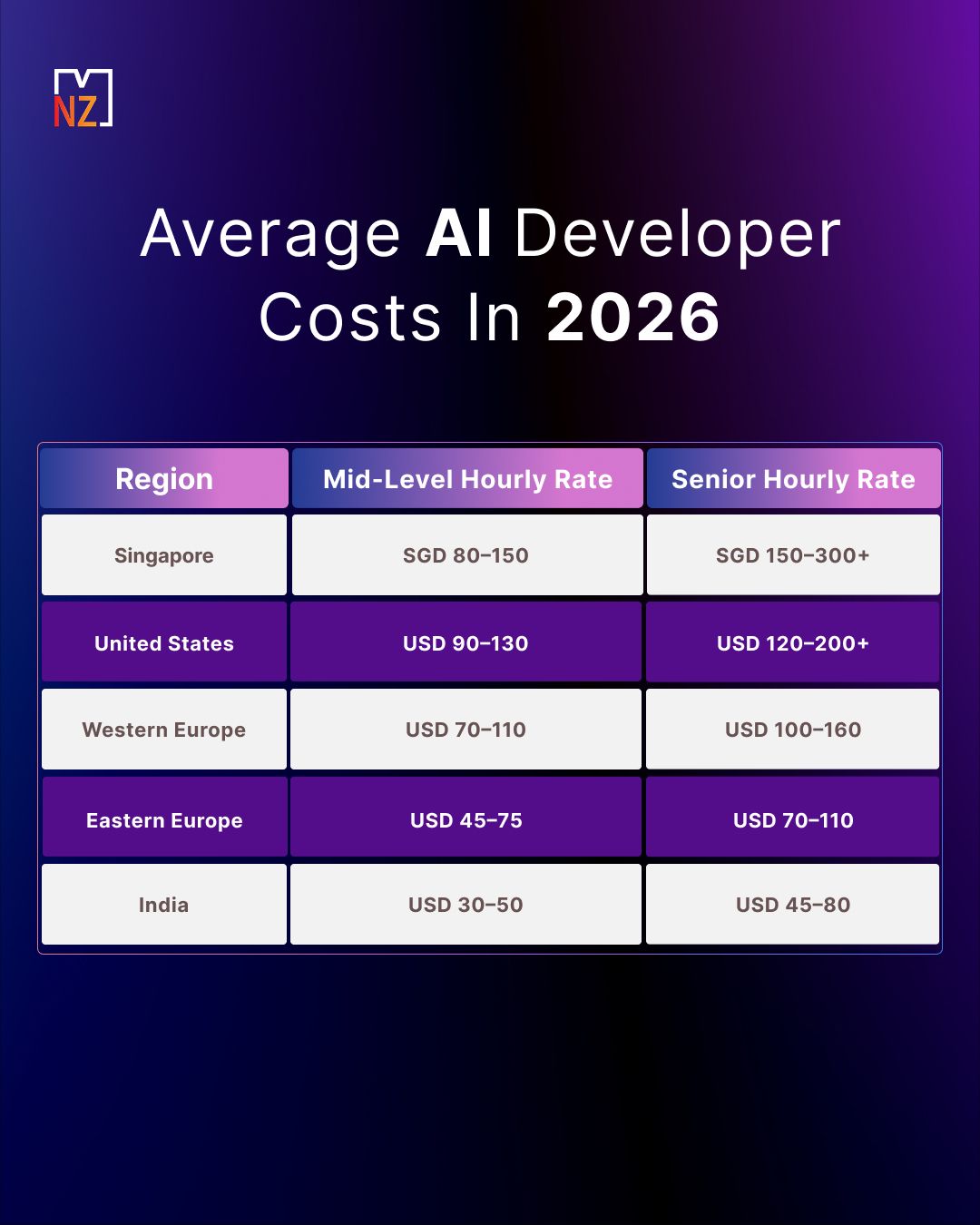
One of the most common questions executives ask is:
"How much does it cost to hire an AI developer?"
The answer depends on more than geography.
Four major factors influence pricing.
Senior engineers command significantly higher rates because they reduce execution risk.
A senior developer who prevents major architectural mistakes often delivers better ROI than multiple junior hires.
Simple integrations cost less than:
The more responsibility involved, the higher the required expertise.
Healthcare, BFSI, logistics, education, and government projects often require additional compliance, governance, and security expertise.
This influences compensation expectations.
Businesses typically choose among:
Each option carries different cost structures.
For many Singapore businesses, managed delivery teams provide the strongest balance between expertise, speed, and budget control.
The cost to hire ai agent developers 2026 is higher than traditional AI development.
There is a simple reason.
Agentic systems are significantly more difficult to build.
Unlike conventional applications, agents can:
This creates greater engineering complexity and greater business risk.
As a result, organizations looking to hire agentic ai developers should expect premium rates.
In many markets, agent specialists command 20% to 40% higher compensation than standard AI integration engineers.
The premium reflects scarcity.
There are many developers who can connect an LLM API.
There are far fewer who can build reliable autonomous workflows safely.
When evaluating agent developers, focus on:
These capabilities matter more than demo quality.
Related Blog: How Much Does AI Development Actually Cost in 2026?
Businesses evaluating global talent eventually face a sourcing decision.
Should they hire ai developer in india or build locally?
The answer depends on priorities.
Advantages include:
Challenges include:
India continues to be one of the largest sources of engineering talent globally.
Advantages include:
Challenges include:
The strongest model for many businesses is hybrid.
Product leadership remains close to customers while engineering execution leverages global talent.
This approach balances quality, speed, and cost.
The rise of distributed work has fundamentally changed AI recruitment.
Organizations are increasingly choosing to hire remote ai developers because geographical limitations no longer make business sense.
When managed properly, remote teams provide access to specialized expertise that may not exist locally.
For Singapore businesses, this means access to global AI talent without lengthy relocation processes.
The key requirements include:
This is one reason demand for ai developers for hire through managed delivery partners continues growing.
Businesses gain access to expertise without building extensive recruitment operations internally.
At NZMinds, we evaluate AI talent using a practical framework called CTR.
Can the engineer design systems with appropriate permissions?
Every AI system should operate with minimum required access.
Can actions be monitored and audited?
Visibility matters.
Businesses must understand what systems are doing and why.
Can failures be reversed safely?
No AI system is perfect.
The ability to recover safely matters as much as preventing failure.
This framework becomes especially important when evaluating developers responsible for autonomous workflows and agentic systems.
Start by defining the business problem rather than the technology. Focus on outcomes, then work with technical advisors or experienced AI partners to translate those goals into hiring requirements. Strong AI engineers should be able to explain their work in language non-technical stakeholders can understand.
Costs vary based on experience, project complexity, and specialization. Senior AI engineers often command premium compensation due to strong demand and limited availability. Many businesses combine local leadership with global engineering teams to optimize budgets.
Yes. India has one of the largest and most mature software engineering ecosystems in the world. Success depends less on geography and more on hiring standards, communication processes, project management, and technical leadership.
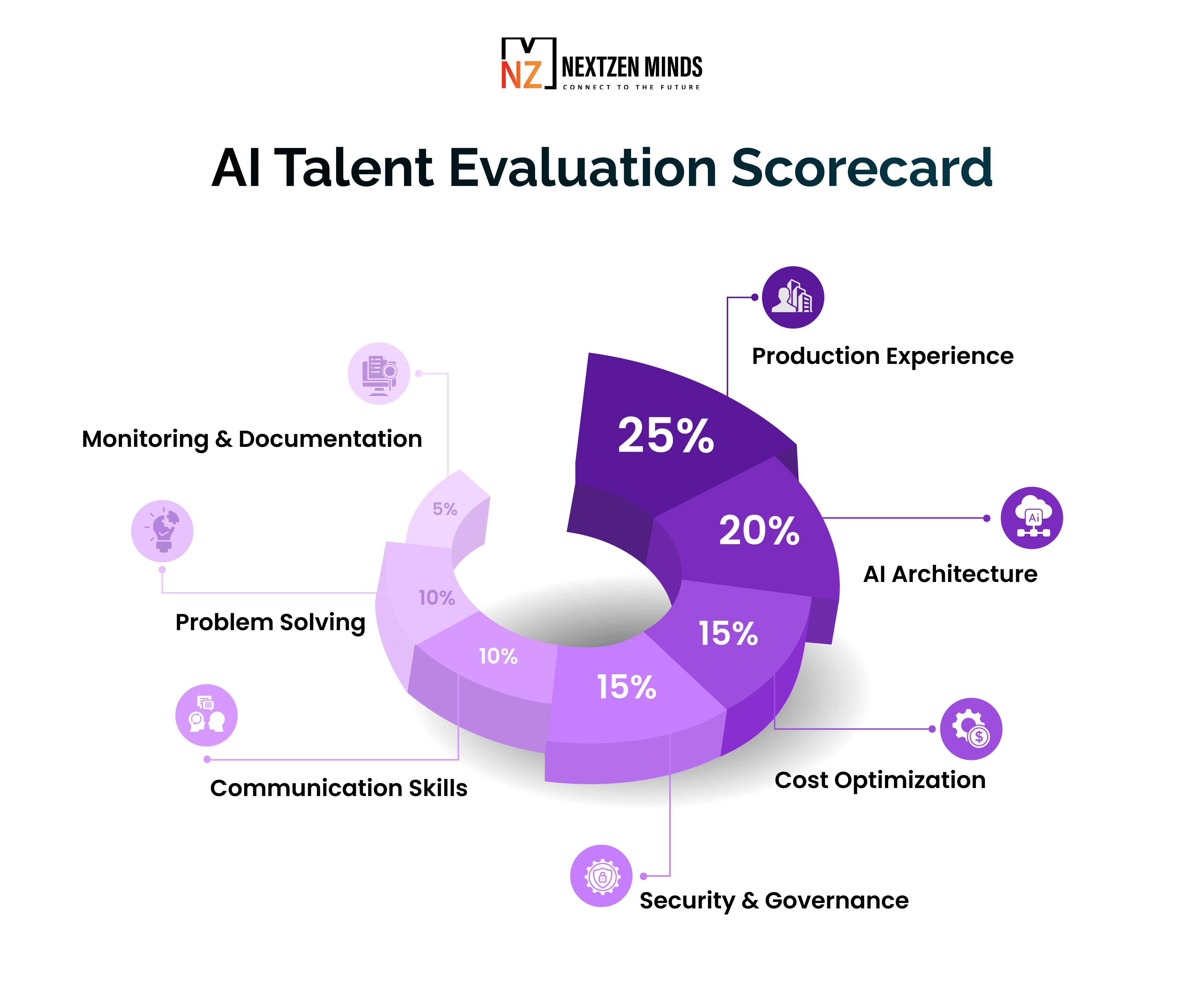
Prioritize production experience, business understanding, cost awareness, governance knowledge, and deployment expertise. Certifications alone are rarely reliable indicators of capability.
Look beyond machine learning theory. Focus on candidates who understand data quality, evaluation frameworks, deployment pipelines, monitoring systems, and long-term model maintenance.
Absolutely. Many successful AI products are built by distributed teams. Clear expectations, structured communication, and strong management practices are more important than physical location.
Traditional AI engineers often focus on prediction, generation, or analysis. Agent developers build systems capable of performing actions, coordinating workflows, using tools, and operating autonomously across multiple systems.
Most startups benefit from versatile builders during early stages. Specialists become valuable after product-market fit is validated and specific technical challenges emerge.
Agentic systems involve additional complexity around permissions, orchestration, monitoring, observability, safety controls, and workflow recovery. The expertise remains relatively scarce, increasing market demand.
Internal hiring makes sense when AI becomes a long-term strategic capability requiring dedicated resources. Partnering with an experienced AI development company often accelerates delivery, reduces hiring risk, and provides access to specialized expertise immediately.
Understanding how to hire ai developers in 2026 is no longer about identifying candidates who know machine learning terminology.
It is about finding professionals who can design, deploy, scale, monitor, and optimize AI systems that deliver measurable business value.
The strongest hires understand architecture, governance, cost management, security, reliability, and operational execution. They think beyond prototypes and focus on outcomes.
Whether you are researching how to hire an ai developer, evaluating ai developers for hire, looking to hire remote ai developers, planning to hire ai developer in india, or exploring how to hire ai engineers for a new product initiative, the same principle applies:
Define the business objective first.
Validate the opportunity.
Then hire talent aligned with the actual work.
Organizations that follow this approach consistently reduce hiring risk, control costs, accelerate delivery, and achieve stronger returns from their AI investments.
If you are planning an AI initiative in Singapore and want expert guidance on talent strategy, project validation, or team assembly, NZMinds can help you move from idea to execution with confidence. Talk to us.