
Enterprise Web Development Company Selection Guide: Build Capability. Accelerate Capacity
June 26, 2026
June 26, 2026
.jpg)
Enterprise websites have evolved far beyond marketing assets.
Today, they power customer acquisition, digital commerce, self-service portals, employee operations, partner ecosystems, data workflows, and business-critical processes. For many organizations, the website is no longer a website, it is a core business platform.
This shift has changed how organizations evaluate development partners.
The question is no longer:
"Can this company build a website?"
The real question is:
"Can this company build, secure, scale, maintain, and evolve a platform that supports our business for the next five years?"
Unfortunately, many organizations still select vendors using criteria that matter far less than they think. They compare hourly rates, review portfolio screenshots, browse "Top Web Development Companies in USA" lists, and choose the vendor with the strongest sales presentation.
Months later, they discover the real problems:
Most enterprise web projects do not fail because developers cannot code.
They fail because the wrong delivery model, governance process, or technical strategy was chosen before development even began.
This guide explains how to evaluate an enterprise web development company, compare engagement models, assess technical fit, avoid costly mistakes, and choose a partner capable of delivering long-term business value.
An enterprise web development company specializes in designing, building, integrating, and maintaining large-scale web platforms for organizations with complex operational requirements.
Unlike traditional websites that primarily serve informational or marketing purposes, enterprise platforms often become critical components of business infrastructure.
Examples include:
These systems often support thousands, or even millions, of users while integrating with multiple business systems simultaneously.
As a result, enterprise web development requires expertise across multiple disciplines:
This is why an enterprise web development company differs significantly from a traditional web development agency.
A design-focused agency may create attractive interfaces.
An enterprise partner must create business-critical systems that remain reliable for years.
One of the most common mistakes organizations make is assuming enterprise web development is simply a larger version of building a standard website.
In reality, enterprise projects introduce challenges that require completely different planning, architecture, governance, and delivery processes.
Let's examine the differences.
A marketing website serving a few thousand visitors per month operates under very different conditions than an enterprise platform serving hundreds of thousands of users.
Enterprise systems must account for:
A platform that performs well during launch may struggle significantly as adoption grows.
This is why scalability planning must occur before development begins.
Questions a strong web development company should address include:
If these questions are not being discussed early, scalability is likely being ignored.
Cybersecurity is no longer a technical concern alone.
It is a business concern.
According to IBM's annual Cost of a Data Breach research, the average cost of a major data breach continues to remain in the millions of dollars for enterprise organizations.
A security incident affects:
A qualified enterprise web development company should have a clear strategy for:
1. Access Management: Controlling who can access what.
2. Authentication: Implementing secure login systems.
3. Data Encryption: Protecting sensitive information both in transit and at rest.
4. Audit Logging: Maintaining traceable records of activity.
5. Security Testing: Identifying vulnerabilities before attackers do.
Security cannot be added after launch.
It must be built into the architecture from day one.
Most enterprise organizations already operate a complex technology ecosystem.
A new platform rarely operates independently.
Instead, it must connect with:
These integrations often become the most technically challenging part of the project.
The development partner must understand:
Without integration expertise, enterprise projects frequently become delayed or over budget.
For many industries, compliance is not optional.
Healthcare organizations must consider regulations such as HIPAA.
Financial institutions face requirements related to security, auditing, and governance.
Organizations operating internationally may need to comply with GDPR and other privacy regulations.
A qualified enterprise web development company should understand how compliance requirements affect:
Ignoring compliance during planning often results in expensive redesigns later.
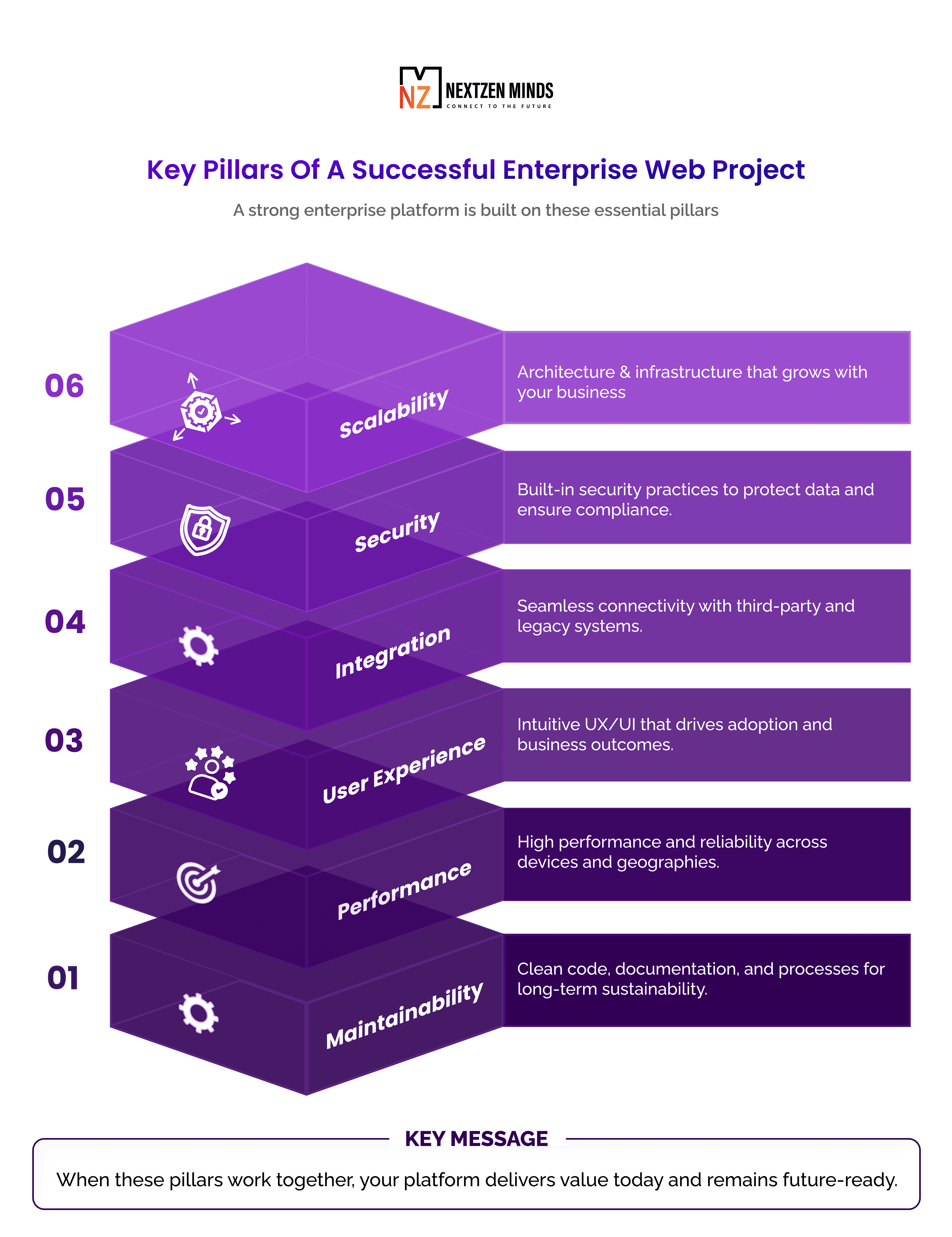
Many buyers assume a web development company simply writes code.
In reality, successful enterprise projects involve a much broader set of responsibilities.
The best web development companies in the USA and globally typically manage the entire product lifecycle.
Before a single line of code is written, the development team should understand:
This stage is often called discovery.
Ironically, it is also the phase most frequently skipped.
Organizations eager to begin development often rush directly into implementation.
The result is predictable:
Teams build features before validating whether those features solve the right problem.
Strong enterprise partners slow the process down initially so the project can move faster later.
Architecture decisions determine how easily the platform can grow.
This includes:
Poor architecture creates technical debt.
Good architecture creates flexibility.
The difference becomes visible months or years after launch.
Enterprise software must balance functionality and usability.
The platform should support business workflows while remaining intuitive for users.
Strong UX design improves:
Design is not just about appearance.
It is about helping users accomplish tasks efficiently.
Development typically includes:
For enterprise platforms, development should occur through structured sprints with clear review and approval processes.
Enterprise platforms require significantly more testing than standard websites.
Testing often includes:
Skipping QA may temporarily reduce timelines but dramatically increase long-term risk.
Most organizations evaluate vendors using the wrong criteria.
They compare hourly rates, review portfolios, and browse industry rankings. While these factors have some value, they rarely predict whether a project will succeed.
A more reliable approach is to evaluate a potential partner against seven critical areas that directly influence project outcomes.
The first question to ask any web development company is not about technology.
It is:
"How do you approach project scoping?"
Enterprise projects often fail before development starts because requirements are unclear.
When the scope is vague:
Strong partners challenge assumptions and ask detailed questions before providing estimates.
Weak partners provide immediate quotes without understanding the business problem.
That may seem convenient initially, but it often leads to expensive surprises later.
A quality enterprise web development company should help define:
The more rigor applied during discovery, the lower the likelihood of costly rework later.
Many organizations evaluate technical capability by reviewing portfolios.
This is insufficient.
A portfolio tells you what was built.
It does not explain how it was built or whether it continues to perform successfully.
Instead, evaluate how a company thinks.
Ask questions such as:
Strong partners discuss:
Weak partners focus exclusively on design and user interface discussions.
Enterprise platforms require both.
However, architecture decisions have a much larger impact on long-term success.
Enterprise software is rarely generic.
Every industry has unique workflows, risks, and compliance requirements.
For example:
A healthcare platform may require:
Banking and financial systems often require:
Manufacturing platforms frequently involve:
A development partner with relevant industry experience can identify challenges earlier and reduce implementation risk.
While industry expertise should not be the only selection criterion, it should absolutely influence the evaluation process.
One of the most overlooked aspects of vendor selection is choosing the correct engagement model.
Different projects require different delivery structures.
Fixed-bid engagements work best when:
Advantages:
Challenges:
Dedicated teams work best when:
Advantages:
Challenges:
Time-and-materials models suit organizations with:
Advantages:
Challenges:
The best web development outsourcing companies help clients select the right model rather than pushing a single engagement structure.
Many project failures can be traced back to communication issues.
Technical capability matters.
However, communication often determines whether that capability creates business value.
Evaluate:
Strong delivery processes create transparency.
Poor delivery processes create uncertainty.
Enterprise projects require clear communication at every stage.
Security should be evaluated before a contract is signed.
Not after development begins.
Ask direct questions about:
A qualified enterprise web development company should confidently explain:
If security discussions remain vague, that should be considered a significant warning sign.
Launch day is not the finish line.
It is the beginning.
Enterprise platforms require ongoing:
When evaluating vendors, ask:
Many organizations discover too late that their vendor has no structured post-launch support process.
This often leads to downtime, security issues, and unexpected costs.
Also Read: How to Choose Top Custom Software Development Firms.
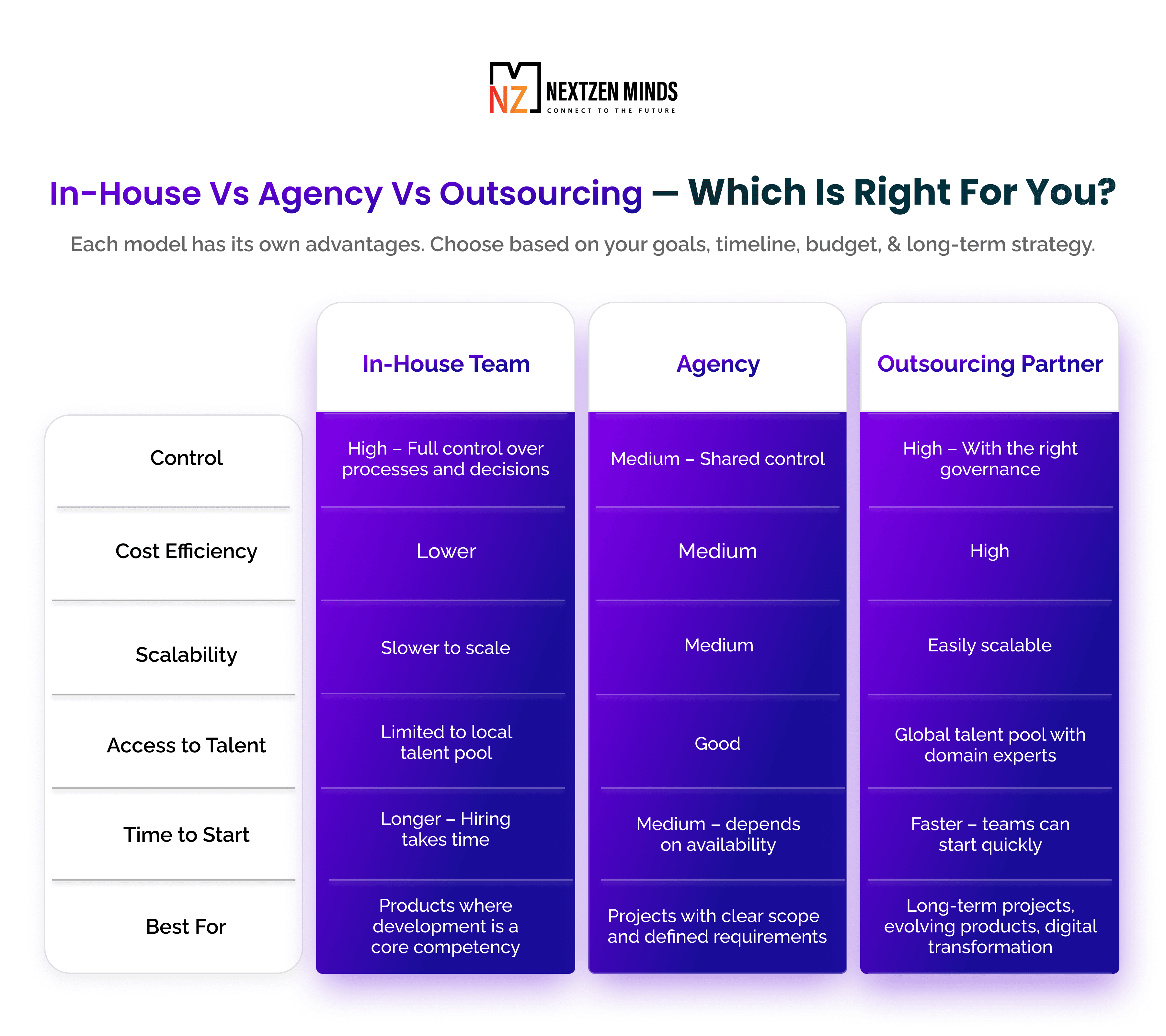
One of the most common questions organizations ask is:
Should we build internally or work with an external partner?
The answer depends on your business priorities.
In-house teams provide maximum control.
Advantages include:
However, challenges include:
Building a complete enterprise engineering team internally often requires significant investment.
A web development agency can be effective for:
Advantages:
Challenges:
Many agencies excel at design but may not provide the deep engineering capabilities required for enterprise platforms.
This model has become increasingly popular among enterprises.
Advantages include:
This explains why searches for web development outsourcing companies continue to grow among enterprise buyers.
The key is selecting a partner with strong governance and communication practices.

Many enterprise projects begin with a simple statement:
"We need a new website."
Unfortunately, that is not a scope.
It is a starting point.
Before approaching any website development company in the USA or offshore partner, define four critical elements.
What outcome should the platform achieve?
Examples include:
Without measurable objectives, success becomes subjective.
Separate essential functionality from future enhancements.
Many projects become overcomplicated because every idea is treated as a requirement.
Prioritize ruthlessly.
Document:
This information dramatically improves the accuracy of the estimate.
This section prevents misunderstandings.
It clarifies what will not be included in the current engagement.
Ironically, defining what is excluded often provides more clarity than defining what is included.
Before hiring an enterprise web development company, verify that they can address the following areas.
Enterprise success depends on all three areas working together.
Security without scalability creates bottlenecks.
Scalability without security creates risk.
Compliance without architecture creates operational complexity.
A mature development partner balances all three.
Most vendors look impressive during sales conversations.
The real challenge is identifying how they will perform once development begins.
The questions below help uncover a company's delivery maturity, technical expertise, and accountability before a contract is signed.
Ownership should never be assumed.
Ask whether:
If ownership terms are unclear, clarify them before proceeding.
A business should never become dependent on a vendor simply to maintain access to its own platform.
Enterprise projects evolve.
New requirements emerge. Market conditions change. Stakeholders discover new opportunities.
Ask:
A mature development company will have a structured approach rather than handling changes informally.
Many organizations evaluate senior leadership during sales conversations, but rarely meet the actual delivery team.
Ask:
Consistency matters.
Frequent team changes often lead to delays and knowledge loss.
Quality should be systematic rather than dependent on individual developers.
Ask about:
Strong engineering organizations treat quality assurance as part of development rather than a final phase.
Many vendors focus heavily on delivery and very little on post-launch support.
Ask:
A platform's long-term success often depends more on maintenance than initial development.
Not every vendor is a good fit.
Recognizing warning signs early can save significant time, budget, and frustration.
A company willing to quote immediately without understanding requirements is effectively pricing uncertainty.
Discovery exists for a reason.
Without it:
If a vendor skips discovery, expect expensive surprises later.
Many buyers interpret agreement as expertise.
In reality, strong partners push back.
A development company should question:
Constructive pushback often prevents costly mistakes.
If a vendor agrees to everything, they may be prioritizing the sale over the project's success.
Security discussions should occur during the earliest conversations.
If security appears only after development planning begins, it is likely not being treated seriously.
This is particularly dangerous for:
Security must be part of architecture, not an optional feature.
Many vendors showcase beautiful screenshots.
Few discuss outcomes.
Ask:
The ability to deliver measurable outcomes is more important than visual design alone.
Extremely low bids often signal one of three problems:
Enterprise projects should be evaluated on value rather than price alone.
The cheapest proposal frequently becomes the most expensive over time.
Organizations frequently search for:
These searches reflect a common assumption:
Local vendors are inherently safer.
In reality, success depends more on process maturity than geography.
Local teams provide:
Local vendors often have:
For large-scale enterprise initiatives, these limitations can become significant.
A mature offshore development company can provide:
The question should not be:
"Local or offshore?"
The question should be:
"Which partner has the strongest delivery process?"
A disciplined offshore partner with strong governance often outperforms a poorly managed local provider.
Many businesses begin their search by looking at lists of the top web development companies in the USA or browsing reviews on platforms such as Clutch and GoodFirms. While these resources can help you create a shortlist, they should not be the deciding factor.
The reality is that the best enterprise web development company for one organization may not be the right fit for another. A company building a healthcare platform will have very different priorities from a SaaS provider, an eCommerce brand, or a financial services organization.
Instead of focusing solely on rankings, evaluate each potential partner based on a few practical questions:
For example, a healthcare organization may prioritize compliance expertise and data security, while a SaaS company may place greater emphasis on scalability, integrations, and product evolution. The right development partner should align with the factors that matter most to your business rather than simply having the biggest portfolio or the lowest price.
When comparing vendors, focus on their ability to solve your specific business challenges, not just their position on an industry ranking list. A partner that understands your objectives, communicates clearly, and has a proven delivery process will almost always outperform a vendor chosen solely based on reputation.
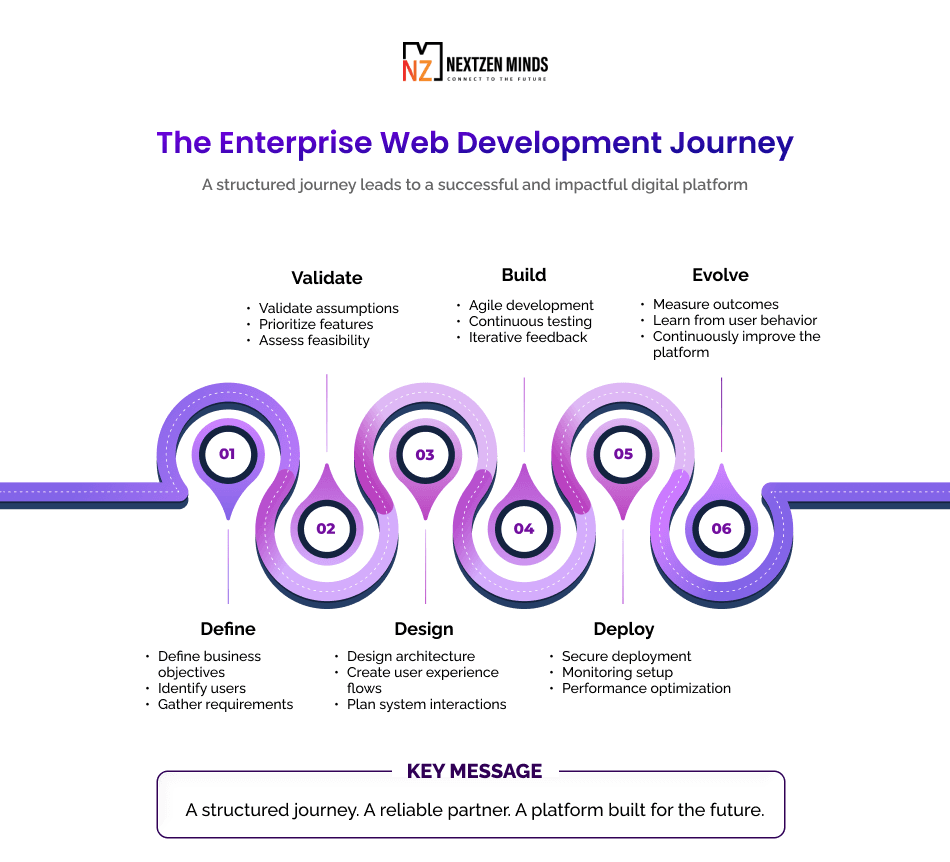
At NZMinds, we believe most enterprise web project failures occur long before development begins.
They originate from:
This is why our methodology focuses on validation before implementation.
Many organizations start by discussing technologies.
Technology matters.
However, selecting technologies before understanding the business problem often creates unnecessary complexity.
Our Scope-Before-Stack approach focuses on:
This helps reduce waste and improve delivery predictability.
Enterprise requirements evolve.
A rigid delivery model often struggles to accommodate change.
NZMinds typically supports enterprise clients through dedicated engineering teams that provide:
This structure allows organizations to scale resources based on project needs.
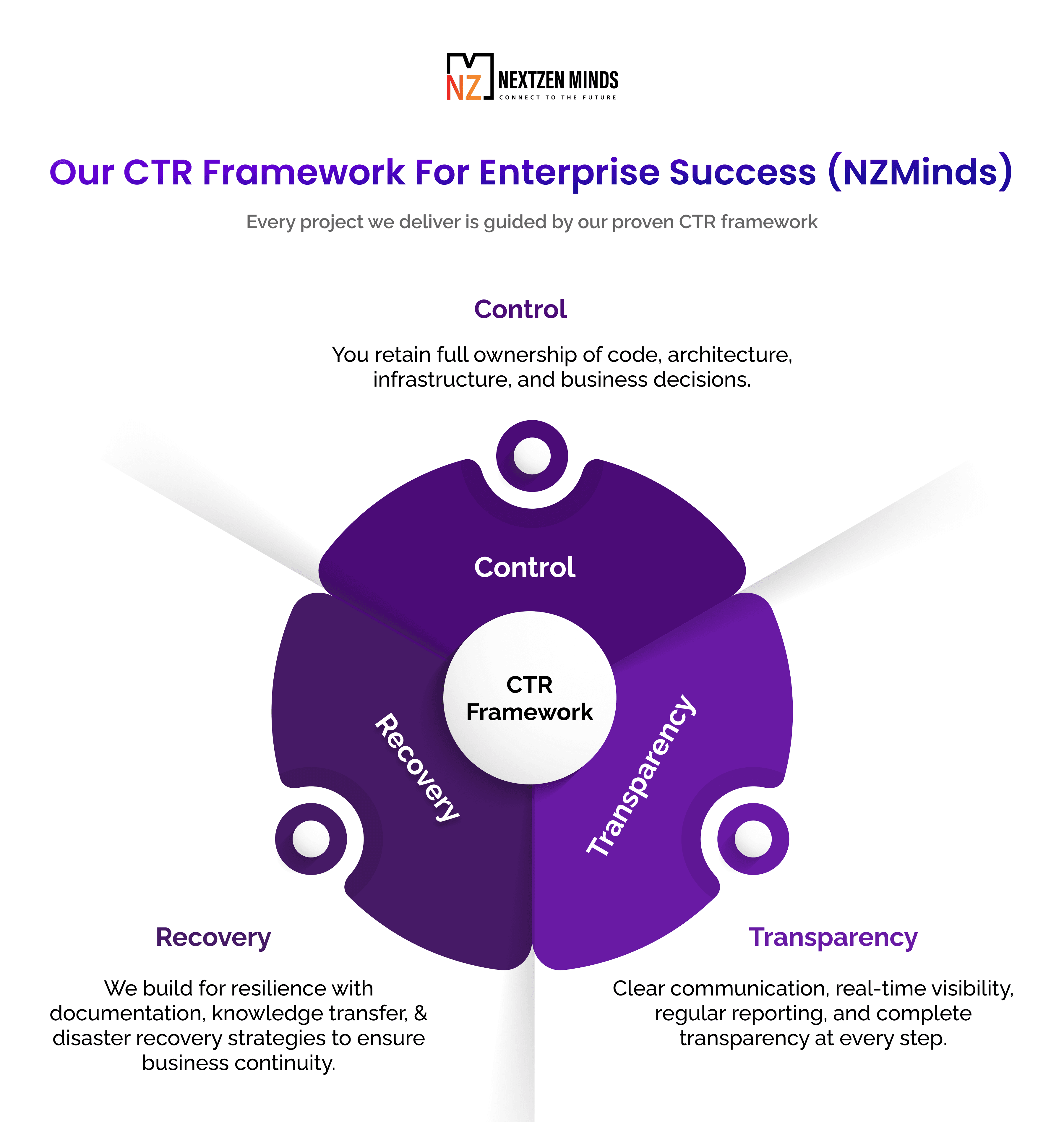
Every enterprise engagement follows our Control-Transparency-Recovery (CTR) framework.
This framework helps reduce operational risk while ensuring long-term ownership.
Consider a mid-sized financial services organization planning a customer self-service platform.
Initial requirements included:
During discovery, several issues emerged:
Rather than beginning development immediately, the project entered a validation and scoping phase.
The result:
This illustrates why scope discipline frequently delivers more value than development speed.
Before signing with any enterprise web development company, run them through these thirteen checks:
If a vendor struggles to provide clear answers to several of these points, consider it a warning sign. The right partner should be able to demonstrate not only technical expertise, but also a disciplined delivery process, transparent governance, and a long-term commitment to your platform's success.

Choosing an enterprise web development company is not about finding the biggest name or the lowest quote. It's about finding the right partner for your business goals, technical requirements, and long-term growth plans.
The most successful enterprise web projects begin with clear objectives, strong governance, and a well-defined scope before any development starts. By focusing on technical expertise, security, scalability, communication, and long-term support, you can reduce project risk and make a more confident investment decision.
At NZMinds, we believe enterprise platforms should be built with a validation-first approach, transparent delivery processes, and long-term ownership in mind. Because the right development partner doesn't just launch a website. It helps create a scalable digital foundation that supports your business for years to come.
Evaluate vendors based on scope clarity, technical expertise, security posture, communication processes, industry experience, and long-term support capabilities.
A web development company typically manages architecture, engineering, testing, deployment, and maintenance. A web development agency may focus primarily on design, branding, and marketing deliverables.
Yes. Many enterprises use outsourcing partners to access specialized expertise, improve scalability, and accelerate delivery while reducing recruitment overhead.
Costs vary significantly depending on project complexity, integrations, compliance requirements, and engagement models. Organizations should focus on total cost of ownership rather than initial development costs alone.
The decision should be based on delivery maturity, communication quality, governance processes, and technical expertise rather than location alone.
Look for proven enterprise experience, strong security practices, scalable architecture expertise, transparent communication, and a structured delivery methodology.
Most failures result from unclear requirements, poor governance, inadequate stakeholder alignment, weak architecture decisions, and insufficient planning rather than coding issues.
Scope clarity. A well-defined problem and validated requirements create the foundation for accurate estimates, predictable delivery, and successful outcomes.