Agentic AI Software Development Services- Build AI agents that don't break production
March 19, 2026
March 19, 2026
.jpg)
Most AI agents are failing because the people in charge didn't specify what they're not supposed to do. When it comes to production, ambiguity is hardly a minor problem; it is the source of failures, data corruption, and broken workflows.
That's why contemporary businesses are switching to agentic AI software development services that place a focus on architecture, control, and safety over merely a model's capacity.
Here at NZMinds, we create AI systems that are designed with the Control–Transparency–Recovery (CTR) framework, allowing agentic systems to function within defined boundaries, yet maintaining autonomous intelligence.
Agentic AI software development services involve the entire lifecycle of creating, developing, and testing AI systems that can make autonomous decisions and execute actions rather than just generate outputs.
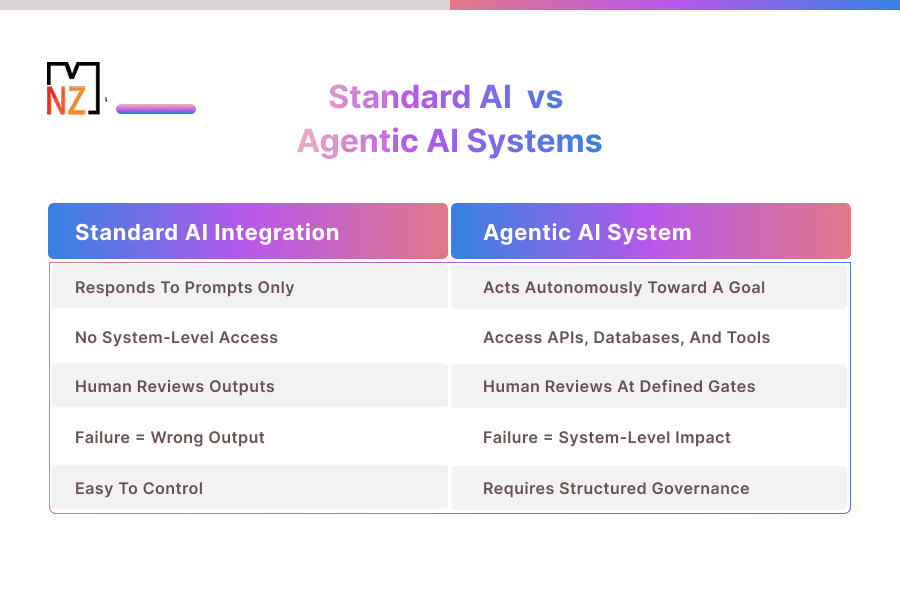
Agentic AI systems are different from traditional AI systems in that they:
A standard AI integration answers questions. An agentic AI system performs actions.
To Nextzen Minds, an AI agent is a system that has:
It's the third one, autonomy, that makes AI agents for software development powerful, yet risky.
The failure rate of agentic systems is not because of poor models, but because of poor system design!
Most teams approach AI agents as a traditional application component, not realizing that they must follow architecture requirements to become autonomous.
Typical failure scenarios are:
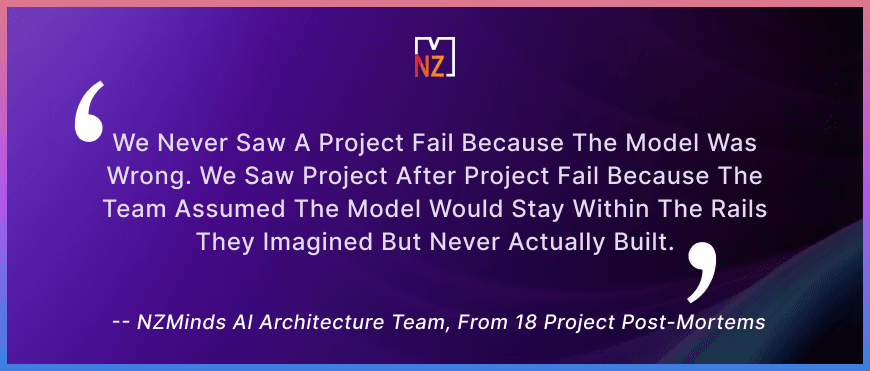
We never saw a project fail because the model was wrong. We saw projects fail because the system had no boundaries.
That's the reason for the need to prioritize architecture over model performance in AI agent development services.
Agentic AI differs from conventional applications, and the mindset for building AI applications is also different.
These systems:
Any good model, if not constrained, can be unpredictable.
This is why production-grade agentic AI software development services work on:
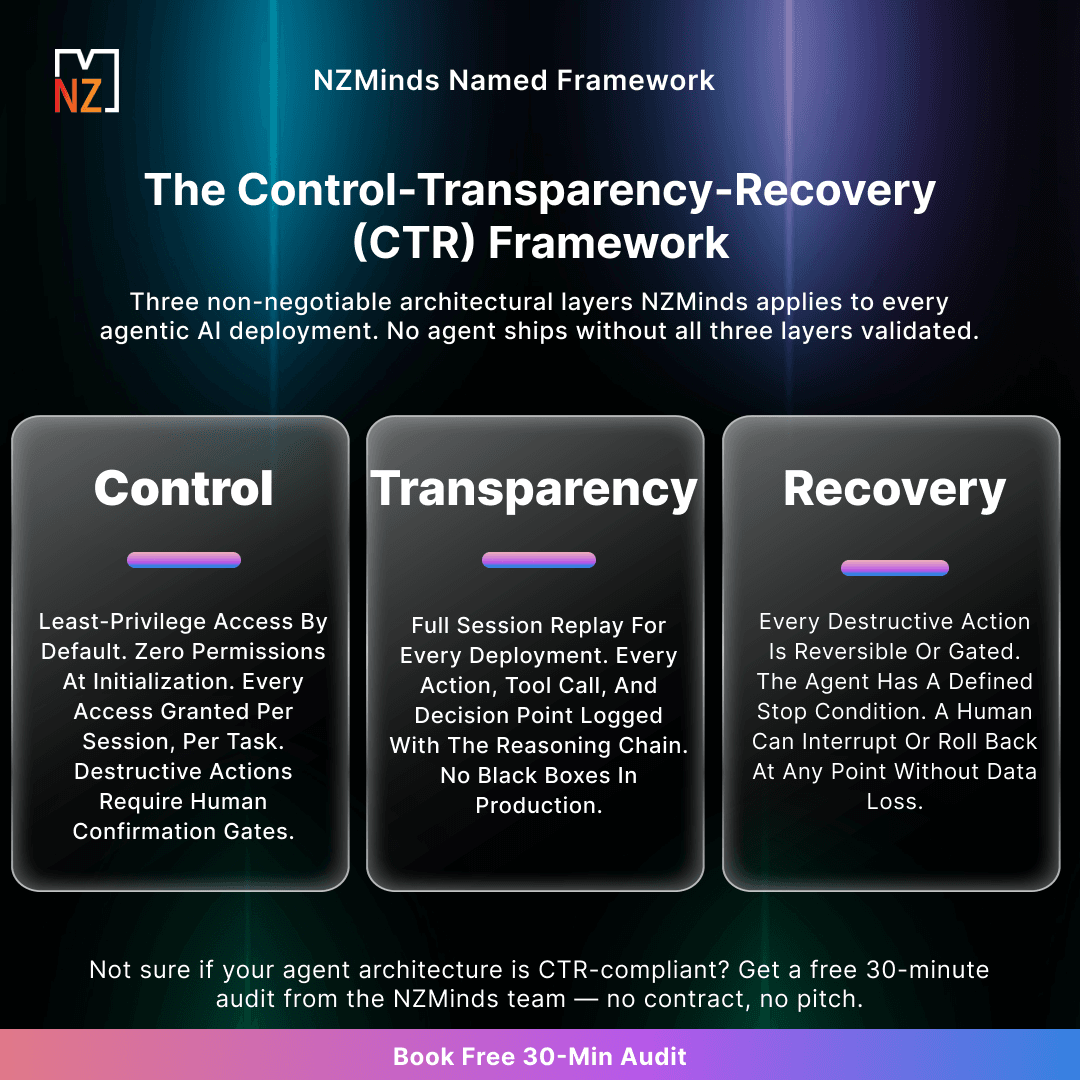
All our systems are designed under the CTR framework, which is the core of developing safe agentic AI software services.
1. Control: Ensures every AI agent operates under least-privilege access. No system starts with full permissions.
2. Transparency: Every decision is logged: - Tool usage - Input/output traces - Decision paths - Execution history
3.Recovery: Every system includes: - Stop conditions - Human override capability - Rollback mechanisms
This ensures failures are contained, traceable, and recoverable.
A production-grade AI agent system won't simply consist of a model or a prompt layer. It is implemented as a multi-layered architecture in real enterprise scenarios for controlling autonomy, ensuring traceability, and avoiding unexpected system behavior.
While experimental AI setups are more about the AI's performance, production-safe AI agentic software development services are more about the management of an AI agent's behavior throughout its operational phases, from goal interpretation to execution and recovery.
In most AI agent designs, there are four main layers:
This is the very building block of any effective AI agent system. Before any model, tool integration, or workflow is implemented, the system needs to be definite about what the agent can and cannot do.
A clear target layer is translated from a general statement to measurable, testable results.
Instead of ambiguous goals like: “Help users with billing issues.”
A production-safe definition would be: “Resolve tier-1 billing queries by retrieving invoice data and providing explanations, without modifying account or payment records.”
This change is crucial because AI agents are self-operating. They are prone to overgeneralizing tasks when not provided with concrete goal boundaries, thus exhibiting unpredictable behavior.
This layer also comprises:
The permission layer sets the specific permissions that the AI agent can access and control throughout systems. In enterprise settings, it is one of the most important aspects of ensuring the safety of agentic AI software development services.
It is a least-privilege execution model, that is, the agent is given the least access necessary to accomplish the task.
Common permissions are:
This layer is crucial to avoid high-risk failures in which an AI agent takes irreversible actions when they are incorrect.
In enterprise-grade AI agent development services, permission design is treated as a security architecture problem, not a feature configuration step.
The observation layer keeps track of all the actions the AI agent takes, making them easily traceable, explainable, and analyzable.
This layer acts as the system’s memory and accountability engine, enabling teams to understand not just what the agent did, but why it did it.
Each execution cycle is recorded in an immutable audit structure that usually records:
This layer plays a critical role in:
In the absence of this layer, production AI agents become “black boxes” and are not appropriate for enterprise-level deployment.
The interruption layer is responsible for ensuring that AI agents do not start doing something when they are in a state that is uncertain, unsafe, or undefined.
In production environments, agents need to be able to pause or suspend execution or postpone decisions rather than making up decisions as they go.
This layer includes:
One common failure mode for AI development services is 'goal drift,' when an AI system carries out actions towards an unintended goal because the state it's interpreting is not clear.
One of the most impactful enterprise applications of agentic systems today is AI agent workflow automation, where organizations can enable automating complex, multi-step workflows that were previously hard to coordinate between tools, systems, and teams.
While traditional automation solutions are based on fixed logic, AI agent workflow systems add adaptive decision-making that operates within the confines of a pre-defined set of rules.
They can control:
The primary distinction in the case of AI agent workflow automation in software development is adaptability, the ability of the agent to dynamically decide what to do next, depending on the real-time state of the system and contextual factors.
As such, they're far more powerful, but also demand a higher level of reliability and control by way of architecture.
In enterprise deployments, there are generally three types of AI-driven workflows:
These agents are used to run a workflow in a linear fashion, with each step requiring the previous one to be performed.
Examples include:
The state management and step validation mechanisms are critical for these.
These agents work in multiple systems, gather, analyze, and combine information from various systems, and then return a combined response.
Examples include:
Careful permission segmentation is required to be sure that one system's scope of access does not penetrate the other.
These agents monitor ongoing systems and intervene only when predefined thresholds or anomalies are detected.
Examples include:
These need very specific trigger definitions; otherwise, too many or too few interventions may be made.
There are different kinds of workflows for each of these workflow types, each of which necessitates a unique control structure in agentic AI software application growth solutions to make sure secure and predictable execution.
Human Interaction with AI is not an on/off switch, but a graduated control system that is tailored to the level of risk and the depth of the intervention.
In production-grade AI agent development services, human involvement takes place over four structured levels:
This is where AI agents are able to function without the human touch.
This is for use with only:
Systems are usually checked for performance and drift even at this level.
All outputs are saved for future review by the human, and the AI agent performs actions on the spot.
This model is used in:
Humans can undo and/or change decisions post execution.
The agent suggests an action, but the action is held up until a human user explicitly gives permission to do the thing.
This is needed for:
This is a commonly adopted standard when developing custom AI agents for enterprises, as it helps in managing the risk while maintaining efficiency.
The AI agent is used in the highest level of control to create outputs, while humans are responsible for the final action step.
This is essential for:
In this case, the AI system works as an assistant and not as an executor.
In Southeast Asia, a financial services firm leveraged NZMinds to create an AI compliance triage agent.
We created an agent that:
Key insight:
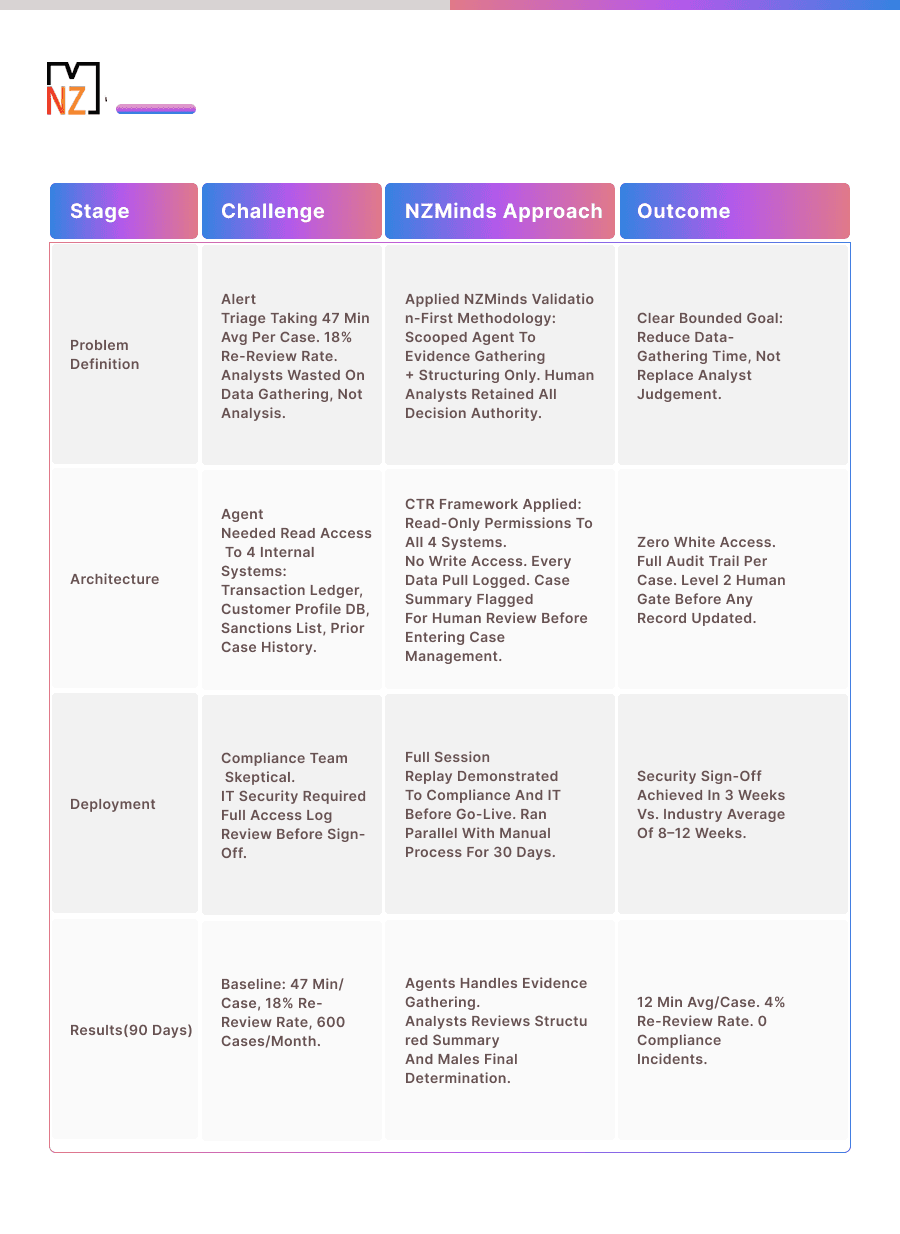
The agent did not make decisions, only structured information.
It's the cornerstone of safe agentic AI software development services.
Use this checklist for each agent deployment. If none of the items are checked, then the agent is not ready to produce.
Not all vendors offering AI agent development services are capable of producing production-grade systems.
Consider choosing partners based on the following:
A good custom AI agent development services provider will demonstrate the system's actions in the event of failure, not success.
Before deploying any agentic system, enterprises should validate:
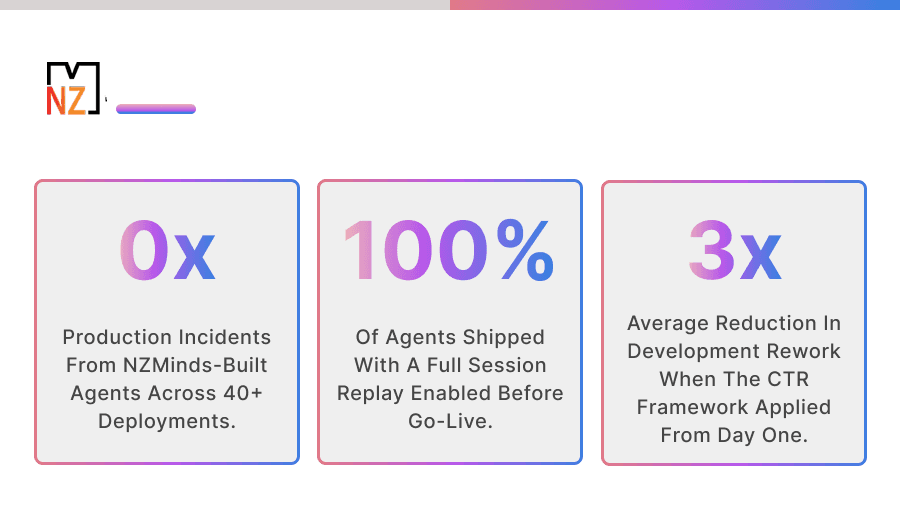
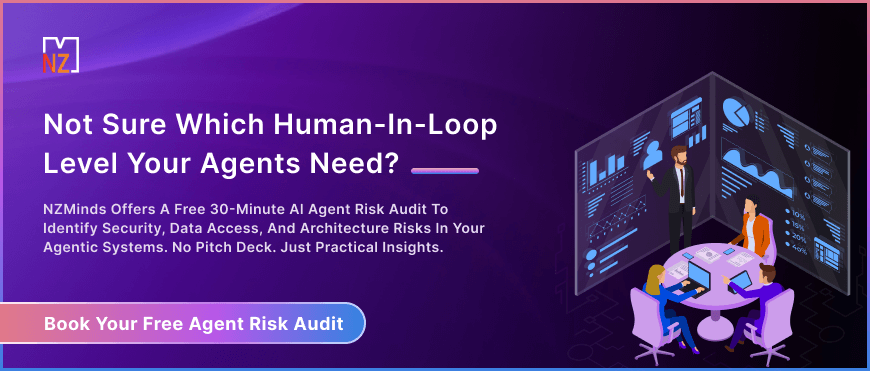
NZMinds has developed an AI Agent Risk Audit (12-point evaluation framework) to help evaluate production readiness before deployment.
AI agents are now being adopted in software development by modern businesses in the following ways:
These systems, if designed properly, can help to decrease the load on the operations while increasing reliability.
Cost depends on:
Typical timelines:
It is important to note that the cost of agentic AI software development services lies in the design of their architecture, not in the development of their models.
A chatbot responds. An AI Agent runs.
Chatbots generate replies. Agents "capture" decisions, workflows, updates, and actions on APIs to complete end-to-end tasks. This is where things get interesting, as opposed to anything automated. If you don't know what your business really needs, you can schedule a free 30-minute scoping session with us.
It usually takes about 10-14 weeks per a single domain system (2-3 integrations). There are systems that are complex and compliance-driven, that take 16-24 weeks. It's not about coding, it's about data readiness, process clarity, and security validation. We can do a FREE architecture review and discuss the feasibility and timeline of your use case.
Process-driven companies, such as BFSI, healthcare, enterprise SaaS, and supply chain, deliver the best results. Efficiency improvements of 30%-40%+ are consistently realized in these environments where workflows are well-defined and data is structured. AI agents can immediately provide leverage if you have repetitive decision cycles in your operations.
CTR is our default architecture standard, meaning it is the standard we use for control, transparency, and recovery. It provides agents with strict permissions, audit trails, and safe failure recovery. All of our systems are tested and validated with CTR before deployment. You can get a free review of your architecture with us.
Yes, but not always. We create systems that have four aspects of oversight: automation, async review, live approval, and human execution for critical actions. The objective isn't to get rid of humans, it's to get rid of unnecessary human bottlenecks.
Security is not about a phase; it is a foundation. From the start, we sanitize input, implement least privilege, and full action logging. We follow a structured approach for security-first deployments, allowing most clients to reach compliance sign-off in 3–4 weeks. If security is an issue, then we can show you our full architecture to walk through with your IT staff.
Agentic AI is not just a technological upgrade; it is a shift in how software systems operate.
Without proper governance, agentic AI software development services can introduce serious operational risks. With the right architecture, they become powerful automation systems that scale enterprise operations safely.
At NZMinds, we build agentic AI software development services that prioritize:
Because in production environments, intelligence without boundaries is not innovation; it is risk.