
Generative AI vs Traditional AI: What Every Business in the USA Needs to Know
June 25, 2025
June 25, 2025

Beyond the Buzz — What’s Really the Difference?
Artificial Intelligence (AI) is no longer just a buzzword for Silicon Valley tech giants, it's now a mainstream tool reshaping industries across the United States. Whether it’s automating business operations, enhancing customer service, or generating entirely new forms of content, AI has evolved rapidly. But as conversations shift, you’ve likely heard two terms thrown around: Traditional AI and Generative AI (often shortened to Gen AI).
So, what exactly is the difference between these two? Which one should your business invest in? And how do they complement, or compete with each other?
Let’s break it all down in a way that’s clear, insightful, and tailored to help you make smarter decisions.
Traditional AI refers to systems designed to analyze data, detect patterns, and make decisions based on rules or training. This form of AI powers things like:
In short, Traditional AI excels at classification, regression, and optimization tasks. It learns from historical data and applies logical frameworks to reach decisions, much like a sophisticated calculator with a brain.
Generative AI, or Gen AI, is a subset of AI focused on creating new content or data that mimics human creativity. Think about chatbots that write emails, tools that generate realistic images from text prompts, or models that compose music, create 3D designs, or write computer code.
Gen AI systems use advanced neural networks, especially large language models (LLMs) or generative adversarial networks (GANs), to generate rather than just analyze.
Core Characteristics of Generative AI:
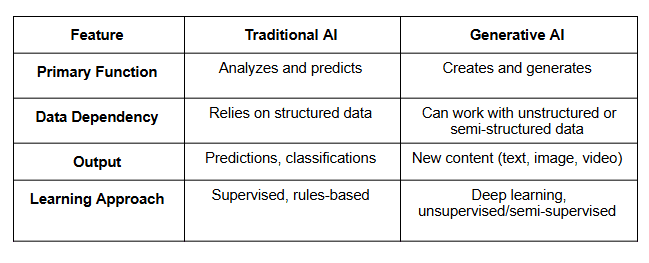
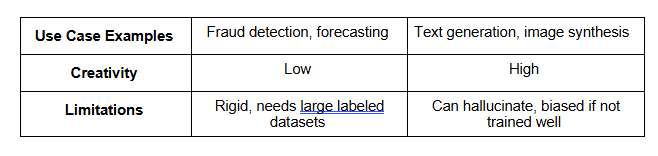
Generative AI isn't replacing Traditional AI, it’s expanding the possibilities. Instead of just identifying what’s already in the data, Gen AI allows machines to reimagine, simulate, and experiment.
For example:
That’s a paradigm shift in how businesses innovate.
Retail & eCommerce
Healthcare
Finance
Marketing
The United States is currently leading global adoption of Generative AI, especially in sectors like marketing, software development, education, healthcare, and legal services. According to McKinsey, 79% of US-based companies have experimented with Gen AI tools, and 22% have integrated them into daily workflows.
Why the rush? Because Gen AI is turning routine tasks into automated, creative, and scalable outputs, boosting productivity while cutting costs.
Ethics & Bias
Both Traditional AI and Gen AI are vulnerable to algorithmic bias. However, Gen AI brings new challenges:
Security Risks:
Cost and Resource Intensiveness:
Use Traditional AI when:
Use Generative AI when:
Often, the best strategy is to combine both, leveraging the precision of Traditional AI with the inventiveness of Gen AI.
The next evolution lies in agentic AI, systems that use both Traditional and Generative AI to autonomously plan, act, learn, and adapt. Imagine a virtual marketing assistant that not only suggests when to run a campaign (Traditional AI) but also writes the email, designs the visuals, and adjusts the tone for your target audience (Gen AI).
Traditional AI analyzes data and predicts outcomes; Gen AI creates new content or data that didn’t exist before.
Not exactly. Gen AI complements Traditional AI by expanding its capabilities into creativity and content generation.
Marketing, software development, healthcare, retail, and education are currently leading Gen AI adoption in the USA.
Yes, including hallucination, bias, misinformation, and IP infringement. Proper oversight and ethical use are essential.
Absolutely. Many Gen AI tools are cost-effective and scalable. With the right partner, small businesses can unlock big value.
At NextZen Minds, we go beyond building AI solutions, we help redefine how businesses operate by strategically embedding Generative AI into their digital DNA.
Our Gen AI capabilities empower startups, enterprises, and mid-sized companies across the USA to transform workflows, content creation, and customer engagement. Whether you're looking to automate support with intelligent chatbots, build next-gen recommendation engines, or create synthetic data for training models, we bring tailored Gen AI solutions that drive real business outcomes.
Custom-Built Gen AI Models:
We don’t just plug and play. We fine-tune models to suit your business needs, whether it’s internal automation or external user experience.
Human-Centered AI Development:
Our solutions combine AI's capabilities with human empathy, delivering context-aware, natural language experiences for your customers.
End-to-End AI Integration:
From strategy to deployment, we handle the entire lifecycle of Gen AI adoption, including ethical compliance, LLM integration, prompt engineering, and scalability.
Experience Across Industries:
From eCommerce and finance to healthcare and logistics, our Gen AI solutions have helped businesses improve time-to-market, reduce operational costs, and personalize customer journeys.
Sample Use Cases We Deliver:
Whether you're starting your first Gen AI experiment or scaling a full platform powered by artificial intelligence, NextZen Minds is your innovation partner. We don’t just deliver technology, we deliver competitive advantage.
Ready to build with Gen AI? Talk to our AI experts today.
Generative AI isn’t here to replace Traditional AI - it’s here to reinvent what's possible. For businesses in the USA, understanding both forms of AI isn’t just a technical choice, it’s a strategic imperative.
Choosing the right AI approach can define how your business scales, innovates, and competes. And if you're ready to explore the power of Gen AI to create, connect, and grow - you're already one step ahead.