Flight Booking App Development: A Practical Guide to APIs, NDC, Compliance and Cost
November 26, 2026
November 26, 2026
Key Takeaways
Introduction
A flight booking app may look simple to a traveler: search, compare, pay and receive a confirmation. Behind that journey, however, are several systems that need to work together. Building those systems is what flight booking app development is really about.
This guide explains the available APIs after the Amadeus Self-Service shutdown, per-order fees, ARC accreditation, PCI DSS, US refund rules, MVP features and development costs. At NZMinds, we use these decisions to shape the architecture before development begins.
In This Article
A booking platform needs to do more than display available flights. It must connect four stages of the journey: shopping, booking, payment and servicing. Together, these form the foundation of flight tickets booking app development.
At NZMinds, we map servicing before designing the search page. Refunds and schedule changes determine support workloads and chargeback exposure. In our experience, designing them late often forces teams to rebuild their order model.
Your app gets airline inventory through a Global Distribution System (GDS), direct New Distribution Capability (NDC) connections or an aggregator API. Each option offers different coverage, commercial terms and levels of control.
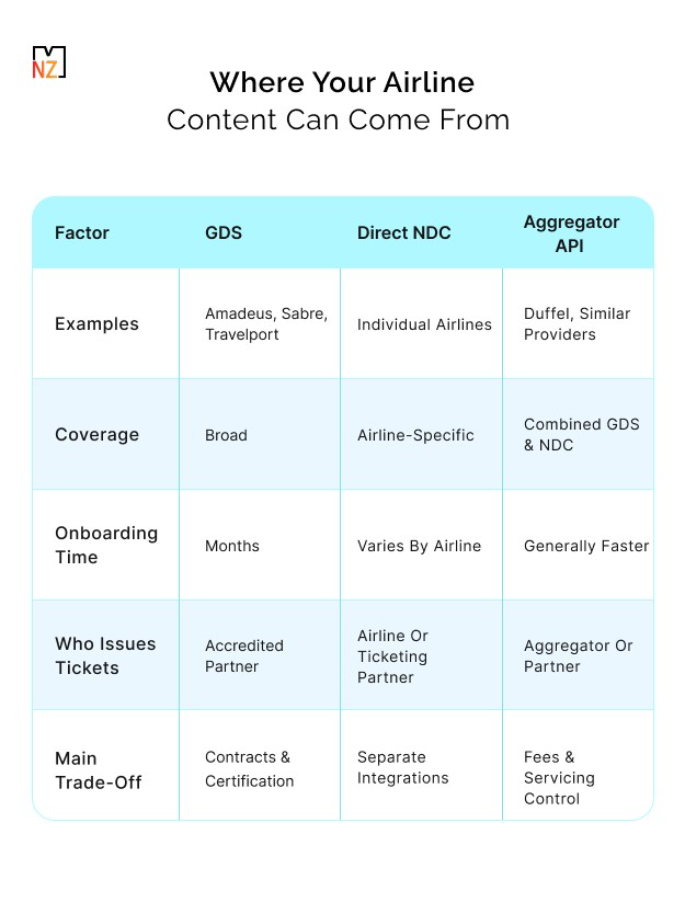
A GDS brings airline content together through established distribution systems. It offers broad coverage but requires commercial agreements, certification and an accredited ticketing partner. Onboarding typically takes months.
NDC is the International Air Transport Association's (IATA) XML-based standard for airline distribution. It supports richer offers, including fare bundles, baggage, seats and dynamic pricing.
Several large carriers reserve selected fares for NDC channels or add surcharges to GDS bookings. This can affect your prices. However, every airline requires a separate integration.
An aggregator combines airline content from NDC and GDS sources behind one API. Onboarding is generally simpler, and some providers let you sell under their accreditation.
The trade-off is straightforward. You pay per-order fees and may have less control over changes, cancellations and refunds.
NZMinds recommends a validation-first approach. Start with an aggregator, test demand on real routes and monitor booking volumes. Move high-volume airlines to direct NDC or GDS connections when the numbers justify the additional work.
Amadeus closed its Self-Service API programme on July 17, 2026. Its Enterprise APIs remain available, but developers now need a commercial agreement.
Amadeus disabled existing Self-Service keys and closed the developer portal. Prototypes that depended on those keys lost access. Older tutorials that begin with free Amadeus test credentials now lead to a dead end.
The Amadeus API integration cost is therefore an enterprise-level discussion. Contracts, certification and commercial negotiations replace the old self-service
sign-up process. For an early-stage product, an aggregator is often a more practical starting point.
There's another lesson here: don't tie your entire application to one supplier.
NZMinds builds a supplier adapter layer for this reason. Your application uses one internal interface, while each supplier operates behind its own adapter. If you add or replace a supplier, you work on that integration rather than rewriting search, pricing and booking logic.
Flight booking API fees depend on the supplier and its pricing model. Aggregators may charge per order, per ancillary and as a percentage of order value. GDS and direct NDC pricing is usually negotiated.
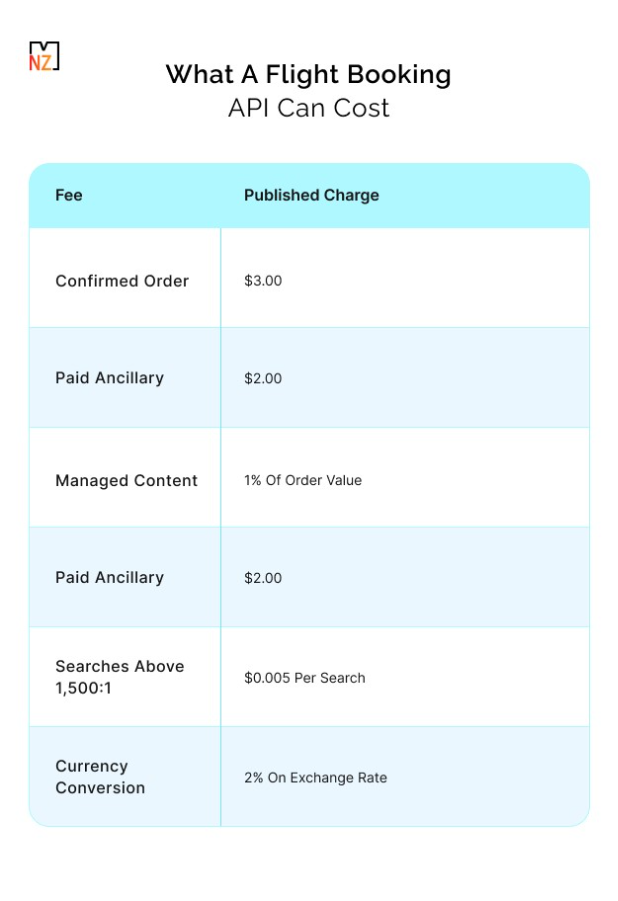
Duffel's published pricing, checked in November 2026, provides a useful reference:
Let's put those fees into a real calculation.
Suppose your app processes 2,000 orders each month, with an average order value (AOV) of $400.
The order fees come to $6,000. Managed-content fees add another $8,000, calculated as 1% of $800,000 in monthly order value. That's $14,000 per month before ancillary purchases, card processing or foreign exchange (FX) charges.
Search volume matters too. At a 1,500:1 search-to-book ratio, 2,000 bookings represent 3,000,000 searches, which is the free allowance under the stated pricing. Every additional million searches adds $5,000.
Worked example: 2,000 orders × $400 AOV = $800,000 order value. Monthly charges: $6,000 order fees + $8,000 managed-content fees = $14,000. Every extra million searches above the 1,500:1 threshold adds $5,000.
At NZMinds, we model these charges by route and booking during discovery. A fare margin might look healthy until you include API fees, payment processing and refunds. It's better to catch that problem in a spreadsheet than after launch.
Every search can trigger a request to an airline or distribution partner. When thousands of people search at once, those requests can become expensive. Caching helps control that load without showing travelers outdated fares.
Consider someone checking ten combinations of travel dates before choosing a flight. Without caching, your application may make ten live supplier calls. Multiply that behaviour across thousands of visitors, and the costs add up quickly.
The trend is moving in one direction. OAG figures reported by PhocusWire indicate approximately 100-200 searches per ticket during early online booking. That figure has grown to 10,000-20,000 today, with 200,000 searches per booking projected as AI agents search for travelers.
Four practices help manage this:
1. Cache information that changes slowly. Store schedules, airports, airline metadata, fare rules and low-fare calendar grids. Refresh them according to their update patterns.
2. Check live prices at commitment points. Re-price when someone selects a fare and again before payment. This reduces unnecessary calls while protecting against price changes.
3. Separate automated traffic from people. Bots and AI agents can receive cached results with clear freshness labels. They don't need to trigger a live supplier request for every search.
4. Measure each channel separately. Track search-to-book ratios across your website, mobile app, partner APIs and AI agents. NZMinds cloud engineers build this monitoring into the first release, so unusual search activity appears on a dashboard before it becomes an unexpected invoice.
See our cloud engineering capabilities for the infrastructure behind this work.
A US flight booking app needs a valid ticketing arrangement, payment security and refund workflows that meet Department of Transportation (DOT) requirements. Passenger data also needs proper protection.
If you want to issue tickets in your own name in the US, you'll generally need Airlines Reporting Corporation (ARC) accreditation.
Requirements include a US-registered entity, owner background checks, qualified ticketing staff and a bond or letter of credit starting at $20,000. Standard processing takes approximately 60-90 days.
You can take a faster route by selling under an aggregator's accreditation or working through a host agency or consolidator.
Payment Card Industry Data Security Standard (PCI DSS) v4.0.1 is the current standard referenced here for protecting cardholder data. Hosted, tokenized
payment fields keep raw card numbers away from your application servers. This also reduces the scope of your compliance work.
The DOT's 2024 refund rule sets specific obligations for ticket agents acting as the merchant of record. When a flight is cancelled or significantly changed and the traveler rejects the alternative, the agent must refund card payments within 7 business days. Other payment methods have a 20-calendar-day deadline.
Refund rights must also be disclosed before vouchers are offered.
Read the Federal Register's DOT refund rule.
International bookings may require passport details. Encrypt this information in transit and at rest, restrict access by role and log every read.
NZMinds treats single sign-on (SSO), multi-factor authentication (MFA), role- based access and a complete audit log as baseline architecture. These controls were included in the first release of the aviation platform discussed below.
A flight booking MVP needs search, clear fare selection, booking, secure payment, booking management and schedule-change alerts. Additional features should earn their place through actual demand.
For a first release, focus on these:
Build now: One-way and round-trip search; filters for stops, times, airlines and price; fare-family comparisons with baggage costs clearly shown; saved travelers; secure checkout; a booking page for viewing, cancelling or requesting refunds; and schedule-change alerts.
Build after launch: Multi-city search, price alerts, supplier-supported seat maps, loyalty features and flight-plus-hotel bundles. Booking data can tell you which additions matter.
Skip until proven: Augmented reality (AR) airport navigation, virtual reality (VR) previews and cryptocurrency payments. These features add work without solving the main booking problems for most early-stage products.
Custom flight booking app development makes sense when your audience has workflows that generic apps don't handle well. Think corporate travel approvals, group bookings or regional airline requirements.
For a general online travel agency (OTA) that mainly needs a different interface, a white-label platform may be faster and cheaper. We will tell you when buying makes more sense than building. To know more about the same explore our custom software development capabilities.
The flight booking app development cost for a US-market product typically starts around $45,000-$90,000 for a validated MVP. A larger product with multiple platforms and advanced features can cost $200,000 or more.
The final cost to develop flight booking app depends less on the number of screens and more on the airline integrations, ticketing responsibilities and servicing workflows your product needs.
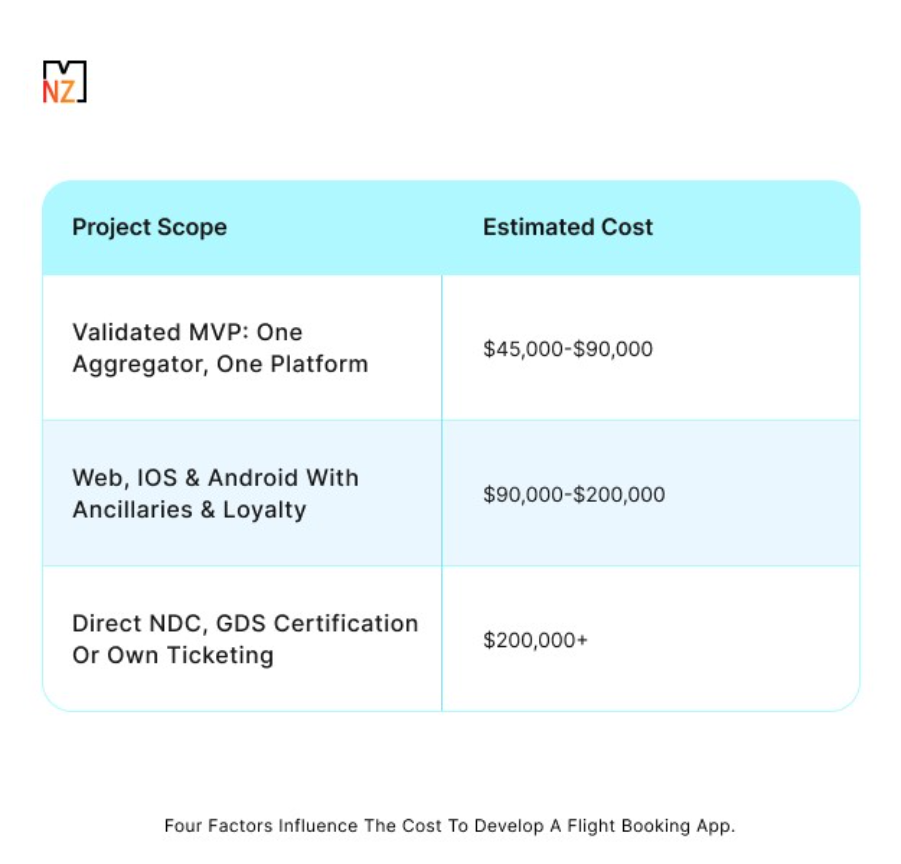
Here are indicative development ranges:
1. Content source: Each direct NDC connection or GDS certification adds integration, testing and commercial work.
2. Servicing depth: Search and booking are only the beginning. Automated changes, cancellations, refunds and schedule-change handling require additional development.
3. Platforms: Web is usually the quickest starting point. Native iOS and Android apps add design, testing and release work. React Native and Flutter can reduce duplicated development, but still require platform-specific testing.
4. Team model: A dedicated team, staff augmentation arrangement or fixed- scope project affects both pricing and delivery speed.
You'll also need to budget for API fees, card processing, hosting and ongoing maintenance. These expenses continue after launch.
Your first release doesn't need every feature found on a large travel platform. It needs to help a specific group of customers find and book suitable flights, then give you enough evidence to decide what to build next.
Client: Corporate aviation department of a large Indian conglomerate.
Challenge: Flight requests, aircraft status and crew compliance were managed through spreadsheets, email and paper. Flight Duty Time Limits (FDTL) were tracked manually.
What NZMinds built: A 25-module platform across web, tablet and mobile. It included flight requests with live aircraft availability, AI-assisted crew assignment governed by FDTL rules, and maintenance, safety, compliance and cost modules on one record.
Integrations: ForeFlight routing, weather, Automatic Dependent Surveillance - Broadcast (ADS-B) flight tracking, Notices to Air Missions (NOTAMs), ground handlers and enterprise resource planning (ERP) and finance systems.
Controls: SSO, MFA, role-based access, encryption in transit and at rest, and a complete audit log.
Delivery: First production go-live at four months. The full platform followed at 6.5 months across two phases.
Why it matters: Live availability, rules-checked allocation, multiple integrations and auditable decisions are also central challenges in a flight booking engine.
See the NZMinds aviation technology practice.
NZMinds' Capacity & Capability Framework addresses both team capacity and technical expertise. If you need more hands, we extend your team with
engineers experienced in aviation integrations; if you need architecture designed, we build it with you. The Capacity & Capability Diagnostic helps identify which constraint is slowing progress.
To understand how to make a website like Expedia, start with one part of its business and build an architecture that can support more later. Expedia combines flights, hotels, cars and loyalty programmes built on years of supplier relationships.
You don't need all those features at launch. Start with a focused product.
1. Pick a niche and route network. Choose a region, traveler type or route group where you can compete. A smaller market gives you a clearer starting point.
2. Choose your airline content source. An aggregator is usually the practical first choice. Test actual fare coverage on your target routes before investing in development.
3. Launch on the web first. A web application generally ships faster, can be updated without app-store reviews and can attract search traffic. Add mobile apps when repeat bookings justify them. Our web application development team can help plan this sequence.
4. Design supplier adapters from the beginning. Keep supplier-specific logic separate. This makes it easier to add another content provider without rebuilding the main application.
5. Add hotels and cars when flights convert. Connect a stays or car rental API using the same order model, rather than creating separate booking processes.
Your website and mobile app should share one backend and one order model. Running two independent stacks doubles the opportunities for servicing bugs.
AI can make flight booking easier by searching, comparing and explaining fares. It becomes risky when it can spend money or change tickets without the traveler's explicit approval.
NZMinds builds that distinction into the architecture rather than relying on a policy document.
Useful applications include natural-language search, such as “cheapest nonstop to Denver after 5 pm Friday.” AI can also explain fare rules in plain English, suggest rebooking options during disruptions and help support teams classify incoming requests.
Our AI development services team works on these applications, and our AI in aviation guide covers related operational use cases.
There are risks to plan for. AI agents can multiply search volume and supplier fees. A model might explain a fare rule incorrectly. An agent with payment access could purchase the wrong ticket.
We use three controls to manage these risks.
Control: Give agents least-privilege access. They can search, compare and place a hold. Issuing a ticket, charging a card or cancelling a booking requires explicit traveler confirmation. Each session also has a spending limit.
Transparency: Log every agent action, including the fare, fare rules and price shown at that moment. Travelers and support teams should be able to see what happened.
Recovery: Unpaid holds expire automatically. Tickets that can be voided are voided within the airline's permitted window. Every agent-created booking must have a human support path.
The same pattern guided the crew assignment system in our case study. Hard eligibility rules come first, AI-assisted ranking comes second and human confirmation comes last. The system never offers an assignment that violates compliance rules.
Successful flight booking app development starts with the right supply, a workable ticketing model and a clear understanding of your operating costs. Validate these decisions before building, then scale the product as booking demand grows.
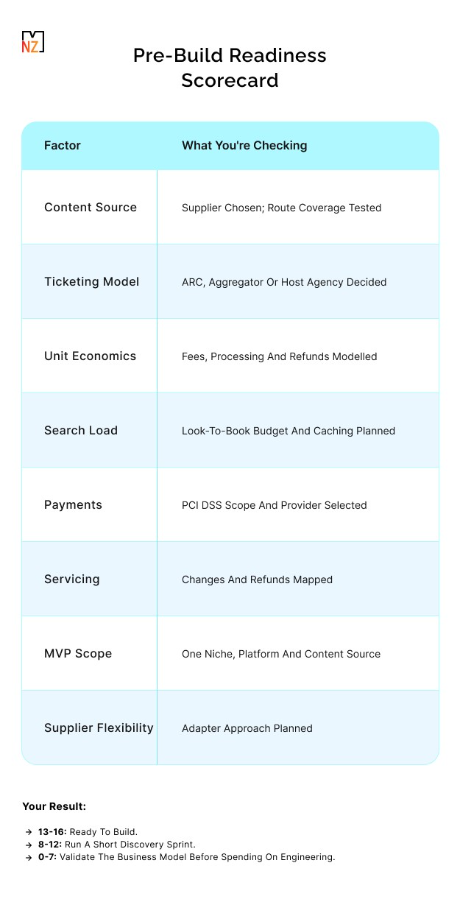
Score each factor from 0 to 2: 0 means not started, 1 means in progress and 2 means decided and tested.
A reliable booking product starts with decisions that users may never see: where the fares come from, who issues the ticket and how changes or cancellations are handled. Get those foundations right, and you have a stronger base to grow from.
A high score doesn't guarantee success. It means you've answered the important questions before committing your development budget.
An MVP using one aggregator and one platform typically costs $45,000-$90,000. Direct NDC connections, GDS certification and your own ticketing can push the budget above $200,000. Running costs include Duffel's $3 per order and 1% for
managed content. NZMinds can model these fees per booking in a free 30- minute review.
A focused MVP using one content source and one platform typically takes 4-6 months to reach production. Direct NDC integrations, GDS certification and ARC accreditation can add months. ARC processing alone takes approximately 60-90 days. Settle your content source and ticketing model during discovery to avoid commercial delays.
No. You don't need accreditation simply to build the application, and you don't always need your own accreditation to sell tickets. You can use an aggregator's accreditation, a host agency or a consolidator. However, issuing tickets in your own name in the US requires ARC accreditation and a bond or letter of credit starting at $20,000.
A GDS, such as Amadeus, Sabre or Travelport, aggregates airline content through established distribution systems and commercial agreements. NDC is IATA's XML-based standard for richer airline offers, including bundles and ancillaries. Several large carriers reserve selected fares for NDC channels, which means GDS-only apps may display higher prices.
Start with an aggregator that covers NDC and GDS content, supports self- service onboarding and lets you sell under its accreditation. Amadeus closed its Self-Service APIs on July 17, 2026, and now requires an enterprise agreement. Test fares on your target routes first. NZMinds can compare suppliers in a free architecture review.
Yes, provided agents cannot spend money or change tickets without explicit traveler confirmation. NZMinds' Control-Transparency-Recovery framework limits permissions, records every action with the fare shown at that moment and provides automatic hold expiry and human support. You should also budget for increased search volumes and supplier fees.

Resources