Drowning in Claims and Loan Paperwork? How We Cut Document Processing by 50% for a Fortune 100 Insurer
October 28, 2026
October 28, 2026

Key takeaways
Introduction
Claims, loan and legal documents rarely arrive in a neat, predictable stream. They come in different formats, carry different information, pass through several people and systems before someone can make a decision and often need to pass through several people and systems before a decision can be made. For insurers, that manual work adds up quickly. Teams spend hours sorting documents, entering data, checking information and preparing files for review. As volumes increase, the backlog grows with them. That is where intelligent document processing can make a measurable difference. By combining AI document classification, data extraction and workflow automation, organizations can reduce manual work while keeping the controls and audit trails that regulated processes require.
In one engagement, NZMinds built a document intelligence platform for a Fortune 100 global insurer that increased daily document throughput by 50-60%, improved data accuracy by 40-50% and reduced audit effort by 40-50%. This article looks at what was built, what changed, and what organizations should consider before starting their own document processing automation project.
Manual review creates backlogs, and backlogs create errors. The insurer in this case study handled high volumes of claims, loan, and contract documents, and every file passed through human hands for sorting, tagging and data entry.
The pattern is common across banking, insurance and other financial services teams, where regulatory scrutiny shapes every release.
Slow review. Volume outran headcount, so turnaround times stretched.
Inconsistent tagging. Classification depended on whoever reviewed the file, so similar documents were tagged differently and rework followed downstream.
Audit gaps. Manual steps left thin trails, which made every audit complex.
Weak fraud signals. Rule-based checks struggled with unstructured document sets.
The scale is large. A 2022 study by the Colorado State University Global White Collar Crime Task Force for the Coalition Against Insurance Fraud puts US insurance fraud at $308.6 billion a year.
Claims and operations leaders know this pain well. The work is not hard. There is simply too much of it, and the cost of one mistake lands in the next audit.
Intelligent document processing (IDP) is AI that reads, classifies and extracts data from documents, then moves them through a workflow without manual entry. Four capabilities carried this build.
AI document classification. Incoming files were categorized automatically with high precision.
Intelligent data extraction. Key fields were pulled straight from documents, so nobody retyped them.
Workflow automation. Digitized pipelines handled high volumes with minimal intervention.
AI-enhanced fraud detection. Anomaly models flagged inconsistencies and suspicious patterns.
Underneath sat a centralized document repository, advanced search and retrieval, role-based access controls and integration with enterprise systems. That foundation turns AI document processing from a demo into automatic document processing an insurer can run at volume. NZMinds used the same anomaly-detection approach in an AI-driven AML investigation platform for a bank, where audit-ready evidence trails were part of the brief.
NZMinds built the audit trail and the workflow first, then added the models on top. At NZMinds, we apply our Control-Transparency-Recovery (CTR) framework to document AI, so every automated action stays governed, visible and correctable.
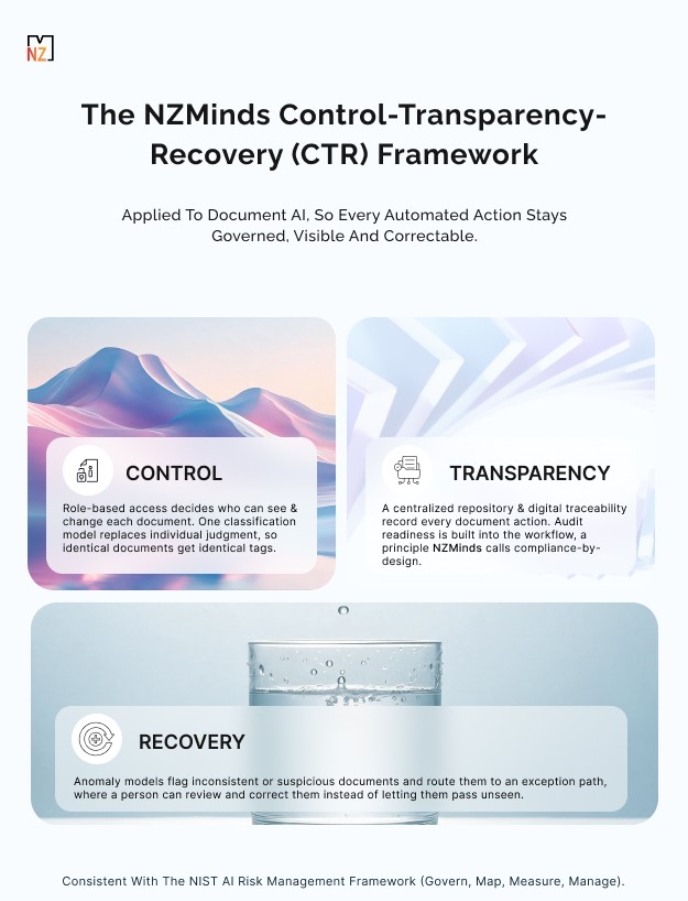
The structure is consistent with the NIST AI Risk Management Framework, a voluntary framework released in January 2023 that organizes AI risk work into four functions: Govern, Map, Measure and Manage.
NZMinds applied compliance-by-design to a cross-border lending platform for a Malaysia and Singapore financial services group, with audit trails and country-level data isolation built in.
The insurer processed 50-60% more documents per day, and every other metric moved with it. These are the four outcomes from the engagement.
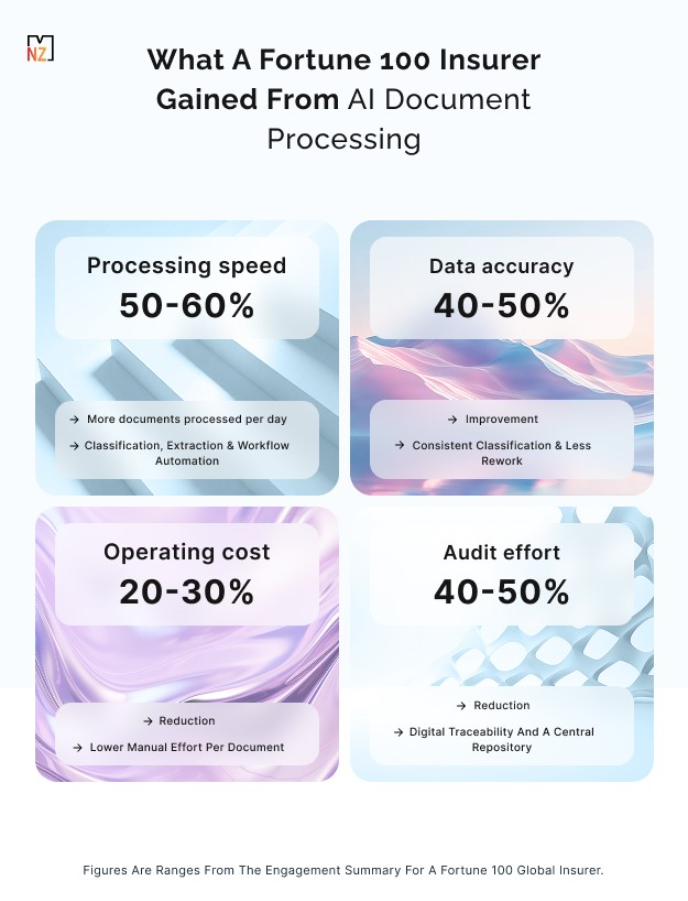
Figures are ranges from the engagement summary for a Fortune 100 global insurer.
It turns the audit trail from a reconstruction job into a by-product of the workflow. When every classification, extraction and access event is logged in one repository, an auditor's question becomes a search, not a scramble. So, this is how intelligent document processing improves audit readiness.
Not sure whether your blocker is bandwidth or expertise? The Capacity & Capability Diagnostic™ helps leaders identify which constraint is limiting execution.
In this engagement, that design cut audit effort by 40-50%. The insurer works in a regulatory-heavy environment where strong audit trails are expected, so traceability was a requirement from day one. NZMinds designs it in first, because it is far easier to build into a pipeline than to retrofit onto one already running.
Regulators are paying attention too. The National Association of Insurance Commissioners adopted a model bulletin on insurers' use of AI in December 2023. It sets expectations for how insurers govern AI and what information regulators may request during an examination. A searchable audit trail turns that request into a lookup.

They go wrong when the model comes before the workflow. Three patterns cause it.
Chasing extraction accuracy alone. A model that reads every field perfectly still stalls when documents arrive from five repositories.
Skipping access control. Open access to claims and legal files creates a compliance problem that automation cannot fix.
Leaving out an exception path. Without a defined route for flagged documents, staff work around the system.
NZMinds recommends the reverse order: workflow and access controls first, models second.
If your gaps are about people rather than process, see why engineering teams feel understaffed even when headcount isn't the problem.
FAQ
It is AI that classifies documents, extracts key fields and routes files through automated workflows. In insurance it covers claims forms, loan files and legal contracts that arrive in mixed formats. NZMinds built one platform that handled all three document types for a Fortune 100 global insurer.
In the NZMinds engagement with a Fortune 100 insurer, daily throughput rose 50-60%. Your gain depends on document mix, volume and how much manual entry exists today. The reliable way to estimate it is to baseline turnaround time per document type first. NZMinds offers a free 30-minute document workflow review to do exactly that.
It logs every classification, extraction and access event in one central repository. Auditors then search for evidence instead of reconstructing it from emails and shared drives. In the NZMinds engagement, audit effort fell by 40-50%. NZMinds calls this compliance-by-design, and it is why audit readiness comes with the workflow.
Yes. Anomaly models flag inconsistencies and suspicious patterns that rule-based checks miss in unstructured document sets. In this build, fraud detection ran alongside classification and extraction. NZMinds recommends keeping a person in the loop for every flagged document, so the model narrows the review queue while people make the final call.
The NZMinds build combined AI classification, data extraction, workflow automation and fraud detection. It also included a centralized repository, advanced search and retrieval, role-based access controls and enterprise system integration. Each layer supports the audit trail. If you are scoping a similar platform, NZMinds can walk you through each layer in a free 30-minute review.
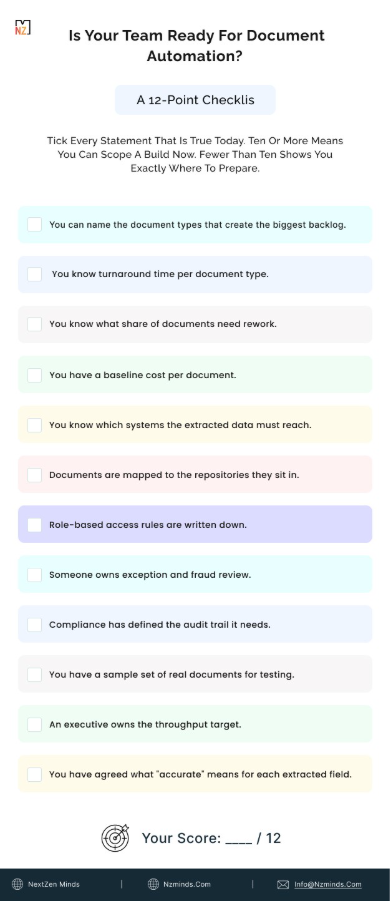
Baseline turnaround time, rework rate and cost per document for the three to five document types that create the most backlog. Then scope a pilot around those types. NZMinds runs this as a free 30-minute review, with no contract and no pitch deck.
Browse more: NZMinds case studies.

Sources