
The Death of Vibe Coding in Software Development: 69 Vulnerabilities, 1.5 Million Leaked Keys, and One Very Expensive Lesson
April 27, 2026
April 27, 2026
.jpg)
There is a moment every vibe coder knows.
The AI spits out a working interface in about forty minutes. It looks polished. It clicks through without errors. You show it to your client, or your co-founder, or even just yourself, and you think: this is incredible. We are going to ship this.
And that’s exactly what makes everything that comes next so expensive.
Because six months later, the same product tells a very different story.
Login tokens are stored insecurely, and half your user sessions are exposed. A second client signs up, and the database you designed for one organization starts mixing their data. The application that felt effortless at 10 users begins to choke at 200. And the developer you hire to extend the system doesn’t talk about features, they talk about cost. The cost of understanding it. The cost of stabilizing it. The cost of rebuilding it.
Because that’s what it is.
This is not hypothetical. We watched it happen to a client.
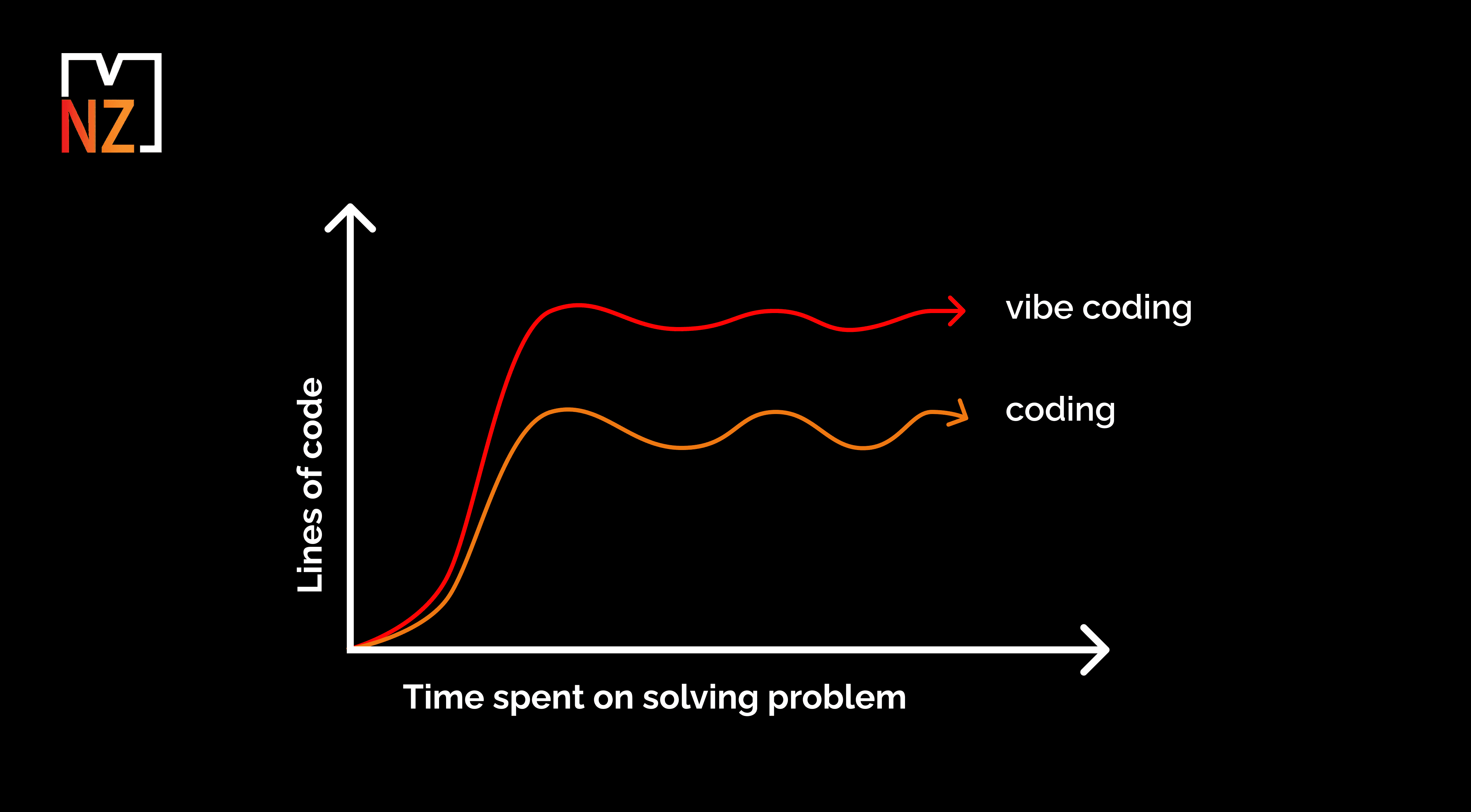
They came to us after the fact, which is always the more expensive way to do it. And they are not alone. Vibe coding failures do not announce themselves during the demo. They show up later - in breach reports, rewrite invoices, and the moment you realize the system you shipped is not the system you thought you built.
Vibe coding did not emerge quietly.
The term itself, coined by Andrej Karpathy in early 2025, captured something the industry had already begun to feel. Software development was shifting from writing code to describing intent. You no longer had to think in syntax. You could think in outcomes.
At its simplest, vibe coding means this:You describe what you want in natural language, and an AI system generates the code, often most of it, with minimal inspection of how that code actually works.
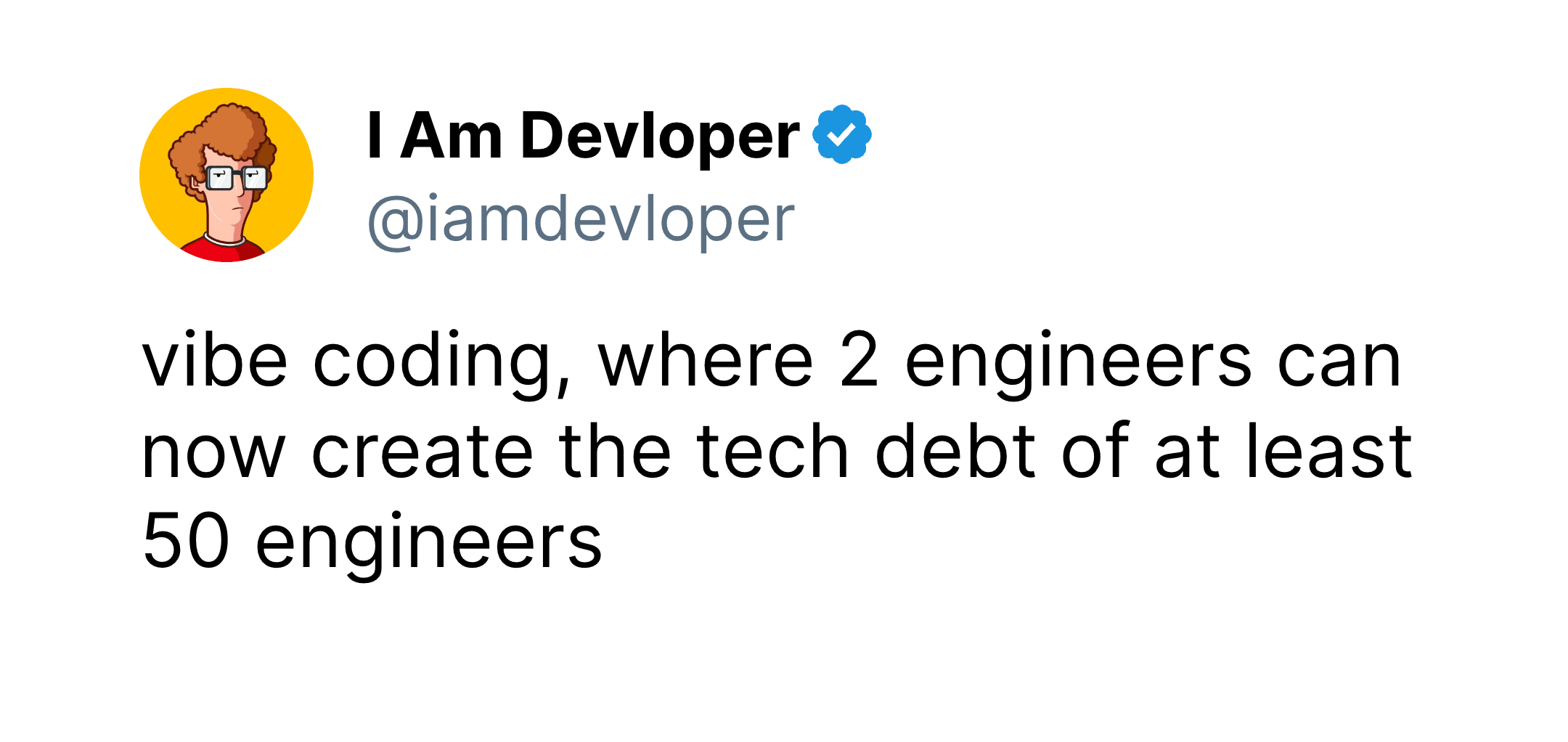
(Source - https://addyo.substack.com/p/vibe-coding-is-not-an-excuse-for)
For a while, this felt like a breakthrough.
The barrier to building software dropped almost overnight. Founders could move from idea to interface in hours. Internal tools that once required weeks of engineering effort could be assembled in an afternoon. Entire startup teams began experimenting with codebases that were overwhelmingly AI-generated. In some cases, more than 90% of the code was written this way.
The excitement wasn’t manufactured. It was earned.
For prototypes, side projects, and internal systems with limited exposure, vibe coding genuinely works. It removes friction. It accelerates iteration. It allows teams to test ideas before committing serious resources.
Nobody serious is arguing that AI coding tools have no place in development. They clearly do.
But the promise came with an assumption that turned out to be fragile that if a system works, it is ready.And that assumption didn’t hold.
By late 2025, the tone had started to shift. Developers brought in to extend AI-generated systems began describing something closer to development debt than progress. Code that looked clean at a glance became difficult to reason about under pressure. Small changes introduced unexpected side effects. Fixing one issue often created two more.
Some of the most telling signals came from controlled studies. In one such trial, experienced developers using AI tools believed they were significantly faster, but were actually slower on complex tasks. The gap between perception and reality was not marginal. It was measurable.
That gap matters.
Because the difference between “it works” and “it works reliably, securely, and at scale” is not incremental. It is structural.
And most vibe-coded systems live in that gap, quietly, until something forces them out of it.
At some point, the conversation around vibe coding stopped being anecdotal.
The early warnings, from developers struggling to maintain AI-generated systems, were easy to dismiss as edge cases or resistance to change. But as more teams adopted the same approach, patterns began to emerge. And once those patterns were studied systematically, the picture became difficult to ignore.
On security alone, the findings are remarkably consistent across independent research.
Veracode’s 2025 GenAI Code Security Report evaluated over a hundred language models across dozens of coding scenarios. Nearly half of the generated outputs contained security vulnerabilities. What’s more concerning is that this number remained largely unchanged across multiple testing cycles, despite improvements claimed by model providers.
Other studies reinforce the same point from a different angle. Research from Carnegie Mellon found that while a majority of AI-generated code, over 60%, was functionally correct, only a small fraction met full security standards. In other words, most of the code worked, but very little of it was safe to deploy without review.
That distinction is not academic. It is operational.
Because a system that fails visibly can be fixed quickly. A system that appears to work while quietly exposing risk is far more dangerous.
The trend is also accelerating.
Georgia Tech’s Vibe Security Radar, which tracks vulnerabilities directly attributable to AI-generated code, documented a sharp rise in incidents within a matter of months, moving from single-digit cases at the start of 2026 to dozens by March. Researchers estimate that the real number of affected systems across the open-source ecosystem is significantly higher than what is publicly reported.
Production environments tell a similar story.
Security firm Escape.tech analyzed over 1,400 AI-generated applications already running in production. The findings were hard to dismiss: a majority of those applications contained security issues, and more than half had at least one critical vulnerability. Within that sample alone, hundreds of exposed secrets were identified, along with numerous instances of personally identifiable information, including sensitive financial data, being accessible where it should not have been.
And then there are the incidents that make it into public view.

(Source- https://tenor.com/view/vibe-coding-bug-alte-säcke-fmj-gif-992069015977834250)
In early 2026, an AI-built social platform called Moltbook launched with significant attention, and failed just as quickly. Within days, the system exposed approximately 1.5 million API authentication tokens, along with tens of thousands of user email addresses and private messages. The cause was not a sophisticated exploit. It was a misconfigured deployment that had never gone through a proper security review.
No advanced attack was required. The system was already open.
Security, however, is only one side of the equation.
The longer-term cost of vibe coding often shows up as technical debt and here, the numbers are just as telling.
AI-assisted projects are accumulating technical debt at a significantly higher rate than traditionally developed systems. Developers report spending substantially more time debugging AI-generated code than they would have spent writing it themselves. In some cases, that overhead approaches a majority of the total development effort.
Code quality trends point in the same direction. Analysis of large-scale repositories shows that code duplication in AI-assisted environments is increasing, while refactoring activity - the process that keeps systems maintainable over time, is declining. At the same time, AI-generated commits are exposing hardcoded secrets at more than twice the rate of human-written code.
Individually, none of these signals would be conclusive.
Taken together, they point to something much more structural.
Vibe coding does not eliminate complexity. It redistributes it, away from the moment of creation and into the lifecycle that follows.
And that is where most teams first encounter it.
When our client came to us, the product didn’t look broken.
It had users. It had functionality. It had momentum. On the surface, it looked exactly like what vibe coding promise, a working system built quickly and ready to grow.
The problem was that everything holding it together existed at the surface level.
The first cracks appeared in authentication.
The application could log users in, but that was where the logic stopped. There was no meaningful token validation, no proper session expiry, and no safeguards against repeated or automated attempts. It worked in the narrow sense, it allowed access, but it had no real concept of controlling or protecting that access.
This is a common pattern in AI-generated systems. The code solves for “does this function complete?” rather than “does this system behave safely under pressure?” The difference only becomes visible once the system is exposed to real users, or real misuse.
From there, the issues moved deeper into how data itself was handled.
The application was collecting user information, but there was no clear model governing where that data lived, who could access it, or how it should be protected. Basic security expectations - things like request validation, protection against common attack vectors, and properly configured headers, were either missing or inconsistently implemented.
In isolation, each of these might seem like an oversight. Together, they form a pattern: the system had never been designed with security as a requirement. It had been assembled to function, not to withstand scrutiny.
The architecture told a similar story.
The product was intended to support multiple organizations, but it had been built with assumptions that only held true for a single user context. As soon as additional clients were introduced, those assumptions began to break. Data that should have been isolated started overlapping. Queries that worked under low load became unreliable.
Performance degraded in ways that were difficult to diagnose because the underlying structure had never been designed for scale.
This is where vibe-coded systems often reveal their limits.
They are tested in controlled environments, with predictable usage and minimal load. Under those conditions, they perform well. But real-world systems are not controlled environments. They are messy, unpredictable, and constantly changing. And that is where structural weaknesses surface.
Then came the issue that surprised the client the most: maintenance.
From their perspective, the system had already been built. Extending it should have been straightforward.
But the moment a new developer stepped in, the problem became obvious. The codebase was difficult to navigate.
Logic was duplicated across multiple areas. There was little documentation, and what existed did not reflect how the system actually behaved. Even small changes required tracing through layers of generated code that had no consistent structure.
This is what many teams eventually run into, the moment when a working system becomes a black box.
Once the original prompts are gone, and the context that generated the code disappears, what remains is an output that was never designed to be read, only to run. Understanding it becomes an effort in reverse engineering.
Modifying it becomes slow and error-prone.
And over time, that friction compounds.
Every new feature adds more code. Fixes often introduce additional layers rather than addressing root causes. The system grows, not in capability, but in complexity. What could have been a clean extension becomes a workaround.
What should have been a refactor becomes another patch.
This is where code bloat sets in.
AI systems are excellent at generating solutions to immediate problems. They are far less effective at simplifying what already exists. Without deliberate intervention, the codebase expands in size while losing coherence. Functions that should be unified remain scattered. Dependencies accumulate. The cost of every future change increases.
None of this happened because of a single mistake.
It happened because the system was never treated as something that needed to last.
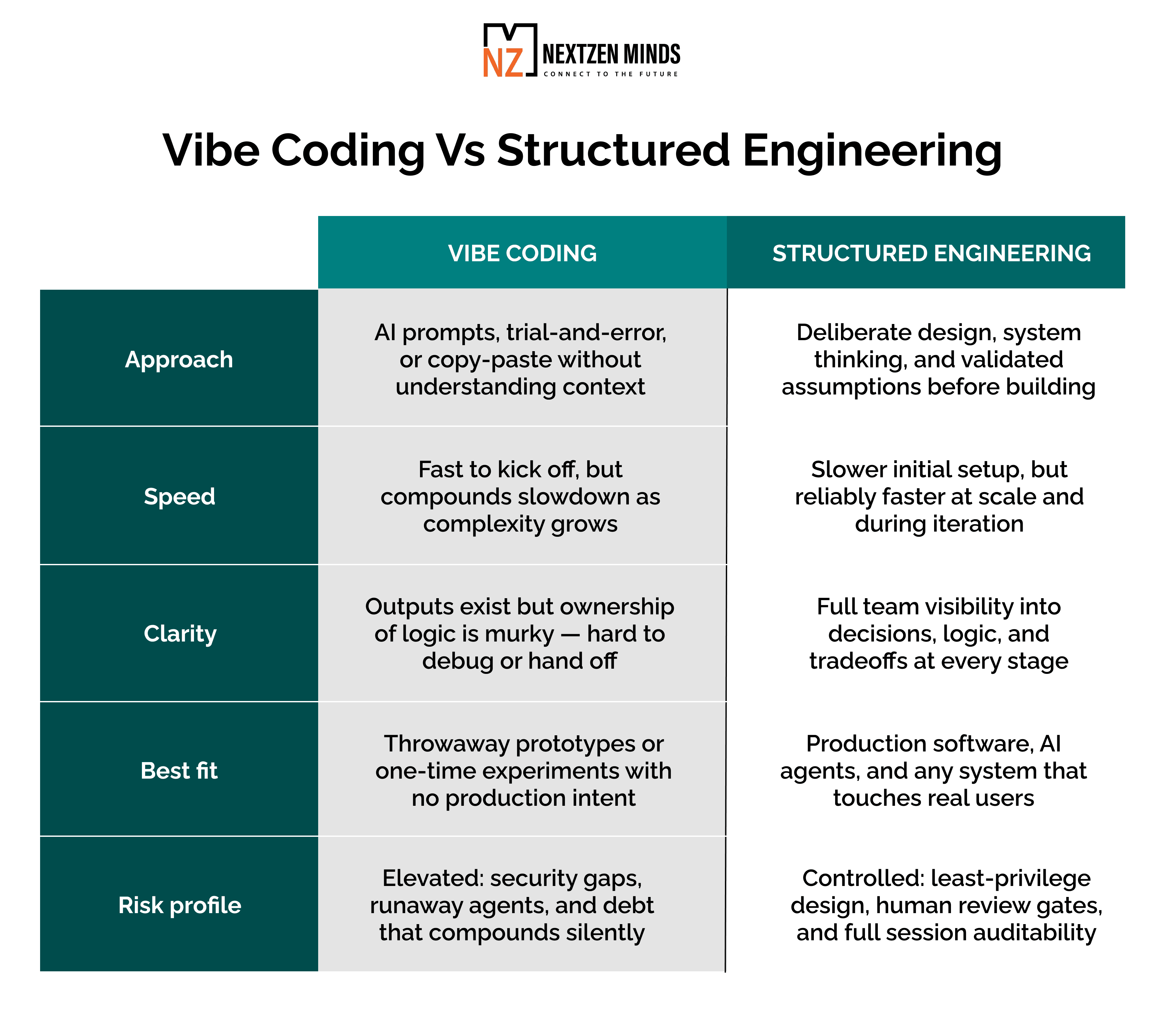
By the time systems like this reach a breaking point, the instinct is to look for a technical failure.
A bug. A misconfiguration. A bad deployment decision.
But those are symptoms.
The actual problem sits much earlier in the process, and it is much easier to miss.
The work never went away.
The decisions never went away.
The judgment calls that define software, how systems are structured, how data is protected, how edge cases are handled, how a product behaves under stress, none of that disappeared when AI started generating code.
What changed is who was making those decisions.
Or, more often, whether they were being made at all.
In traditional development, those decisions are embedded in the act of writing code. A developer does not just implement functionality, they make hundreds of small choices along the way. How should this input be validated?
What happens if this request fails? Will this query still hold up when usage increases tenfold?
Most of those decisions are invisible in the final output. They don’t announce themselves. But they are what make the system hold together.
When AI generates the code and the person reviewing it does not fully understand it, those decisions do not get transferred.
They get skipped.
And skipped decisions don’t disappear. They accumulate.
They sit quietly in the system until something forces them into the open - a security incident, a scaling failure, a feature that takes far longer to implement than expected.
That’s the part vibe coding gets wrong.
It treats software as if the output is the product.
It isn’t.
The output is just the surface. The product is the set of decisions underneath it.
And if those decisions were never made, the system is not complete, no matter how functional it appears.
This is why the “it works” test is so misleading.
A system can pass every visible check and still fail the moment conditions change. Because what matters is not whether it works in the present, it’s whether it was built to handle what comes next.
As reliance on AI increases, the role of the developer does not disappear. It shifts.
From writing code to evaluating it.
From producing output to taking responsibility for it.
That shift is not optional. It is the cost of using these tools effectively.
And it comes with a simple constraint:
You cannot safely ship what you do not understand.
At this point, the conversation often swings too far in the opposite direction.
If vibe coding introduces risk, the instinct is to assume that the solution is to avoid AI altogether. That conclusion misses the point just as much as blind adoption does.
The issue is not whether AI should be used in software development.
It is how.
At NextZen Minds, AI is part of the development process, but it is not the process itself. The difference shows up in how systems are designed, reviewed, and ultimately shipped.
Want to know more about how we incorporate AI as a development process? Book your free architecture review.
Long before any code is generated, the structure of the system is defined. The database schema, the authentication model, the way tenants are isolated, how APIs are structured, these are decisions made deliberately, not inferred through prompts. AI operates within that framework. It does not create it.
That distinction matters more than it appears to.
Because once the architecture is defined, every piece of generated code has context. It fits into a system that was designed to handle growth, not just to demonstrate functionality.
Security follows the same principle.
It is not treated as something to verify after the system is built. It is part of the system from the beginning.
Authentication flows are reviewed by people who understand what secure access actually requires. Endpoints that handle user data are evaluated not just for correctness, but for exposure. Protections that are often missing in AI-generated code - validation layers, headers, access controls - are implemented deliberately, not assumed to exist.
The difference is not in the tools. It is in the standard.
Code, in this process, is not something you simply run to see if it works. It is something you read.
That might sound obvious, but it is one of the first habits that disappears in vibe coding. When systems are generated quickly, the temptation is to validate output through execution alone. If it runs, it passes.
But execution only tells you what happens under expected conditions. Reading the code tells you what happens when those conditions change.
That is where most issues live.
Scalability is handled with the same intent.
Systems are not built for the demo environment. They are built for what the system is expected to become. If the product will support multiple tenants, the data model reflects that from the beginning. If usage is expected to grow, query patterns are evaluated with that growth in mind. The goal is not to retrofit scalability later, it is to avoid needing to.
And then there is the part that rarely gets attention early enough: maintenance.
Every system will eventually be extended, modified, or handed over to someone new. When that happens, the quality of the codebase becomes immediately visible. A system that was built quickly but without structure becomes expensive to change. A system that was built with clarity remains adaptable.
That is not an accident. It is the result of treating maintainability as a requirement, not a side effect.
Internally, we describe this approach as Build–Validate–Ship.
Not because the steps are unique, but because the discipline is.
You build with AI where it accelerates progress.
You validate with human judgment where it matters.
And you only ship when both align.
This does not slow development in the way most teams fear.
It slows the part that is visible, the first demo.
But it dramatically accelerates everything that comes after.
None of this means vibe coding has no value.
In fact, in the right context, it is one of the most useful shifts we’ve seen in how software gets built.
Where it works, it works extremely well.
If the goal is to explore an idea, validate a concept, or get from abstraction to something tangible as quickly as possible, vibe coding removes a level of friction that used to slow teams down. What once required days of coordination can now happen in hours. For early-stage thinking, that speed is not just convenient, it is valuable.The same applies to internal tools.
When the system is not exposed to external users, when the data is limited in sensitivity, and when long-term maintenance is not a primary concern, the trade-offs become acceptable. In those environments, the ability to move quickly often outweighs the risks introduced by imperfect structure.
This is close to how vibe coding was originally framed, software for a specific purpose, built quickly, used narrowly, and iterated on without the expectation that it needs to scale or endure.
The problem is not the approach.
The problem is what happens next.
Because the moment a prototype becomes a product, the requirements change. The expectations change. The risks change.
And if the process does not change with it, the system carries assumptions that no longer hold.
That is where most teams run into trouble.
They continue building with the same speed, the same level of validation, and the same reliance on generated output, long after the context that made that approach safe has disappeared.
Vibe coding is not inherently flawed.
It is simply being used beyond the conditions it was designed for.
By the time a system reaches the point where it can be demonstrated, there is a natural temptation to move forward.
It works. It looks complete. It feels ready.
But that moment, right before something ships, is where a small pause can prevent a much larger problem later.
Not by introducing complexity, but by asking the right questions.
If your application were compromised tomorrow, would you know where to look first?
Not in theory, but in practice. Could you trace how data flows through your system, identify where exposure might occur, and explain it clearly - to your users, to your team, or to anyone who depends on it? Because in a real incident, the time you spend figuring out what went wrong is often more damaging than the issue itself.
If your user base grew faster than expected, what would break first?
Growth rarely arrives in a controlled way. It shows up unevenly, in traffic spikes, in unexpected usage patterns, in parts of the system that were never stress-tested. Would your architecture absorb that pressure, or would it start to reveal assumptions that only worked at a smaller scale?
If the person who built the system stepped away today, what would remain?
Not the output, but the understanding. Could someone new step in and make meaningful changes without unraveling what already exists? Or would they first need to reverse-engineer how the system works before they can even begin?
And finally, if a new feature became critical in the next ninety days, how would it fit?
Would it extend naturally from what you’ve built, or would it require navigating layers of complexity that were never designed to work together? Because the cost of adding something new is often the clearest indicator of how well the existing system was structured.
These are not edge-case concerns.
They are the conditions every production system eventually faces.
And if the answers are uncertain, the risk is not hypothetical; it is already present, waiting for the right moment to surface.
The client we worked with eventually got to a stable place.
Their authentication layer was rebuilt. Their data architecture was redesigned to properly support multiple tenants. The codebase was cleaned, structured, and made maintainable. The system, finally, was something they could build on with confidence.
But getting there required time, focus, and a willingness to revisit decisions that should have been made at the beginning.
It also cost more than it would have to build it right the first time.
That is the part of vibe coding that rarely gets discussed.
The speed you gain at the start does not disappear. It gets deferred, into future complexity, future cost, or future risk. And by the time it surfaces, the system is no longer an experiment. It is something users depend on.
At that point, the margin for error is gone.
If you are currently building with AI tools, the most valuable step is not slowing down, it is gaining visibility into what you have already built.
Before making new changes, before adding new features, before scaling further, it is worth understanding where the system stands today. Not at the surface level, but underneath it - where architecture, security, and maintainability actually determine whether the product holds up.
A simple production-readiness checklist can often reveal more than expected. It doesn’t require deep technical intervention. It just requires looking at the system through the lens it will eventually be judged by.
And if those answers raise questions, that is the right time to go deeper.
At NextZen Minds, this is where most conversations begin.
Not with a pitch, but with a review. A focused look at how a system is structured, where the risks are, and what would need to change for it to scale reliably. Are you ready to discuss that? Get your review here.
Because once a product is in the hands of real users, the question is no longer how quickly it was built.It is whether it will hold.

Vibe coding security risks refer to vulnerabilities introduced when AI-generated code is deployed without proper human review. These often include weak or missing authentication, absence of CSRF protection, exposed API keys and secrets, lack of security headers, and Server-Side Request Forgery vulnerabilities.
The core issue is that AI optimizes for code that works, not code that is secure by default.
Not on its own.
While AI can accelerate development, production-grade SaaS systems require deliberate decisions around architecture, security, and scalability. Without that human engineering layer, AI-generated systems often carry hidden risks that surface only under real-world usage.
Vibe coding can support development, but it cannot replace it.
Most AI-generated systems are tested in controlled environments with limited users and predictable inputs. Real-world conditions introduce variability - higher load, concurrent access, unexpected usage patterns - that expose architectural gaps.
Scaling failures are rarely caused by a single issue. They are the result of systems that were never designed for growth in the first place.
The most frequent issues include insecure authentication flows, missing data protection layers, exposed secrets, lack of proper authorization controls, and poor database design, especially in multi-tenant systems.
Many of these map directly to well-known security and architecture fundamentals that are often skipped when code is generated without deeper review.
Yes, but it is usually more expensive and time-consuming than building it correctly from the start.Fixing these systems often requires restructuring core components, authentication, data models, and overall architecture, rather than applying surface-level patches.
The earlier these issues are identified, the easier they are to resolve.
It combines AI-driven speed with human-led decision-making.
AI is used to accelerate implementation, but architecture, security validation, and code quality remain deliberate responsibilities. Systems are designed before they are generated, reviewed before they are trusted, and tested under real-world conditions before they are deployed.
Vibe coding should be avoided in systems that handle sensitive user data, require strict compliance (such as healthcare or financial applications), or are expected to scale across multiple users or organizations.
In these cases, the cost of failure is too high to rely on unvalidated generated code.
A system is production-ready when its architecture, security, scalability, and maintainability have been validated, not just its functionality.
If you cannot clearly explain how your system handles authentication, data isolation, failure scenarios, and growth, it is likely not ready for production, regardless of whether it currently works.
Vibe coding did not remove the hard parts of software development.
It made them easier to ignore.
And ignoring them works, right up until the moment it doesn’t.