
The Capacity & Capability Framework™- Are You Solving the Right Technology Constraint?
September 9, 2026
September 9, 2026
.jpg)
Technology investment continues to accelerate.
Enterprises are adopting AI, modernizing platforms, strengthening data infrastructure, expanding digital products, and building larger engineering organizations.
Yet investment does not always translate into execution.
Roadmaps slip. Backlogs grow. Transformation programs lose momentum. Experienced teams become overloaded. Promising AI initiatives struggle to move beyond experimentation.
When this happens, organizations usually respond quickly.
Hire more engineers. Bring in specialists. Introduce another tool. Change the delivery process. Increase investment.
Any of these decisions might be right.
But what if the organization is solving the wrong problem?
A delayed technology initiative tells you that something is limiting execution. It does not necessarily tell you what.
Consider two organizations struggling to deliver an important product roadmap.
The first has experienced teams, strong engineering practices, and a clear understanding of what needs to be done. But those teams are supporting too many priorities simultaneously.
The second has enough people available, but architecture decisions keep changing, unfamiliar technologies create uncertainty, and rework slows progress.
The visible problem is the same: delivery is behind schedule.
The underlying constraints are completely different.
Adding more engineers might help the first organization. In the second, it could simply add coordination and complexity without addressing the real problem.
This distinction sits at the heart of The Capacity & Capability Framework™.
Instead of beginning with “What should we add?”, the Framework encourages technology leaders to begin with two questions:
Do we have the Capacity to execute what the business expects?
Do we have the Capability to execute it effectively?
Capacity is about execution bandwidth: whether the organization can absorb and deliver the work required at the pace the business demands.
Capability is about execution effectiveness: whether the organization has the expertise, engineering maturity, architectural judgment, delivery discipline, and transformation experience required to execute successfully.
The distinction matters because increasing one does not automatically strengthen the other.
A highly capable engineering organization can still struggle when business demand exceeds available bandwidth.
An organization with significant resources can still struggle when an initiative requires expertise or execution maturity it has not yet developed.
And sometimes, both dimensions are constrained simultaneously.
Bringing Capacity and Capability together creates four different execution environments within the Capacity–Capability Matrix™:
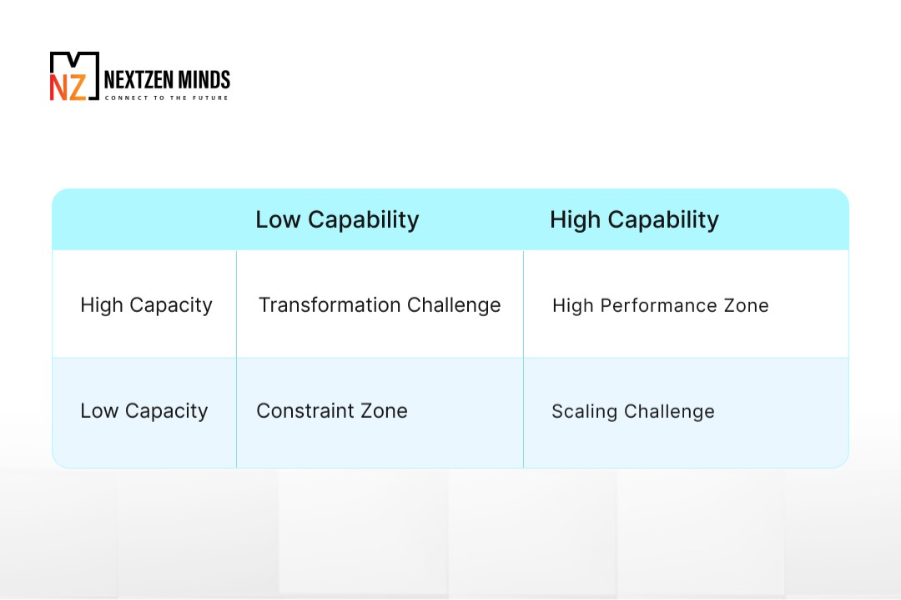
These environments are not permanent labels.
An organization may have sufficient Capacity and Capability for its existing product portfolio while facing a Transformation Challenge when introducing enterprise AI. Another may possess mature engineering Capability but encounter a Scaling Challenge as customer demand and strategic priorities accelerate.
The more important question is therefore not whether an organization is high-performing or low-performing.
It is:
What is constraining execution right now?
That question can change technology investment decisions.
If capable teams are overloaded, increasing Capacity may be necessary.
If resources are available but architecture uncertainty, repeated rework, or unfamiliar technology is slowing execution, strengthening Capability may need to come first.
If both are constrained, rapidly adding resources could scale the problem rather than solve it.
This is why effective technology execution should begin with diagnosis before intervention.
Before asking:
“How do we move faster?”
Leaders need to understand:
“What is preventing us from moving faster today?”
The answer can provide a clearer basis for deciding where to invest, what to strengthen, and when to scale.
Technology creates opportunity. Execution determines how much of that opportunity becomes reality.
As AI adoption, cloud transformation, platform modernization, digital product development, and other strategic initiatives increase both demand and complexity, organizations need more than access to technology and talent.
They need the right balance of Capacity and Capability to turn ambition into consistent outcomes.
The Capacity & Capability Framework™ provides a structured way to examine that balance and identify the constraints that may be limiting technology execution.
But identifying Capacity and Capability is only the beginning.
The complete whitepaper explores the Capacity–Capability Matrix™, the four execution environments, the different layers at which constraints can emerge, leadership considerations, and the principles for moving from constraint toward stronger execution.
Discover what may really be limiting your organization’s technology execution, and how to start asking better questions before making the next investment decision.
Download The Capacity & Capability Framework™